
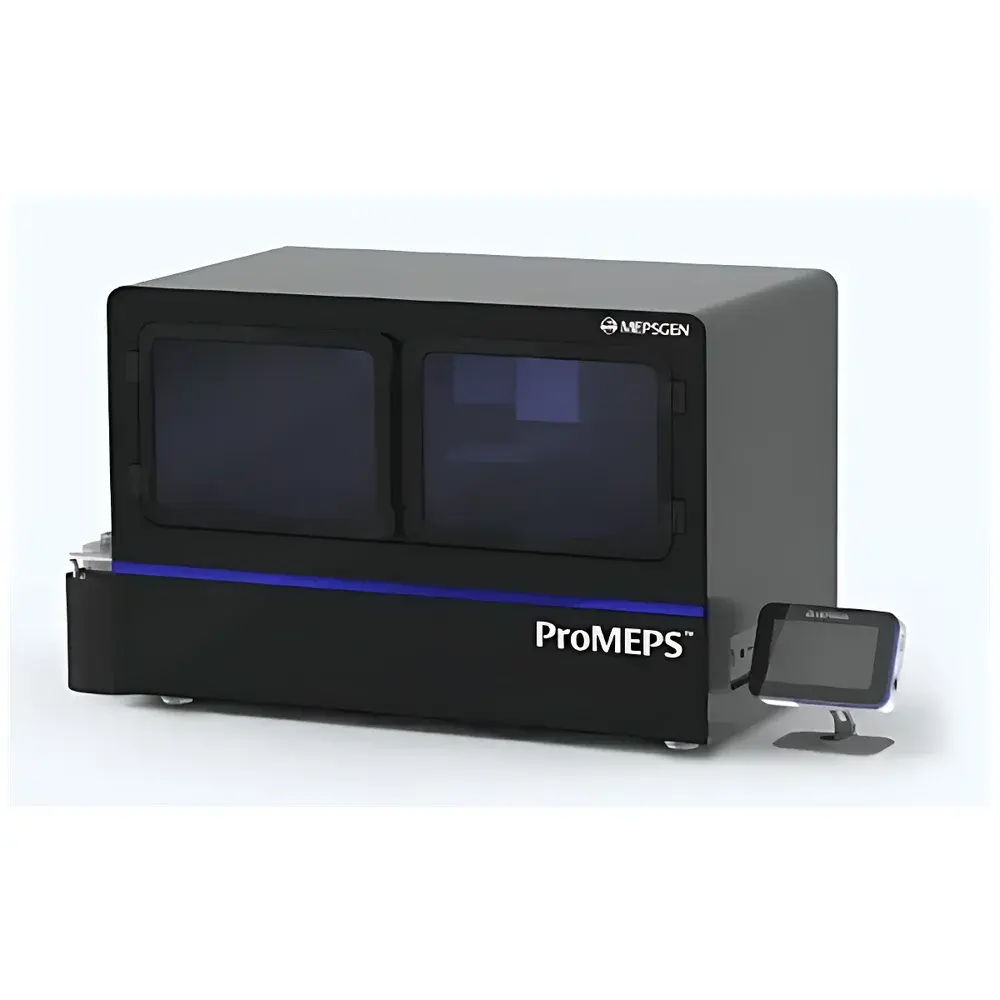
MEPSGEN PROMEPS Automated Organoid Culture System
| Brand | MEPSGEN |
|---|---|
| Origin | South Korea |
| Model | PROMEPS |
| Weight | ~50 kg |
| Power Consumption | ~2000 W |
| Input Voltage | 100–130 VAC / 200–240 VAC, 60 Hz |
| CO₂ Supply Pressure | 1.2 bar |
| CO₂ Purity | 100% |
| Operating Temperature | 20–30 °C |
| Relative Humidity (Operating) | 30–80% RH |
| Storage Temperature | 0–60 °C |
| Storage Humidity | 30–90% RH |
| CO₂ Control Range | 1–20% |
| Media Flow Rate | 200 mL/min |
| Temperature Control Range | Ambient to 45 °C |
| Impedance Channels | 32 |
| Impedance Measurement Range | 0–100 kΩ |
| Display Resolution | 800 × 480 px |
| Touchscreen Type | Capacitive |
| Connectivity | Ethernet, USB |
Overview
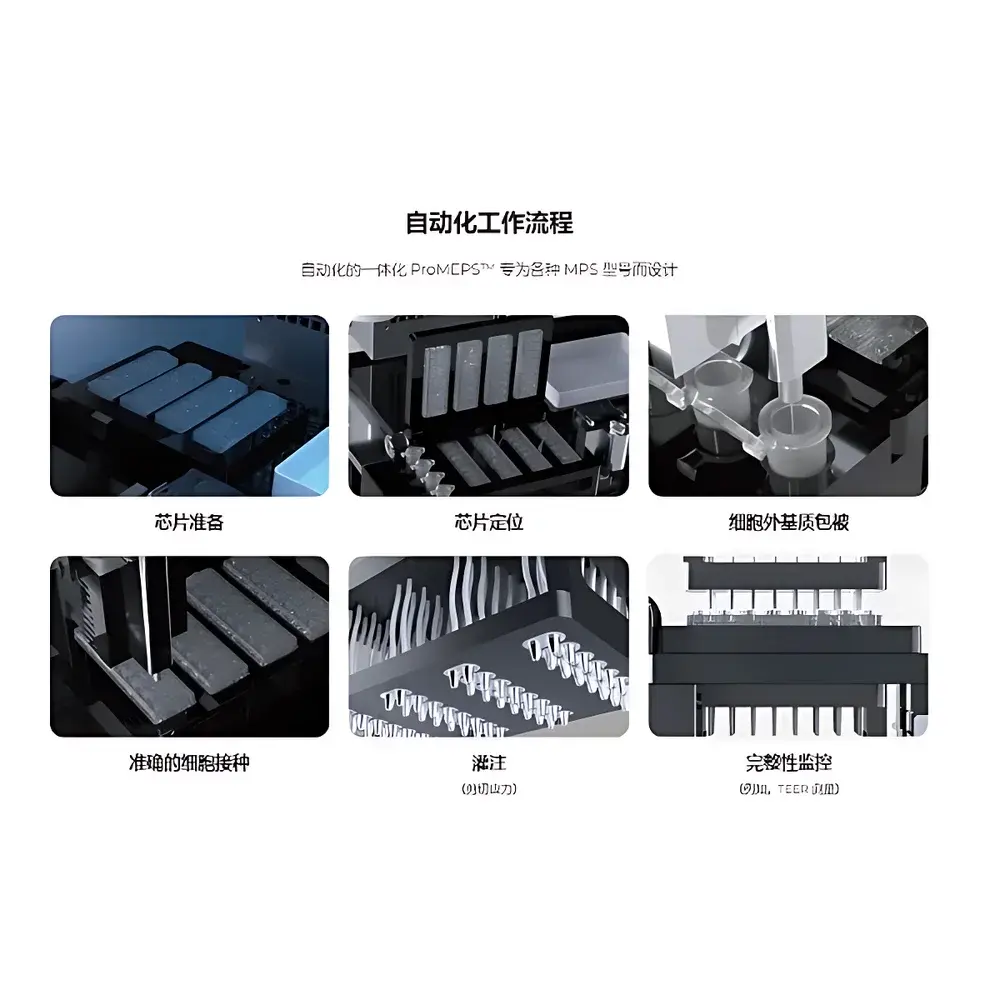
The MEPSGEN PROMEPS Automated Organoid Culture System is an integrated microphysiological platform engineered for reproducible, long-term 3D human organoid cultivation under dynamically controlled physiological conditions. Built upon a modular robotic architecture, PROMEPS implements closed-loop automation for sequential cell seeding, hydrogel embedding, perfusion-based nutrient delivery, real-time barrier integrity monitoring (via TEER), and environmental regulation—enabling physiologically relevant in vitro modeling of human tissue function. Unlike conventional static or manually operated systems, PROMEPS leverages continuous laminar shear flow across porous membranes to maintain epithelial/endothelial polarization, cellular differentiation, and extracellular matrix remodeling—key prerequisites for predictive drug response profiling. The system operates as a benchtop micro-environmental bioreactor, compliant with principles outlined in FDA’s “Advancing Regulatory Science for Human-Relevant Microphysiological Systems” white paper and aligned with ISO/IEC 17025 requirements for measurement traceability in preclinical assay development.
Key Features
- Integrated robotic liquid handling: Precision dispensing of cells, Matrigel®-based hydrogels, and media with sub-microliter accuracy across 96-well and custom multi-chamber formats.
- Dynamic perfusion module: Programmable parallel-channel perfusion delivering uniform shear stress (0.1–5 dyn/cm²) to preserve tight junction integrity and enable longitudinal TEER tracking.
- Multi-parameter environmental control: Independent regulation of CO₂ (1–20% v/v), temperature (ambient to 45 °C ±0.3 °C), and humidity (30–80% RH) within the culture chamber, validated per ASTM E2912-21 for environmental chamber performance.
- Real-time impedance monitoring: 32-channel ECIS (Electric Cell-substrate Impedance Sensing) platform supporting non-invasive, label-free assessment of monolayer confluence, barrier disruption, and cytotoxicity kinetics.
- Modular protocol engine: Pre-loaded organ-specific workflows (e.g., intestinal crypt expansion, hepatic spheroid maturation, blood-brain barrier co-culture) with editable parameters for passage number, media exchange frequency, and flow rate ramping profiles.
- Benchtop footprint & safety compliance: CE-marked enclosure with interlocked access doors, HEPA-filtered exhaust, and UL 61010-1 certified electrical architecture for Class II laboratory deployment.
Sample Compatibility & Compliance
PROMEPS supports primary human cells (e.g., iPSC-derived progenitors, patient-isolated epithelial/endothelial cells), immortalized lines (Caco-2, HepG2, hCMEC/D3), and complex co-cultures (e.g., organoid–immune cell or organoid–fibroblast interfaces). All fluidic pathways are constructed from USP Class VI-certified silicone tubing and cyclic olefin copolymer (COC) chambers, ensuring low protein adsorption and leachate-free operation per ISO 10993-5. The system meets GLP-relevant documentation standards: audit trails record operator ID, timestamp, parameter changes, and sensor calibration events—fully compatible with 21 CFR Part 11-compliant electronic signature modules when deployed with validated LIMS integration.
Software & Data Management
The PROMEPS Control Suite (v4.2+) provides a role-based web interface accessible via Ethernet-connected workstations or local touchscreen (800 × 480 capacitive display). It features automated log generation compliant with ALCOA+ principles (Attributable, Legible, Contemporaneous, Original, Accurate, Complete, Consistent, Enduring, Available), including raw impedance waveforms, temperature/CO₂ trend logs, and robotic actuation timestamps. Export options include CSV, HDF5, and .mat formats; API support enables bidirectional communication with third-party analysis platforms (e.g., MATLAB, Python-based scikit-learn pipelines) for unsupervised clustering of organoid maturation trajectories.
Applications
- High-throughput pharmacokinetic/pharmacodynamic (PK/PD) screening across liver-, kidney-, and gut-on-a-chip models under flow conditions mimicking in vivo hemodynamics.
- Toxicity phenotyping: Quantitative assessment of mitochondrial dysfunction, barrier leakage, and cytokine secretion kinetics following compound exposure.
- Disease modeling: Generation of patient-derived tumor organoids for personalized therapy selection and resistance mechanism studies.
- Biological validation of AI-predicted drug candidates: Bridging computational target engagement predictions with functional tissue-level readouts.
- Regulatory submission support: Generating repeatable, instrument-qualified datasets suitable for inclusion in IND-enabling nonclinical study reports (per ICH S7B/S8 guidelines).
FAQ
What types of organoids can be cultured on PROMEPS?
PROMEPS supports epithelial, stromal, and vascularized organoids derived from human pluripotent stem cells or primary tissues—including cerebral cortex, proximal tubule, alveolar, and epidermal models—with validated protocols for >12 organ systems.
Is the system compatible with existing lab infrastructure?
Yes: Standard 100–240 VAC input, Ethernet-based network integration, and USB export capability ensure seamless adoption into core facilities operating under ISO/IEC 17025 or CAP-accredited quality management systems.
How is data integrity ensured during long-term experiments?
All sensor outputs undergo hardware-level timestamping via onboard RTC; raw data buffers are redundantly stored on internal SSD and external NAS via configurable auto-sync intervals, satisfying 21 CFR Part 11 audit trail requirements.
Can PROMEPS be used for GMP-aligned process development?
While not a GMP manufacturing tool, PROMEPS supports qualification (IQ/OQ/PQ) documentation packages and has been deployed in Phase I–II translational labs conducting GLP-compliant safety pharmacology studies.
What maintenance is required for sustained operational reliability?
Scheduled quarterly calibration of CO₂ sensors and impedance electrodes using NIST-traceable reference standards; fluidic path sterilization via 70% ethanol flush cycles between runs—no consumable cartridges required.



