
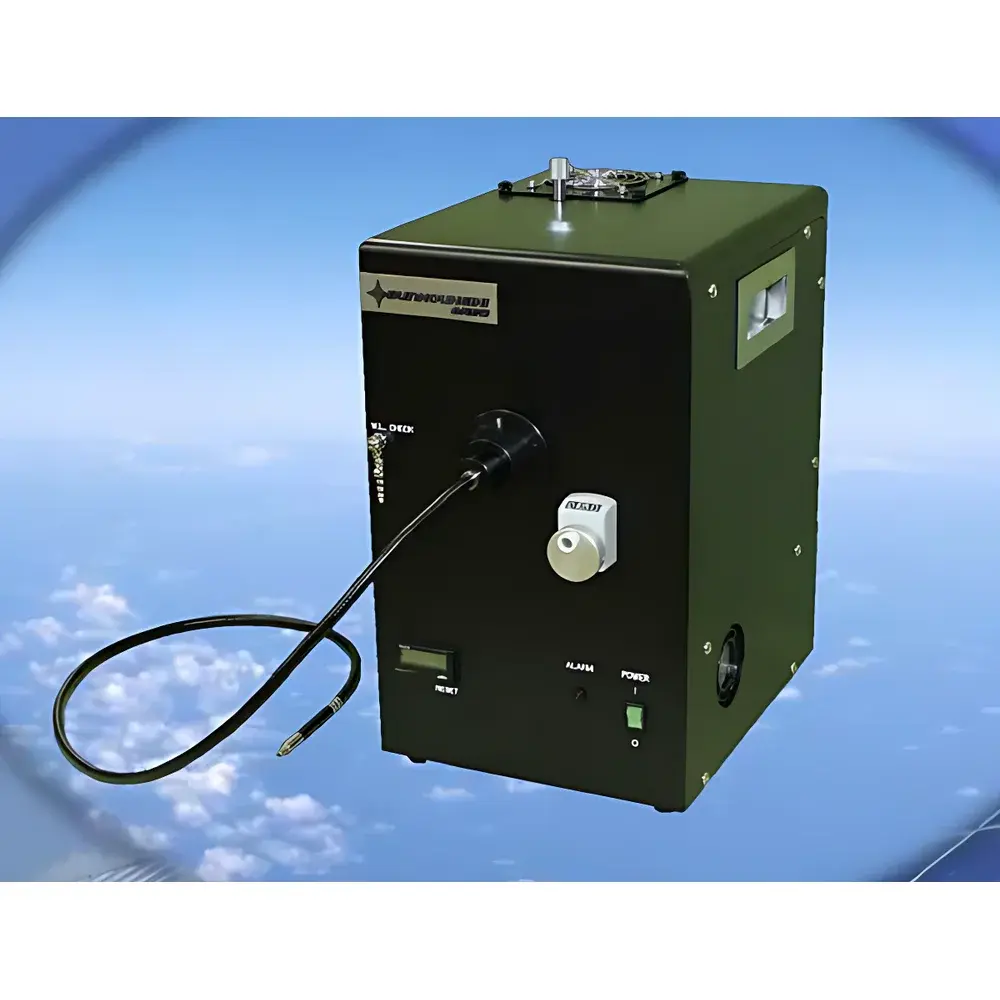
Bunkoukeiki MM-3 Illumination Test System with Xenon Light Source
| Brand | Bunkoukeiki |
|---|---|
| Origin | Japan |
| Model | WAD |
| Light Source | 150 W Xenon Lamp |
| Spectral Range | 300–1150 nm |
| Bandwidth Options | 5 / 10 / 20 nm (FWHM) |
| Irradiance | ≥1 mW/cm² (≥40 μmol/m²/s) |
| Illumination Area | Ø ≥3 mm |
| Fiber Optic Coupling | Ø3 mm, 1 m length |
| Shutter | Manual |
| Calibration Sensor | Silicon Photodiode |
| Dimensions (W×D×H) | 230 × 295 × 414 mm (excluding protrusions: 242.5 × 350.4 × 441.2 mm) |
| Compliance | CE-marked optical test equipment for laboratory use |
Overview
The Bunkoukeiki MM-3 Illumination Test System is a precision-engineered optical irradiation platform designed for controlled photostability, photochemical reaction screening, and spectral response validation in R&D and quality control laboratories. Built around a stabilized 150 W xenon arc lamp, the system delivers continuous broadband irradiance spanning the full UV-Vis-NIR spectrum (300–1150 nm), enabling physiologically and industrially relevant light exposure conditions. Unlike filtered LED or monochromatic laser sources, the xenon-based architecture provides high spectral continuity and intensity stability—critical for simulating solar irradiance, accelerating material degradation studies, or calibrating photodetectors across multiple wavelength bands. The MM-3 integrates optical, mechanical, and electronic subsystems into a compact benchtop enclosure, eliminating external power supplies or water cooling requirements. Its modular design supports interchangeable bandpass filters and calibrated silicon photodiode monitoring—ensuring traceable irradiance quantification per ISO/CIE standard practices.
Key Features
- Stabilized 150 W short-arc xenon lamp with integrated ignition and current regulation for <1.5% RMS intensity drift over 1 hour
- Adjustable spectral bandwidth via motorized filter wheel (5 nm, 10 nm, or 20 nm FWHM options) compatible with standard 25 mm diameter interference filters
- Real-time irradiance monitoring using NIST-traceable silicon photodiode sensor (calibrated in mW/cm² and μmol/m²/s), mounted coaxially with output beam path
- Manual iris shutter with tactile feedback and position lock, rated for >10⁵ actuation cycles
- OEM-grade Ø3 mm core silica fiber optic delivery (1 m length, SMA 905 connector), optimized for minimal UV attenuation and thermal load management
- Integrated LED status indicators for lamp operation, shutter position, and sensor readiness—accessible without software interface
- Compact footprint (230 × 295 × 414 mm) with vibration-damped base plate; operates on standard 100–240 VAC, 50/60 Hz input
Sample Compatibility & Compliance
The MM-3 accommodates diverse sample geometries—including Petri dishes, cuvettes (10 mm path), thin-film substrates, and solid-state photovoltaic devices—via its open-beam configuration and optional magnetic fiber holder (WAD-FH-MAG). Irradiance uniformity across the Ø3 mm field exceeds ±3% (measured per ISO 9276-2). The system conforms to IEC 61000-6-3 (EMC emission limits) and carries CE marking for laboratory instrumentation under Directive 2014/30/EU. While not classified as medical device or GMP production equipment, its irradiance repeatability (<±2% CV over 8-hour session) and calibration traceability support GLP-compliant photostability testing per ICH Q1B guidelines. Optional documentation includes factory calibration certificate (NIST-traceable photodiode response curve) and spectral irradiance report (measured with calibrated spectroradiometer).
Software & Data Management
The MM-3 operates as a standalone instrument with no mandatory software dependency. However, optional USB-connected data acquisition module (WAD-DAQ-USB) enables time-stamped logging of irradiance values at user-defined intervals (1 Hz to 1 kHz sampling). Output files are saved in CSV format with embedded metadata (timestamp, filter ID, sensor gain setting, ambient temperature). All firmware adheres to IEC 62443-1-1 security principles; no remote access, cloud connectivity, or proprietary drivers required. Audit trails—including shutter activation logs and lamp runtime counters—are stored in non-volatile memory and exportable via USB mass storage mode. For regulated environments, the system supports 21 CFR Part 11 compliance when paired with validated third-party LIMS integration protocols.
Applications
- Photostability assessment of pharmaceuticals per ICH Q1B Option 2 (UV-Vis irradiation)
- Spectral responsivity mapping of photodiodes, solar cells, and imaging sensors
- Accelerated aging of polymers, coatings, and OLED materials under controlled spectral flux
- Validation of optical filter transmission curves in metrology labs
- Calibration reference source for hyperspectral camera systems (300–1150 nm range)
- Photochemical kinetics studies requiring stable, tunable broadband excitation
FAQ
Is the xenon lamp replaceable by the user, and what is its typical lifetime?
Yes—the lamp is field-replaceable using standard torque tools; average operational lifetime is 1,200 hours at rated current, with end-of-life defined as >20% radiant flux decay.
Can the MM-3 be synchronized with external detectors or shutters?
It provides TTL-compatible trigger output (5 V, sinking) for external synchronization; no built-in input for external triggering.
Does the system include spectral irradiance calibration data?
A baseline spectral irradiance map (300–1150 nm, 1 nm resolution) is supplied with each unit; additional wavelength-specific calibration certificates are available upon request.
What safety interlocks are implemented?
Mechanical lamp compartment door switch disables high-voltage ignition when open; no radiation shielding beyond standard Class 3R laser safety labeling per IEC 60825-1.
Is fiber optic coupling mandatory, or can free-space irradiation be used?
Both configurations are supported: the standard output is collimated free-space beam; fiber coupling is optional and requires separate WAD-FIBER adapter kit.




