
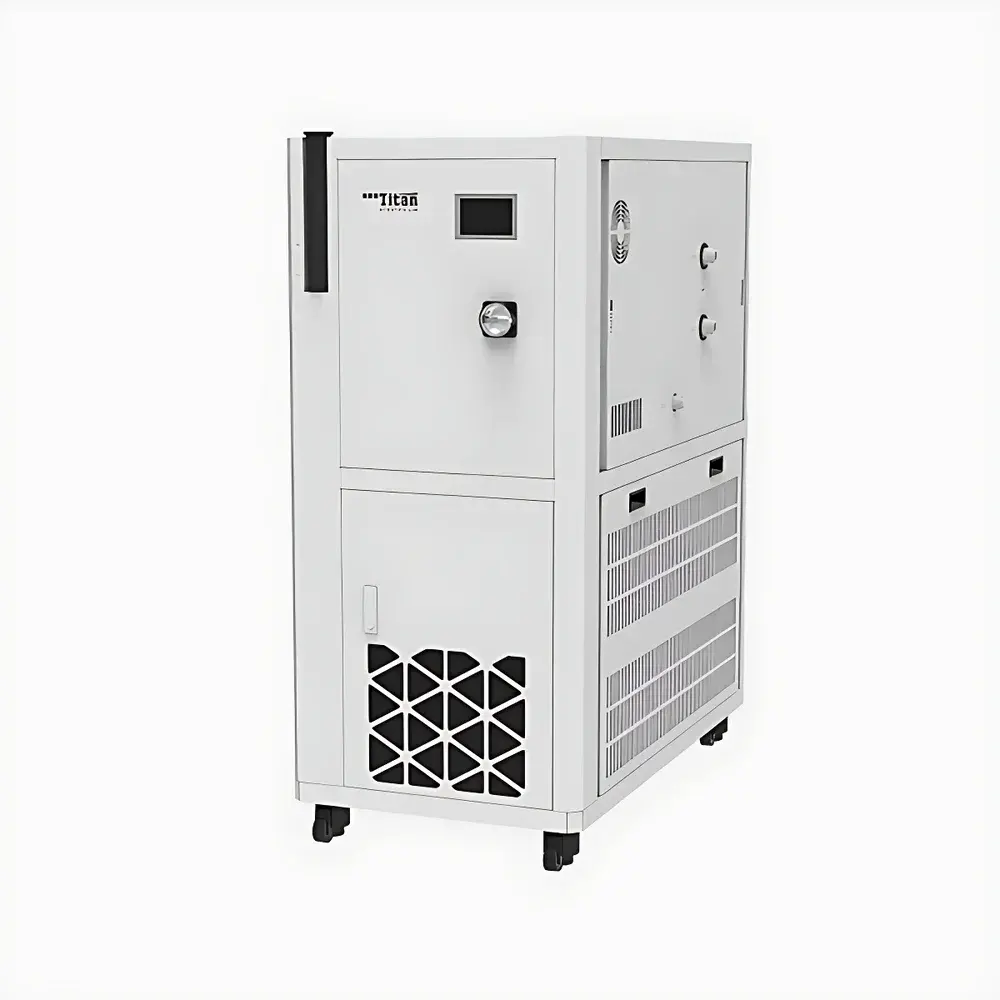
Titan HLD-120 Dynamic High-Low Temperature Circulating Chiller
| Brand | Titan |
|---|---|
| Origin | Shanghai, China |
| Manufacturer Type | Direct Manufacturer |
| Product Category | Domestic |
| Model | HLD-120 |
| Instrument Type | Integrated Unit |
| Cooling Method | Air-Cooled |
| Temperature Range | –40 °C to +200 °C |
| Cooling Capacity | 12,000 W (Heating Capacity: 12,000 W) |
| Temperature Stability | ±0.1 °C |
| Circulation Pump Pressure | 5.5 bar |
| Circulation Flow Rate | 110 L/min |
| Reservoir Volume | 20 L |
| Operation Mode | Continuous |
Overview
The Titan HLD-120 Dynamic High-Low Temperature Circulating Chiller is an integrated thermal management system engineered for precise, stable, and bidirectional temperature control in demanding laboratory and pilot-scale applications. Unlike conventional chillers limited to sub-ambient cooling, the HLD-120 employs a dual-mode refrigeration–heating architecture based on cascade compressor staging and electric resistance heating, enabling seamless operation across a continuous range from –40 °C to +200 °C. Its design adheres to fundamental thermodynamic principles governing heat transfer in closed-loop fluid systems, utilizing high-efficiency R-404A/R-23 refrigerant blends (or equivalent low-GWP alternatives per regional compliance) and optimized heat exchanger geometry to ensure rapid thermal response and minimal overshoot. The unit is intended for external circulation—serving jacketed reactors, calorimeters, spectroscopic cells, material testing chambers, and other process equipment requiring tightly regulated thermal environments.
Key Features
- Integrated dual-function architecture: simultaneous high-capacity cooling (12 kW) and heating (12 kW) within a single compact chassis, eliminating the need for separate heating and cooling units.
- Air-cooled condensation system with intelligent fan speed modulation—reducing acoustic emissions and energy consumption while maintaining performance under ambient temperatures up to 35 °C.
- High-stability temperature control: ±0.1 °C setpoint stability over full operating range, achieved via PID algorithms with adaptive tuning and platinum RTD (PT100) sensing at both reservoir and outlet ports.
- Industrial-grade circulation pump delivering up to 110 L/min at 5.5 bar maximum pressure—compatible with long fluid paths, high-viscosity heat transfer media (e.g., silicone oil, ethylene glycol/water mixtures), and backpressure-prone instrumentation.
- 20 L stainless-steel reservoir with level monitoring, leak detection circuitry, and integrated filtration to prevent particulate ingress into sensitive downstream equipment.
- Continuous-duty operation certified for 24/7 unattended use, supported by redundant safety systems including high-pressure cut-off, dry-run protection, overtemperature shutdown, and refrigerant leak detection.
Sample Compatibility & Compliance
The HLD-120 supports a broad spectrum of heat transfer fluids—including water, 30–50% aqueous glycol solutions, synthetic silicone oils (up to 200 °C), and specialized low-temperature cryogenic fluids—subject to material compatibility verification with wetted components (316 stainless steel, EPDM/FKM seals, borosilicate glass sight gauges). It complies with IEC 61000-6-3 (EMC emission standards), IEC 61000-6-2 (immunity), and meets CE marking requirements for machinery (2006/42/EC) and low-voltage directives (2014/35/EU). For regulated environments, its digital interface supports audit-trail-ready operation when paired with compliant SCADA or LIMS platforms; optional analog/digital I/O modules enable integration into GLP/GMP workflows requiring traceable temperature logging per ISO/IEC 17025 and FDA 21 CFR Part 11 guidelines.
Software & Data Management
The HLD-120 features a built-in 5.7″ color touchscreen HMI with real-time graphical display of temperature profiles, flow rate, pressure, and system status. Internal non-volatile memory logs operational data at user-defined intervals (1 s to 60 min resolution) for up to 30 days. Data export is supported via USB 2.0 (CSV format) or RS-485 Modbus RTU protocol for third-party acquisition. Optional Ethernet/Wi-Fi connectivity enables remote monitoring and control through Titan’s WebHMI platform—supporting role-based access, email/SMS alerts on deviation events, and TLS-encrypted data transmission. All firmware updates are digitally signed and validated to maintain integrity in validated environments.
Applications
- Chemical synthesis: precise thermal control during exothermic/endothermic reactions in jacketed glass or stainless-steel reactors (1–50 L).
- Materials science: thermal cycling tests for polymers, composites, and phase-change materials under controlled ramp rates (0.1–10 °C/min).
- Pharmaceutical R&D: dissolution testing apparatus conditioning, stability chamber calibration, and lyophilizer shelf precooling.
- Analytical instrumentation: temperature stabilization of HPLC columns, GC injectors, FTIR sample compartments, and XRD stages.
- Automotive and aerospace testing: environmental simulation for battery thermal management system validation and composite curing ovens.
FAQ
What heat transfer fluids are compatible with the HLD-120 across its full temperature range?
Water-based solutions (with corrosion inhibitors) are suitable from +5 °C to +95 °C; 30–50% propylene glycol/water mixtures extend low-temperature capability to –30 °C; methyl silicone oil (e.g., DC-200 series) enables stable operation up to +200 °C.
Does the unit support external temperature feedback control?
Yes—the HLD-120 accepts external PT100 or thermocouple inputs via optional analog input module, enabling cascade control where the chiller regulates based on sensor readings from the process vessel rather than internal reservoir temperature.
Is the system suitable for cleanroom or ISO Class 5 environments?
While the HLD-120 itself is not classified for cleanroom installation, it may be located outside the controlled space with fluid lines routed through pass-throughs; all wetted materials comply with USP Class VI biocompatibility and meet ISO 14644-1 particle generation limits when operated with filtered fluid circuits.
Can multiple HLD-120 units be synchronized for large-scale thermal control networks?
Yes—via Modbus TCP or EtherNet/IP protocols, up to 16 units can be coordinated under a central DCS or PLC to manage multi-zone temperature profiles with master-slave load balancing.
What maintenance intervals are recommended for continuous operation?
Compressor oil analysis every 6,000 operating hours; refrigerant circuit integrity check annually; filter replacement every 6 months or per fluid contamination assessment; full calibration verification every 12 months per ISO/IEC 17025 traceable procedures.



