
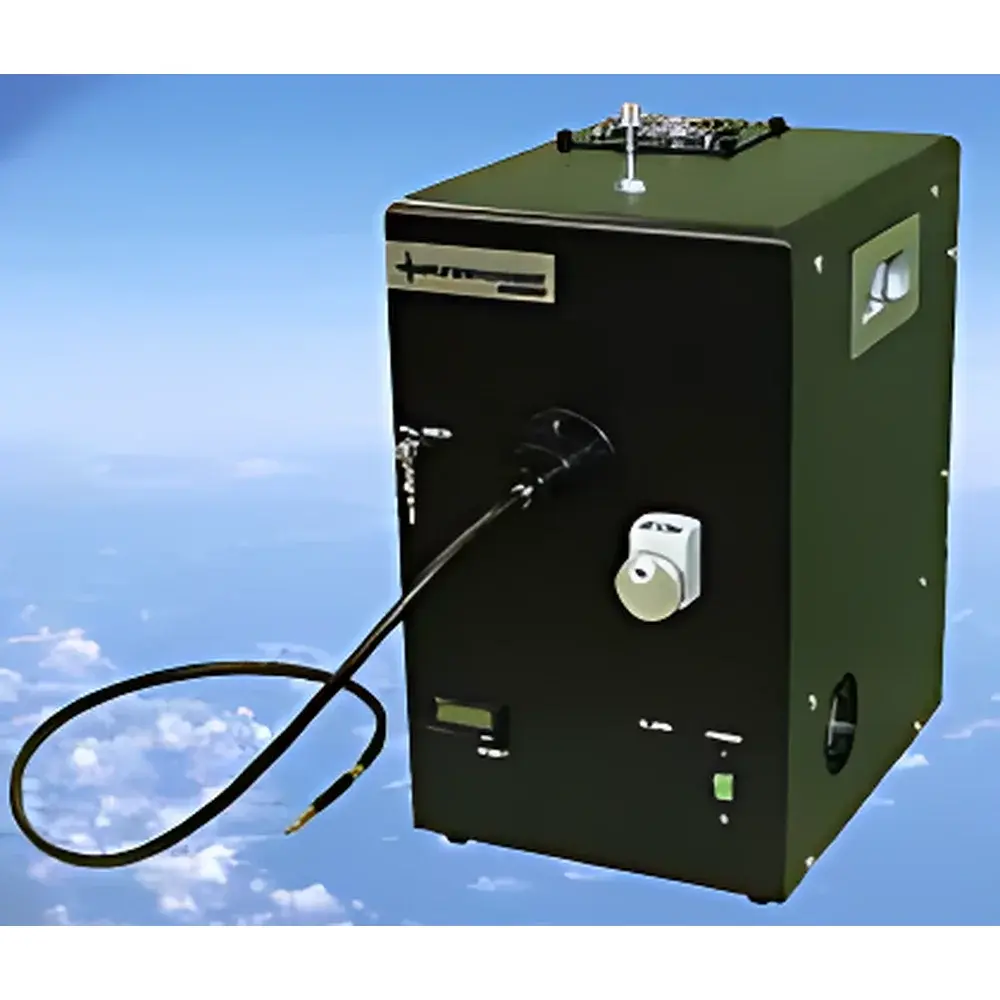
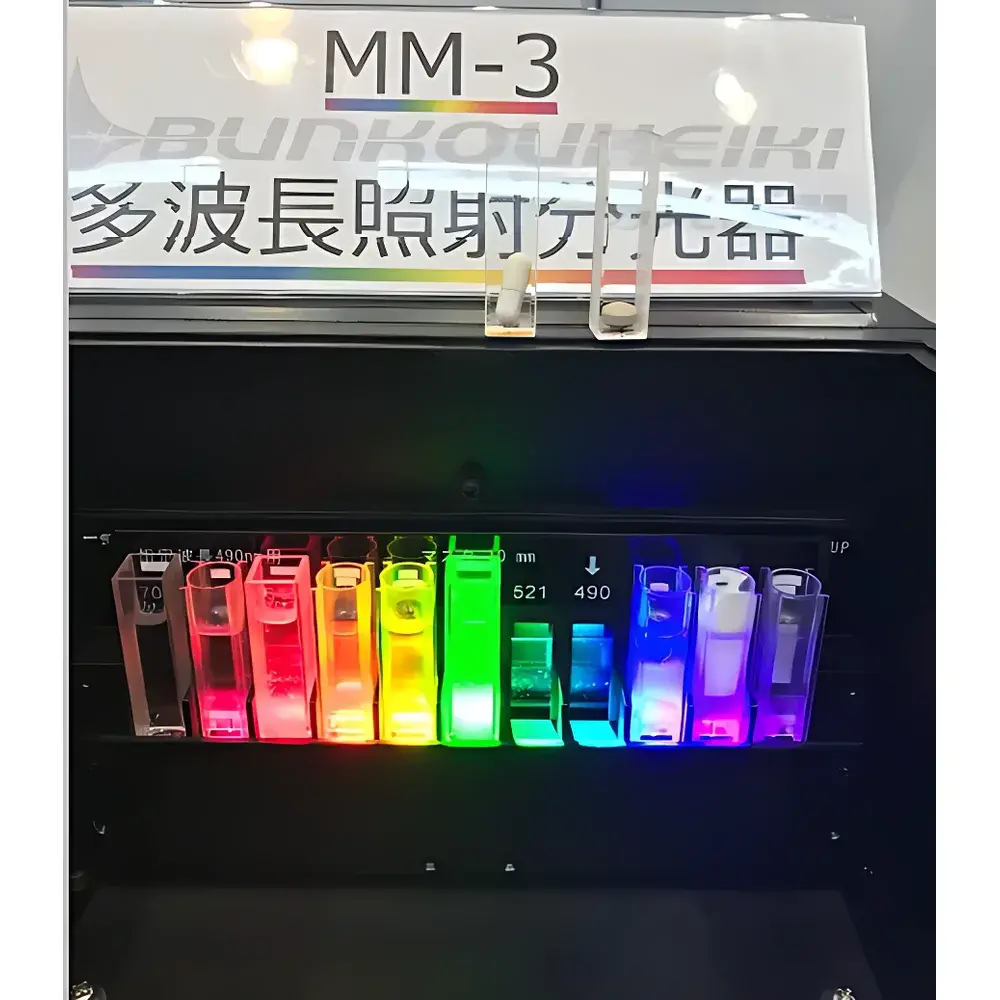
NIJI-2 Multi-Band Photostability Chamber
| Origin | Japan |
|---|---|
| Manufacturer Type | Authorized Distributor |
| Origin Category | Imported Instrument |
| Model | NIJI-2 |
| Pricing | Upon Request |
Overview
The NIJI-2 Multi-Band Photostability Chamber is a precision-engineered optical stability testing system designed for pharmaceutical photostability assessment in compliance with ICH Q1B guidelines. It functions as a tunable monochromatic irradiation source based on high-intensity xenon arc lamp excitation coupled with a high-resolution grating monochromator, enabling discrete wavelength selection across a continuous spectral range from 300 nm to 1150 nm. Unlike broad-spectrum UV–vis exposure chambers, the NIJI-2 delivers spectrally resolved irradiance—critical for mechanistic photodegradation studies, action spectrum determination, and wavelength-dependent quantum yield evaluation. Its architecture supports controlled photolytic stress under defined photon flux (≥40 μmol·m⁻²·s⁻¹) and narrow spectral bandwidth (5/10/20 nm FWHM), making it suitable for both regulatory-compliant forced degradation studies and fundamental photochemical investigation.
Key Features
- Xenon arc lamp (150 W) with stabilized power supply ensuring long-term radiometric consistency and minimal spectral drift over time
- Grating-based monochromator with selectable spectral bandwidths: 5 nm, 10 nm, or 20 nm (FWHM), optimized for resolution versus throughput trade-offs
- Wavelength tuning range: 300–1150 nm, covering deep UV, visible, and near-infrared regions relevant to drug chromophore absorption and packaging material transmission
- Minimum irradiance output ≥1 mW·cm⁻² (equivalent to ≥40 μmol·m⁻²·s⁻¹ at 400 nm), calibrated traceably to NIST-traceable reference detectors
- Irradiation spot diameter ≥Φ3 mm, uniformity >90% across central 80% of beam profile, verified via scanning photodiode mapping
- Manual shutter mechanism with tactile feedback and mechanical interlock for operator safety and exposure timing control
- Integrated wavelength indicator with digital readout and calibration verification function
- Standardized optical fiber interface (Φ3 mm core, 1 m length, SMA 905 connector) enabling flexible light delivery to sample holders, cuvettes, or custom reaction cells
Sample Compatibility & Compliance
The NIJI-2 accommodates solid dosage forms (tablets, capsules), liquid formulations (solutions, suspensions), and raw materials placed in quartz or borosilicate containers compatible with UV–NIR transmission. Sample positioning fixtures support ISO-standard petri dishes (Ø90 mm), USP compliant vials, and custom multi-well plates. The system meets essential requirements for ICH Q1B Option 2 (individual wavelength exposure) and supports supplementary validation per ASTM E2652 (Standard Practice for Calibration of Monochromators). While not a fully automated environmental chamber, its optical module integrates seamlessly with temperature- and humidity-controlled enclosures (e.g., ICH Q1A-compliant stability chambers) to enable combined photothermal stress protocols. Documentation packages include instrument qualification templates aligned with GMP Annex 15 and FDA 21 CFR Part 11 data integrity expectations for audit trails and user access control.
Software & Data Management
The NIJI-2 operates in standalone mode with manual wavelength selection and exposure timing; no proprietary software is required for basic operation. However, optional RS-232 or USB-to-serial interfaces allow integration with third-party laboratory information management systems (LIMS) or custom Python/Matlab scripts for automated wavelength sweeps, irradiance logging, and timestamped exposure event recording. All irradiance values are referenced to calibrated photodiode measurements traceable to national standards. For regulated environments, users may implement electronic lab notebooks (ELN) to capture method parameters (wavelength, bandwidth, exposure duration, sample ID), operator signature, and instrument serial number—fulfilling ALCOA+ principles (Attributable, Legible, Contemporaneous, Original, Accurate).
Applications
- ICH Q1B-compliant photostability testing of active pharmaceutical ingredients (APIs) and finished products
- Photochemical reaction kinetics studies, including photocatalytic degradation pathways and radical-mediated oxidation mechanisms
- Spectral responsivity characterization of CCD/CMOS image sensors, photodiodes, and optoelectronic components
- Quantum efficiency mapping of perovskite and silicon-based photovoltaic devices under monochromatic illumination
- Photosynthetic action spectrum analysis using algal or plant tissue samples under defined PAR (photosynthetically active radiation) sub-bands
- Calibration and validation of broadband light sources (e.g., LED arrays, halogen lamps) against monochromatic references
- Development and qualification of light-shielding packaging materials through spectral transmittance profiling
FAQ
Does the NIJI-2 comply with ICH Q1B Option 2 requirements for monochromatic photostability testing?
Yes—the system enables precise selection of individual wavelengths within 300–1150 nm and delivers stable, quantifiable irradiance meeting ICH Q1B’s minimum photon flux thresholds.
Can the irradiance be calibrated and re-verified in-house?
Yes—users may perform routine calibration using NIST-traceable photodiode sensors (e.g., Thorlabs S120VC) connected via the standard optical fiber port.
Is temperature control integrated into the NIJI-2 unit?
No—temperature regulation must be provided externally via an ambient chamber or Peltier-cooled sample stage; the NIJI-2 is an optical engine only.
What maintenance is required for the xenon lamp?
Lamp lifetime is rated at ≥1,000 hours under continuous operation; replacement requires realignment verification using the built-in wavelength indicator and output calibration.
Can multiple wavelengths be programmed sequentially without manual intervention?
Not natively—but with external controller integration (e.g., Arduino or LabVIEW), automated wavelength stepping and exposure sequencing are technically feasible.





