
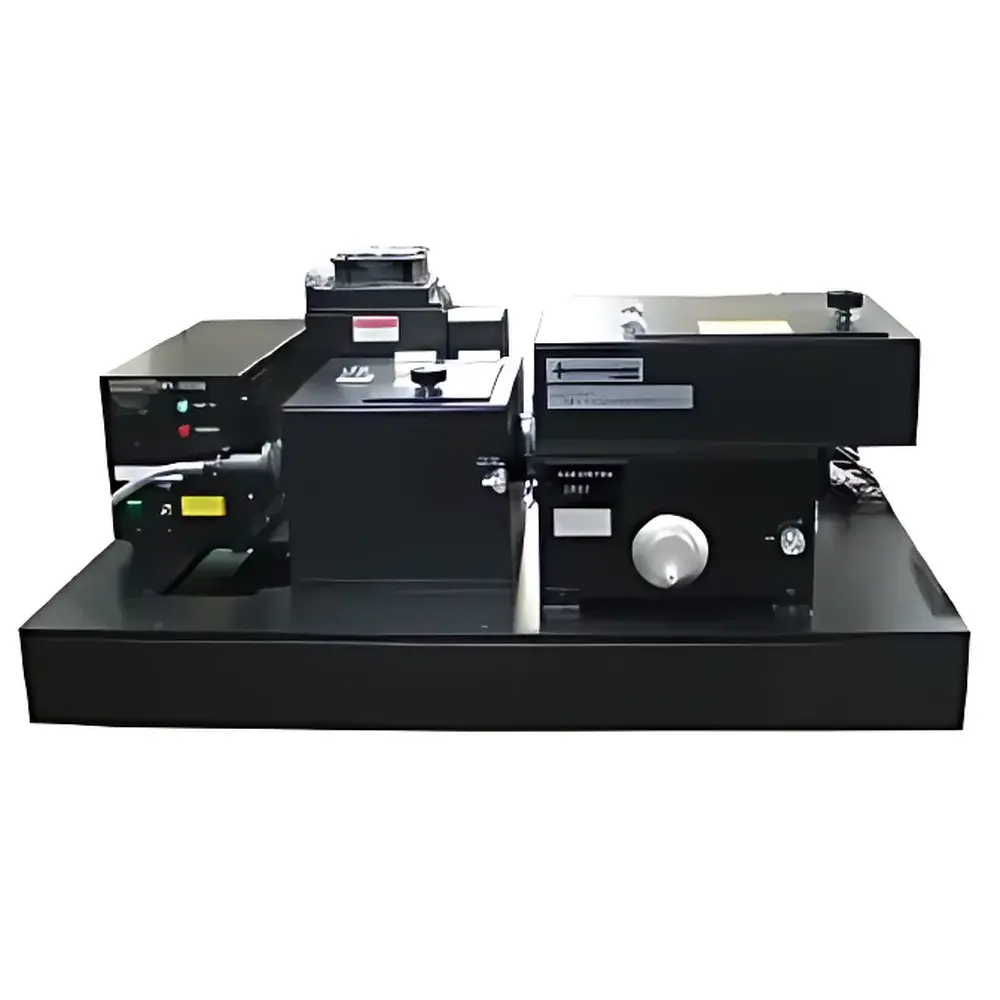
IUV-25CP-1 Photolithographic Resist Spectral Sensitivity Measurement System
| Brand | Bunkoukeiki (Japan) |
|---|---|
| Origin | Japan |
| Model | IUV-25CP-1 |
| Wavelength Range | ~240 nm (continuous irradiation band) |
| Irradiation Area (Vertical) | 89 mm (5–13 adjustable steps) |
| Irradiation Area (Wavelength Direction) | 80 mm (~240 nm spectral span) |
| Exposure Time | 0.01–1200 s |
| Exposure Steps | 1–13 |
| Light Sources | Deep UV Mercury Lamp (line spectrum) + Xenon Arc Lamp (broadband continuum) |
Overview
The IUV-25CP-1 Photolithographic Resist Spectral Sensitivity Measurement System is a precision-engineered spectro-radiometric platform designed for quantitative characterization of photoresist spectral responsivity across the deep ultraviolet (DUV) to near-UV range. Built by Bunkoukeiki, a Japanese manufacturer with decades of expertise in optical metrology and photolithography support instrumentation, this system implements a monochromator-coupled, step-scanning irradiation methodology to deliver spatially resolved, wavelength-dependent exposure profiles. Unlike conventional broadband integrators or single-wavelength dose meters, the IUV-25CP-1 enables direct mapping of resist sensitivity as a function of incident photon energy—critical for process window optimization in semiconductor lithography, mask shop qualification, and advanced photoresist formulation development. Its core architecture adheres to fundamental principles of actinometry and spectral radiance traceability, supporting calibration against NIST-traceable reference standards.
Key Features
- Integrated dual-light-source configuration: A high-intensity deep UV mercury lamp (emitting strong line spectra at 185 nm, 254 nm, and 365 nm) and a stabilized xenon arc lamp (providing continuous spectral output from ~200 nm to >400 nm), enabling both discrete-line and broadband spectral sensitivity profiling.
- Precision mechanical scanning stage with programmable vertical (89 mm travel) and wavelength-direction (80 mm, ~240 nm spectral coverage) positioning, allowing systematic irradiation of resist-coated wafers or test substrates at defined spatial and spectral coordinates.
- High-resolution exposure control: Adjustable exposure time from 0.01 s to 1200 s per step, with up to 13 independently configurable irradiation steps—supporting multi-dose, multi-wavelength experimental matrices required for contrast curve (Dill parameters) extraction.
- Optimized optical path design minimizing stray light and spectral crosstalk, with quartz-transmissive optics and calibrated UV-grade filters to ensure spectral fidelity and irradiance stability over extended measurement cycles.
- Compact benchtop footprint engineered for cleanroom-compatible operation (Class 100–1000 environments), with ESD-safe housing and vibration-damped base for high-reproducibility lithographic exposure testing.
Sample Compatibility & Compliance
The IUV-25CP-1 accommodates standard silicon wafers (up to 200 mm diameter), quartz plates, and glass substrates coated with positive/negative tone photoresists—including chemically amplified resists (CARs), novolac-based resists, and metal oxide hybrid systems. Sample mounting uses vacuum chucking with edge exclusion control to prevent shadowing artifacts. The system conforms to ISO 9022-7 (optical instruments — environmental testing — irradiation), and its radiometric performance supports alignment with ASTM E2027 (Standard Practice for Calibration of Ultraviolet Radiation Sources Used in Accelerated Exposure Testing) when operated with certified reference detectors. While not a GMP-certified instrument per se, its deterministic exposure control, step-repeat repeatability (<±0.8% irradiance variation across 100 consecutive steps), and full parameter logging make it suitable for GLP-compliant R&D environments and internal process validation protocols.
Software & Data Management
The system operates via a dedicated Windows-based control application that provides real-time monitoring of lamp status, shutter timing, stage position, and exposure accumulation. All irradiation parameters—including wavelength coordinate, vertical position, exposure duration, and step number—are timestamped and saved in ASCII-delimited (.csv) format for post-processing in MATLAB, Python (NumPy/Pandas), or lithography simulation tools (e.g., PROLITH, Sentaurus Lithography). Audit trail functionality records operator ID, session start/end time, and parameter modifications—meeting foundational requirements for FDA 21 CFR Part 11 compliance when deployed with institutional electronic signature policies. Raw spectral irradiance data can be exported for correlation with FTIR, ellipsometry, or CD-SEM measurements to establish full process-response models.
Applications
- Determination of spectral sensitivity curves (λ vs. E₀, where E₀ is threshold exposure) for DUV (248 nm, 193 nm) and EUV-resist candidates.
- Quantification of resist contrast (γ), photospeed (E₀), and aerial image log-slope (AILS) under controlled spectral irradiance conditions.
- Evaluation of post-application bake (PAB) and post-exposure bake (PEB) thermal effects on spectral response drift.
- Inter-laboratory round-robin studies requiring traceable, reproducible UV exposure delivery across resist vendors and foundry nodes.
- Support for ISO/IEC 17025-accredited calibration labs performing photoresist certification services.
FAQ
Does the IUV-25CP-1 provide absolute spectral irradiance calibration out of the box?
No. Absolute calibration requires optional NIST-traceable photodiode or thermopile sensors installed at the sample plane. The system includes relative spectral flatness verification routines and supports third-party calibration certificates.
Can the system be integrated with automated wafer handlers or track systems?
Yes—via RS-232 and TTL I/O ports for external trigger synchronization and position acknowledgment. Custom API wrappers (DLL/COM) are available upon request for SECS/GEM protocol compatibility.
Is ozone generation from the 185 nm mercury line managed internally?
The deep UV lamp chamber incorporates active ozone destruction via catalytic converter and exhaust coupling—compliance with OSHA PEL and local ventilation codes requires connection to facility exhaust.
What maintenance intervals are recommended for lamp sources and optical components?
Xenon lamp lifetime: ~1,000 hours; mercury lamp: ~2,000 hours. Quartz optics require quarterly inspection and cleaning with UV-grade methanol; monochromator gratings are sealed and maintenance-free under normal operating conditions.





