
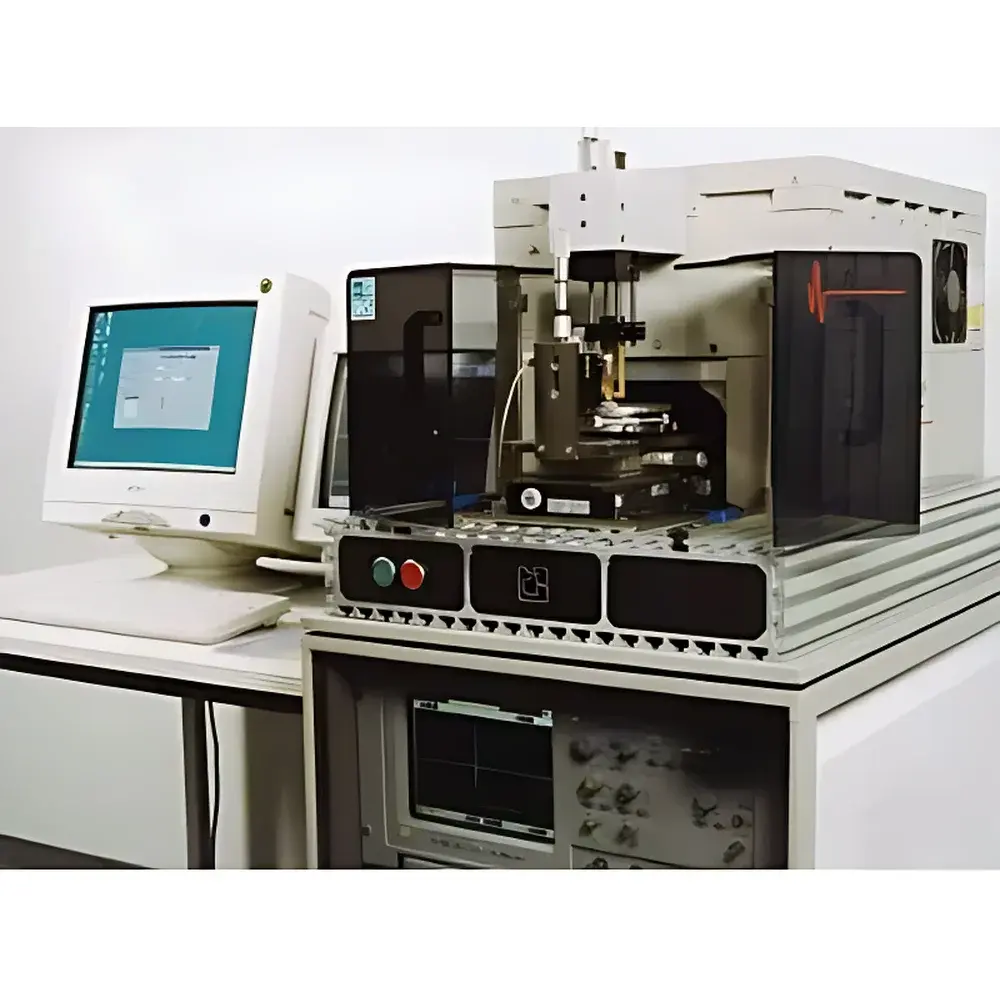
LAwave Laser Ultrasonic Elastic Modulus and Poisson’s Ratio Analyzer
| Origin | Germany |
|---|---|
| Manufacturer Type | Authorized Distributor |
| Origin Category | Imported Instrument |
| Model | LAwave |
| Pricing | Available Upon Request |
Overview
The LAwave Laser Ultrasonic Elastic Modulus and Poisson’s Ratio Analyzer is a non-contact, non-destructive metrology system engineered for the quantitative determination of elastic constants—including Young’s modulus, shear modulus, bulk modulus, and Poisson’s ratio—of thin films, coatings, and near-surface material layers. It operates on the principle of laser-generated and laser-detected surface acoustic waves (SAWs) and bulk acoustic waves (BAWs), leveraging time-resolved interferometric detection to extract dispersion characteristics of guided elastic modes. By analyzing wave velocity as a function of frequency across a broad bandwidth (typically 10 MHz–1 GHz), the instrument solves the inverse problem using physics-based forward modeling constrained by layered elastic theory. This enables depth-resolved mechanical property profiling without physical contact or sample preparation—critical for in-line process monitoring and R&D validation of functional thin-film systems.
Key Features
- Non-destructive, non-contact measurement: No coupling media, vacuum requirements, or surface metallization needed.
- Full-field mapping capability: Acquires spatially resolved elastic modulus and Poisson’s ratio data over areas up to 100 × 100 mm² with micron-scale lateral resolution.
- Ultra-broad thickness coverage: Validated for films ranging from sub-10 nm (e.g., ALD-grown oxides) to >1 mm (e.g., thick thermal barrier coatings).
- Simultaneous multi-parameter extraction: Derives Young’s modulus, Poisson’s ratio, mass density gradient, and layer adhesion quality from a single acquisition sequence.
- Real-time process compatibility: Designed for integration into cleanroom environments and vacuum deposition tools via Ethernet/IP and SECS/GEM interfaces.
- Self-calibrating architecture: Eliminates need for reference standards or empirical calibration curves through ab initio wave propagation modeling.
Sample Compatibility & Compliance
The LAwave supports heterogeneous material systems including sputtered metal films (TiN, CrN, AlCrN), CVD/ALD dielectrics (SiO₂, Si₃N₄, HfO₂), low-k sol-gel organosilicates, polymer electrolytes (PEO-LiTFSI), piezoelectric MEMS membranes (AlN, ZnO), and plasma-sprayed ceramic coatings (YSZ, CeO₂). It complies with ASTM E2587 (Standard Practice for Ultrasonic Testing of Metallic and Nonmetallic Materials), ISO 20483-2 (Acoustic microscopy for thin-film mechanical characterization), and supports GLP/GMP documentation workflows via audit-trail-enabled software logging. Data integrity conforms to FDA 21 CFR Part 11 requirements when deployed with validated user access control and electronic signature modules.
Software & Data Management
The LAwave Control Suite provides integrated acquisition, inversion, and visualization modules built on a modular Qt/C++ framework. Raw interferometric signals are processed using robust singular-value decomposition (SVD)-based denoising and dispersion curve tracking algorithms. Inverse modeling employs finite-element-based forward solvers coupled with Levenberg–Marquardt optimization to minimize misfit between measured and predicted phase velocities. All datasets are stored in HDF5 format with embedded metadata (sample ID, acquisition timestamp, environmental conditions, operator credentials). Export options include CSV, MATLAB .mat, and standardized ASTM E2928-compliant XML reports for LIMS integration.
Applications
- In situ monitoring of PVD/CVD film stress evolution during deposition and post-annealing.
- Quantitative assessment of interfacial delamination and bond strength in wafer-level packaging.
- Mechanical grading of porous low-k films to correlate stiffness loss with pore volume fraction.
- Elastic anisotropy mapping of textured polycrystalline layers (e.g., columnar TiN) for microstructure–property correlation.
- Quality assurance of biomedical coatings (hydroxyapatite, diamond-like carbon) where mechanical mismatch induces clinical failure.
- Validation of multiscale simulation models (e.g., molecular dynamics + continuum FEM) against experimentally derived depth profiles.
FAQ
Does LAwave require vacuum or inert atmosphere operation?
No—measurements are performed under ambient laboratory conditions; optional environmental chambers support controlled temperature/humidity or reactive gas exposure.
Can it resolve elastic gradients within a single film layer?
Yes—the instrument resolves vertical variations in stiffness and density at sub-10 nm depth resolution using higher-order Lamb wave mode analysis.
Is operator training required for routine use?
Basic operation requires ≤2 days of certified training; advanced inversion and modeling workflows are supported by application engineers under service contracts.
How is traceability maintained for regulatory submissions?
Each measurement includes NIST-traceable laser wavelength and timing references; full uncertainty budgets (Type A/B) are auto-generated per ISO/IEC 17025 guidelines.
What sample geometries are supported beyond flat wafers?
Curved substrates (radius ≥5 mm), trenches, and patterned structures are accommodated via motorized 5-axis stage alignment and adaptive beam steering optics.






