
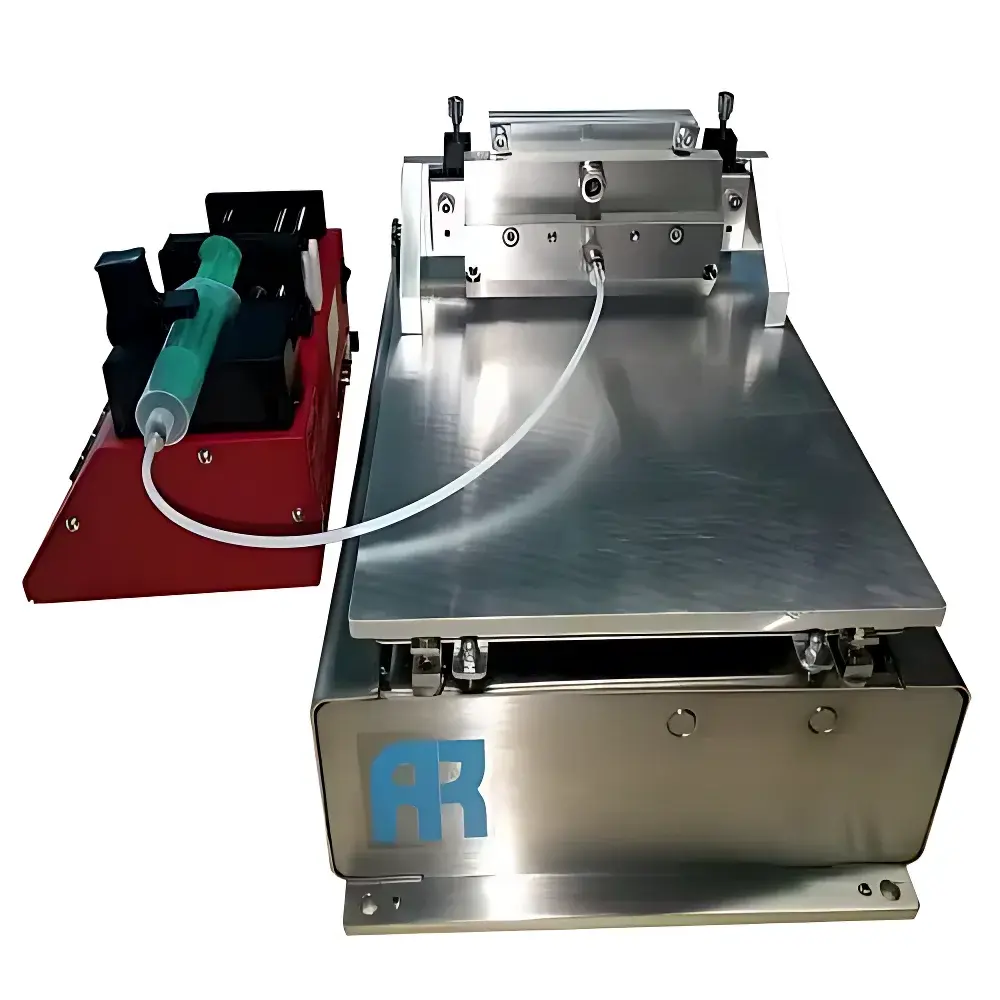
TFC 200–400 Precision Slot-Die & Doctor Blade Coater
| Origin | Germany |
|---|---|
| Supplier Type | Authorized Distributor |
| Origin Category | Imported Instrument |
| Model | TFC 200–400 |
| Coating Speed | 1–100 mm/s (adjustable in 0.1 mm/s increments) |
| Maximum Slot-Die Head Height | 300 mm |
| Standard Coating Area Options | 200 × 300 mm² up to 150 × 150 mm² |
| Blade Adjustment | Motorized, micrometer-precision vertical positioning |
| Compatibility | Integrated with syringe pumps, slot-die modules, coating frames, and consumables |
Overview
The TFC 200–400 Precision Slot-Die & Doctor Blade Coater is an engineered platform for controlled, reproducible thin-film deposition on rigid and flexible substrates. It combines two complementary coating modalities—doctor blade (knife-over-edge) and slot-die extrusion—within a single compact, modular architecture optimized for inert-atmosphere environments such as gloveboxes. The system operates on the principle of meniscus-controlled fluid delivery: in doctor blade mode, a precisely positioned blade shears excess material from the substrate surface, establishing a uniform wet film thickness governed by gap height, viscosity, and withdrawal speed; in slot-die mode, metered fluid is extruded through a precision-machined die channel, forming a stable coating bead that transfers continuous, edge-defined films without substrate contact. Designed for functional nanomaterials—including perovskite precursors, polymer electrolytes, conductive inks, and quantum dot dispersions—the TFC 200–400 delivers sub-100 nm thickness control across laboratory-scale substrates (up to DIN A4 / Letter size), supporting R&D workflows in photovoltaics, solid-state lighting (LED/OLED), battery electrode fabrication, and printed electronics.
Key Features
- Modular dual-mode operation: switch between doctor blade and slot-die coating without realignment or recalibration
- Motorized, digitally indexed blade height adjustment with ±0.5 µm repeatability and fine-tuned gap control (range: 10 µm – 2 mm)
- Slot-die head compatibility up to 300 mm width, supporting scalable process transfer and multi-zone flow distribution
- Compact footprint (W × D × H ≈ 600 × 550 × 320 mm) engineered for integration into nitrogen- or argon-purged gloveboxes (ISO Class 5 compatible)
- Linear motion stage with high-resolution encoder feedback, enabling programmable coating speeds from 1 to 100 mm/s in 0.1 mm/s increments
- Interchangeable tooling interface for rapid mounting of custom dies, coating frames, vacuum chucks, and heated/cooled substrate stages
Sample Compatibility & Compliance
The TFC 200–400 accommodates substrates ranging from silicon wafers and ITO/glass to flexible PET, PI, and metal foils (thickness: 25 µm – 2 mm). Its non-contact slot-die configuration minimizes shear-induced particle aggregation and preserves colloidal stability in nanoparticle suspensions. For regulated development environments—including those aligned with ISO 9001, ASTM D823 (standard practice for drawing films), and IEC 61215 (photovoltaic module qualification)—the system supports traceable parameter logging and user-accessible calibration certificates for motion and gap actuators. While not a GMP-certified production tool, its design conforms to GLP principles: all operational parameters are timestamped, user-identified, and exportable in CSV format for audit readiness. Optional firmware upgrades enable 21 CFR Part 11–compliant electronic signatures and audit trails when paired with validated LIMS or ELN platforms.
Software & Data Management
Coating protocols are defined and executed via a dedicated Windows-based control interface featuring intuitive drag-and-drop sequence programming. Each protocol stores motion profiles (speed, acceleration, dwell time), blade/die positioning, pump synchronization signals (for integrated syringe or gear pumps), and environmental metadata (e.g., glovebox O₂/H₂O levels if external sensors are connected). Real-time position and speed feedback is logged at 100 Hz and synchronized with external instrumentation (e.g., in situ UV-Vis, ellipsometry). Export formats include .csv (for statistical process analysis), .xml (for lab automation integration), and .pdf reports with embedded parameter checksums. Firmware updates are delivered via secure HTTPS channels with SHA-256 integrity verification.
Applications
- Perovskite solar cell R&D: sequential deposition of HTL/ETL/absorber layers with thickness uniformity < ±3% over 100 cm²
- Flexible OLED encapsulation: solvent-resistant barrier layer coating on ultra-thin polyimide substrates
- Li-ion battery electrode prototyping: aqueous and NMP-based slurries coated onto Cu/Al foil with minimal edge defects
- Functional ink patterning: direct-write fabrication of microelectrode arrays using silver nanowire or PEDOT:PSS inks
- Optical interference coatings: multilayer stacks requiring precise interlayer thickness ratios and refractive index matching
FAQ
Can the TFC 200–400 be used inside a nitrogen-filled glovebox?
Yes. Its sealed linear guides, brushless DC drive system, and absence of outgassing plastics make it fully compatible with Class 5 inert-atmosphere gloveboxes. Optional stainless-steel enclosure upgrades are available for enhanced corrosion resistance.
Is slot-die head calibration included with the system?
Each slot-die head is supplied with a certified dimensional report (traceable to DKD/DAkkS-accredited metrology labs) and a baseline flow uniformity test certificate measured using calibrated dye-tracer methods.
Does the system support closed-loop thickness monitoring?
While the base configuration does not include in-line metrology, the motion controller provides TTL-triggered output ports for synchronization with external interferometers, laser profilometers, or optical density sensors.
What substrate heating options are available?
A plug-and-play Peltier-based heated stage (±0.1 °C stability, range: 20–120 °C) and a vacuum-chuck variant for thermal management during high-solids-content coating are offered as factory-installed options.







