
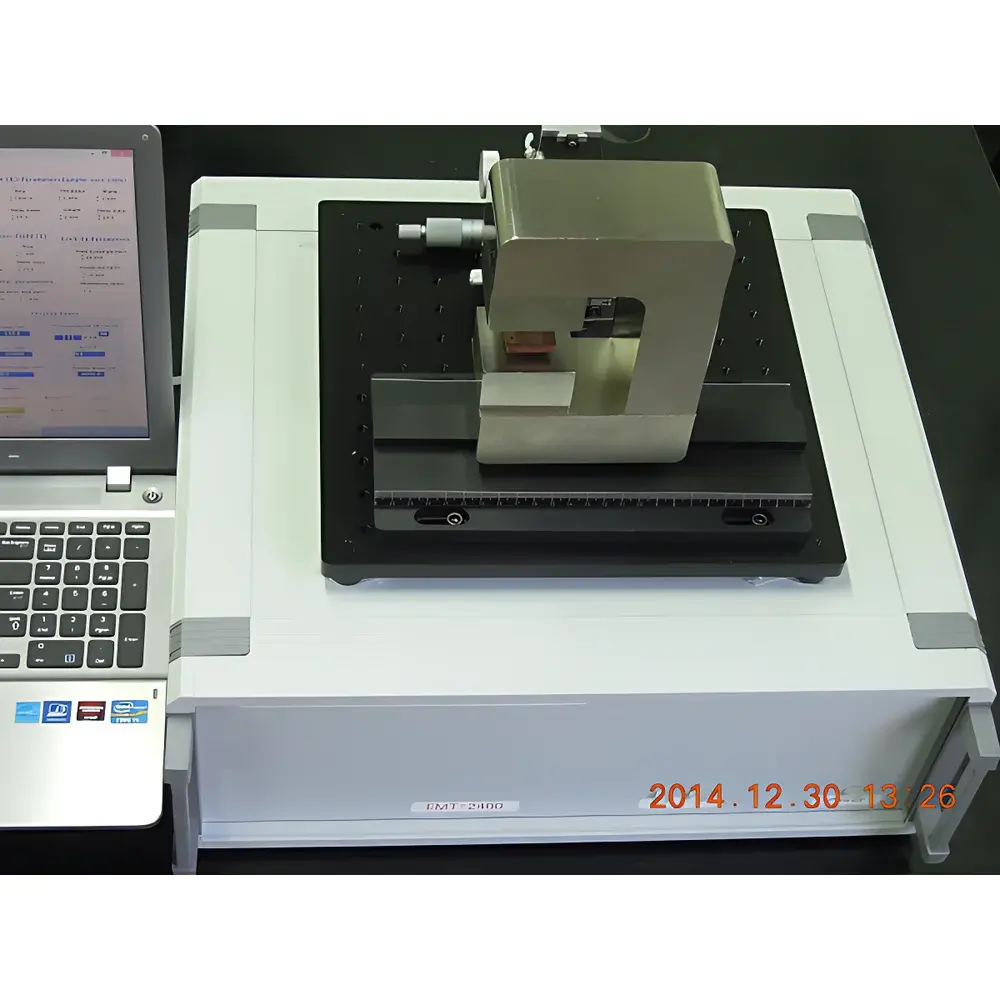
EMT7065 Variable-Temperature Hall Effect Measurement System
| Origin | Taiwan |
|---|---|
| Manufacturer Type | Authorized Distributor |
| Domestic/Import Status | Domestic (Taiwan-sourced) |
| Model | EMT7065 |
| Pricing | Upon Request |
Overview
The EMT7065 Variable-Temperature Hall Effect Measurement System is a precision-engineered platform designed for comprehensive electrical transport characterization of semiconductor thin films and bulk materials under controlled cryogenic to high-temperature conditions. Based on the classical Hall effect principle—where a transverse voltage develops across a current-carrying conductor in the presence of a perpendicular magnetic field—the system quantitatively determines carrier type (n-type or p-type), carrier concentration (10⁶–10²¹ cm⁻³), Hall mobility (1–10⁶ cm²/V·s), resistivity (10⁻⁵–10⁸ Ω·cm), and Hall coefficient (RH) with high reproducibility. Its modular architecture integrates industry-standard Keithley source-measure units (SMUs) and low-noise preamplification stages, enabling four-point probe and van der Pauw geometry measurements compliant with ASTM F76–22 and ISO 14577–2 standards.
Key Features
- Wide operational temperature range: 4 K to 1000 K, achieved via interchangeable cryogenic and high-temperature sample stages—including closed-cycle helium refrigerators (4 K–350 K), liquid nitrogen inserts (77 K–350 K), and resistive heating modules (300 K–1000 K)
- High-field magnet compatibility: Supports integration with superconducting magnets up to 9 T (optional upgrade); includes active field homogeneity compensation and field calibration traceability to NIST standards
- Modular sample stage design: Rigid, vibration-isolated mounting directly above the cold head; no disassembly required for sample exchange—minimizing thermal cycling stress and preserving vacuum integrity
- Van der Pauw and Hall bar configuration support: Pre-aligned contact pads, gold-plated spring-loaded probes, and automated probe positioning for repeatable contact resistance < 100 mΩ
- Full system synchronization: Precise timing coordination between temperature ramping, magnetic field sweeping, and electrical biasing sequences via IEEE-488 (GPIB) and USB 2.0 interfaces
Sample Compatibility & Compliance
The EMT7065 accommodates standard semiconductor wafer formats (up to 4-inch diameter) and custom substrates including Si, SiGe, SiC, GaAs, InGaAs, InP, and GaN—both n-type and p-type doping configurations. All measurement protocols adhere to ASTM F76–22 (“Standard Test Method for Measuring Resistivity and Hall Coefficient of Semiconductor Materials”) and ISO/IEC 17025–2017 requirements for testing laboratory competence. The system supports GLP-compliant data acquisition with full audit trail functionality—including user authentication, timestamped parameter logs, and electronic signature capability per FDA 21 CFR Part 11 when paired with optional validated software modules.
Software & Data Management
Controlled via EMT-HallSoft v4.x, a Windows-based application developed for scientific metrology environments, the system delivers real-time visualization of Hall voltage, longitudinal resistance, and derived parameters during temperature/magnetic field sweeps. Data export conforms to HDF5 and CSV formats with embedded metadata (sample ID, ambient pressure, thermal history, calibration certificates). Software includes built-in uncertainty propagation models per GUM (JCGM 100:2018), automatic correction for offset voltages and thermoelectric EMFs, and batch processing for multi-sample comparative analysis. Remote operation and monitoring are supported through secure TLS-encrypted Ethernet connections.
Applications
- Process development and QC of epitaxial layers in compound semiconductor fabrication lines
- Characterization of wide-bandgap device structures (e.g., GaN HEMTs, SiC MOSFETs) under thermal stress conditions
- Fundamental research on carrier scattering mechanisms in 2D materials and heterostructures
- Validation of dopant activation efficiency following ion implantation and rapid thermal annealing
- Correlation studies between structural defects (via XRD/TEM) and transport properties in novel thermoelectrics
FAQ
What vacuum level is required for optimal low-temperature Hall measurements?
A base pressure ≤5×10⁻⁶ mbar is recommended to minimize gas conduction errors and prevent condensation on cold surfaces at sub-77 K temperatures.
Can the system perform simultaneous Hall and Seebeck coefficient measurements?
No—the EMT7065 is dedicated to Hall-effect and resistivity characterization; Seebeck measurements require a separate thermoelectric property module (e.g., EMT-TEP7000 series).
Is magnetic field homogeneity mapping included in standard commissioning?
Yes—field uniformity verification over ±10 mm³ volume is performed using a calibrated Hall probe and documented in the factory acceptance test report.
Does the system support automated temperature-dependent mobility modeling (e.g., Matthiessen’s rule fitting)?
Basic Arrhenius and variable-range hopping fits are available; advanced scattering mechanism modeling requires export to external tools such as MATLAB or Python-based transport simulators.
What documentation is provided for regulatory compliance in pharmaceutical or medical device manufacturing?
A complete IQ/OQ protocol package, traceable calibration certificates (NIST-traceable SMUs and thermocouples), and raw data file structure validation reports are supplied upon request.



