
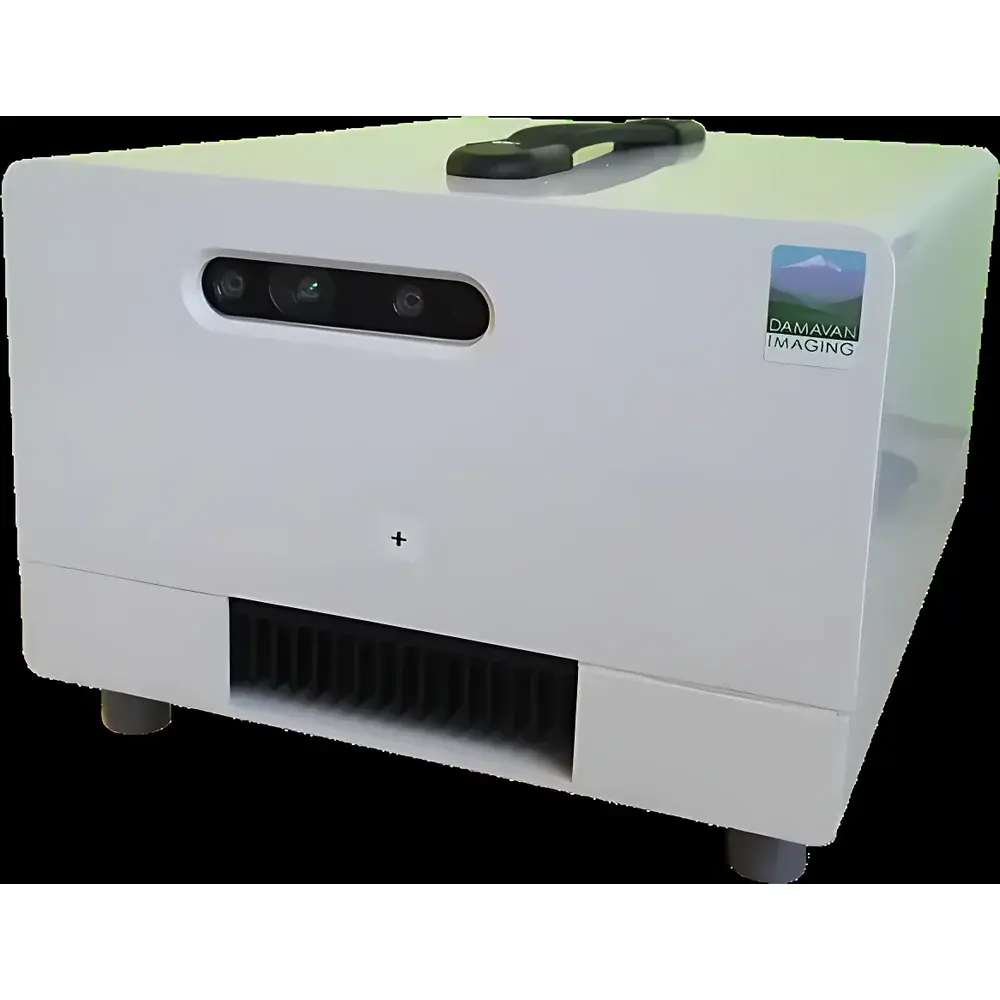
Gamma Camera Compton V1 by Daman Imaging
| Origin | France |
|---|---|
| Manufacturer Type | Distributor |
| Origin Category | Imported |
| Model | Compton V1 |
| Price Range | USD 70,000–140,000 (approx.) |
| Instrument Type | Portable Gamma Spectrometer & Imager |
| Sample Form | Solid |
| Detector Material | CeBr₃ (Cerium Bromide) |
| Radiation Type | Gamma-Ray Sources |
| Energy Range | 100 keV – 3 MeV (spectroscopy), 250 keV – 3 MeV (imaging) |
| Sensitivity | 0.03 µR/h (1-hour integration), 1 kBq @ 1 m (2-hour imaging), >3 µR/h (sub-minute detection) |
Overview
The Compton V1 Gamma Camera is a compact, field-deployable gamma-ray spectrometer and imager engineered for high-fidelity nuclear radiation characterization in environmental monitoring, nuclear safety, and emergency response applications. Unlike conventional scintillation-based survey meters or single-channel detectors, the Compton V1 implements time-resolved Compton imaging — a technique that reconstructs gamma-ray source location and energy spectrum by analyzing the three-dimensional interaction coordinates (X, Y, Z), arrival time (T), and deposited energy (E) of individual photon events within its dual 32 × 32 mm CeBr₃ scintillator array. This multi-parameter event tagging enables true spectroscopic imaging without mechanical collimation, delivering angular resolution of 6° FWHM and temporal resolution of 300 ps — performance metrics validated under ISO 4037-3 and IEC 62327 standards for portable radiation instrumentation.
Key Features
- Portable dual-module architecture: Separated detector head (CeBr₃ + Philips DPC3200 tile sensor) and embedded processing unit for real-time event reconstruction
- Active temperature stabilization of scintillation crystals to maintain spectral linearity and energy resolution across ambient conditions (−10 °C to +50 °C)
- Simultaneous spectroscopy and imaging: Full energy spectrum acquisition (100 keV – 3 MeV) concurrent with spatial source localization (250 keV – 3 MeV imaging band)
- Time-of-flight enabled Compton reconstruction: Each detected event yields a 5D vector (X, Y, Z, T, E), enabling background suppression and directional source identification
- Onboard calibration: Factory-traceable energy and spatial response matrices stored in non-volatile memory; supports post-acquisition reprocessing with updated algorithms
- USB-C and Ethernet interfaces for remote operation; compatible with Windows-based analysis software for offline image reconstruction and dose rate mapping
Sample Compatibility & Compliance
The Compton V1 is optimized for solid-phase environmental samples — including soil cores, concrete surfaces, debris fragments, and contaminated equipment — where isotopic identification (e.g., 137Cs, 60Co, 241Am, natural U/Th series) and spatial distribution mapping are required. It meets IEC 62327:2017 for handheld radioisotope identifiers and complies with ANSI N42.33-2022 for radiation detection instrument performance criteria. Its sensitivity profile (1 kBq @ 1 m in 2 hours) satisfies EPA Method 901.1 requirements for low-level environmental gamma surveys. The system supports audit-ready data logging aligned with GLP principles, including timestamped raw event files, detector temperature logs, and user-accessible calibration metadata.
Software & Data Management
Data acquisition and visualization are managed via Daman Imaging’s proprietary GammaView Suite, a Windows-native application supporting real-time spectral display, Compton back-projection image generation, and isotope-specific activity mapping. All raw event vectors (X, Y, Z, T, E) are stored in HDF5 format with embedded metadata per IAEA TECDOC-1329 guidelines. Software features include configurable ROI selection, nuclide library matching against ENDF/B-VIII.0 and ICRP-107 databases, and export to CSV, DICOM-SR, and GeoTIFF for GIS integration. Audit trail functionality records operator ID, session start/end times, calibration status, and parameter modifications — satisfying FDA 21 CFR Part 11 requirements for electronic records in regulated environments.
Applications
- Environmental remediation site characterization: Mapping Cs-137 contamination in soil or sediment with sub-meter spatial fidelity
- Nuclear facility decommissioning: Locating activated components or residual fission products behind shielding
- Border security and customs screening: Discriminating medical isotopes from SNM signatures in cargo or scrap metal
- Emergency response triage: Rapid identification and localization of orphan sources or dispersal events in urban settings
- Geological prospecting: In-situ measurement of K/U/Th ratios in rock outcrops without sample preparation
- Research-grade Compton imaging validation: Benchmarking Monte Carlo simulations (e.g., Geant4) against measured event topology
FAQ
What distinguishes Compton V1 from traditional NaI(Tl)-based gamma cameras?
It replaces mechanical collimation with time-resolved Compton kinematics, achieving higher sensitivity per unit mass and eliminating collimator-induced efficiency loss.
Is factory recalibration required annually?
No — the embedded CeBr₃ calibration matrix is stable for ≥24 months; users may perform verification checks using 133Ba and 60Co reference sources per ISO 8529-2.
Can the system operate unattended for long-term monitoring?
Yes — with external power and optional GPS/time sync module, it supports scheduled acquisitions and automated FTP upload of compressed event archives.
Does it support spectral deconvolution of overlapping peaks?
Yes — GammaView Suite includes constrained least-squares fitting with physical peak shape models (Gaussian + low-energy tail) and background polynomial subtraction.
What is the minimum detectable activity for 137Cs at 1 m distance?
Under typical field conditions (2-hour integration, no shielding), MDA is ≤0.8 kBq with 95% confidence (ISO 11929).
Related Products







