
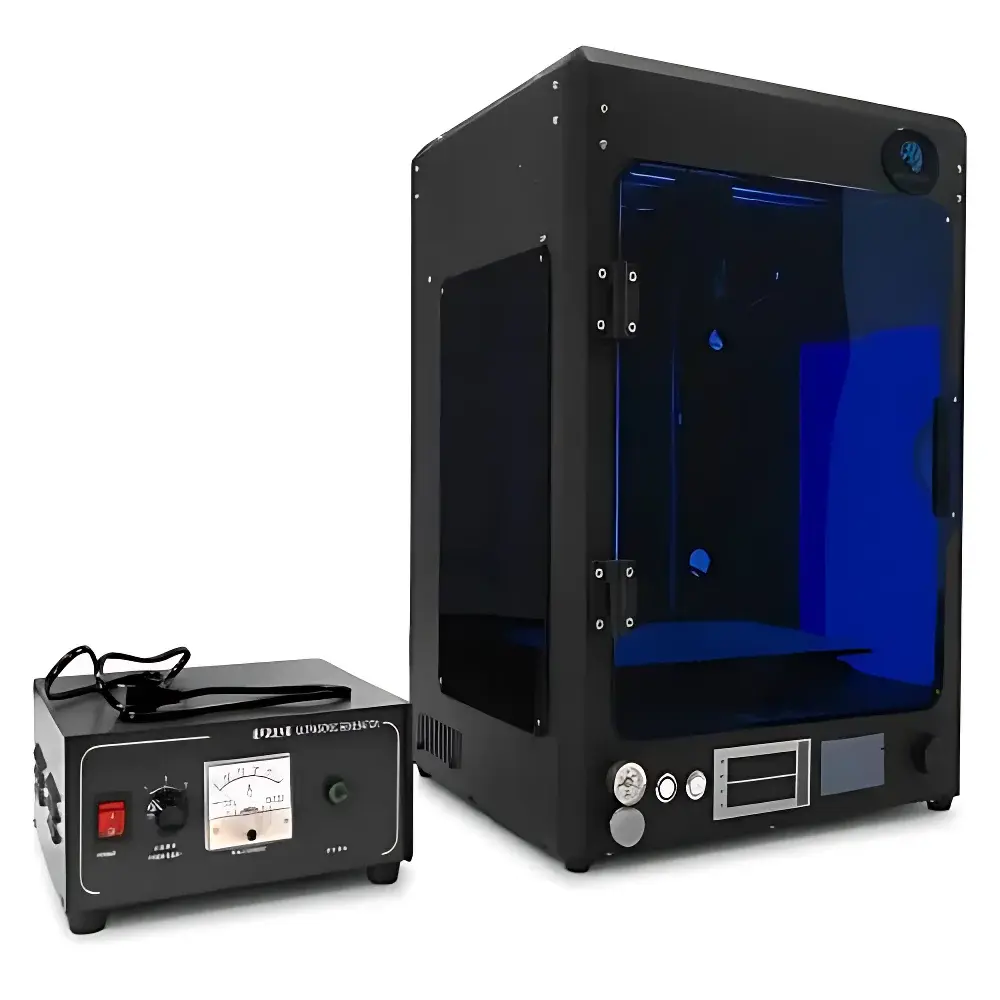
DATAMAKER CPT-Ultra-19 Ultrasonic Spray Coating System
| Origin | Jiangsu, China |
|---|---|
| Manufacturer Type | Authorized Distributor |
| Origin Category | Domestic (China-made) |
| Model | CPT-Ultra-19 |
| Quotation | Upon Request |
| Spray Area | 280 × 230 mm |
| Nozzle Frequency | 50 kHz (Extended-Nozzle Design) |
| Flow Rate Range | 3–30 mL/min |
| Flow Resolution | 1 µL/s |
| Maximum Translation Speed | 150 mm/s |
| Working Envelope | 250 × 250 × 200 mm (X-Y-Z) |
| Power Supply | AC 220 V, 50 Hz |
| Rated Power | 800 W |
| Auxiliary Air Pressure Range | 0–0.2 MPa (adjustable) |
| Control Interface | G-code compatible |
| Operation Modes | Online (USB/Ethernet) or Offline (SD Card) |
| Supported OS | Windows, macOS, Linux |
| Software Platform | DATAMAKER proprietary control suite + Notepad++-editable script environment |
Overview
The DATAMAKER CPT-Ultra-19 Ultrasonic Spray Coating System is a fully integrated precision deposition platform engineered for controlled, low-waste thin-film fabrication via high-frequency ultrasonic atomization. Unlike conventional pneumatic two-fluid nozzles—which rely on turbulent gas–liquid interaction—the CPT-Ultra-19 employs piezoelectric transduction at 50 kHz to generate capillary-wave-induced droplet breakup, producing a narrow, monodisperse aerosol with median droplet diameters typically in the 10–50 µm range. This physical mechanism enables deterministic control over film thickness (down to sub-10 nm equivalent uniformity), exceptional edge definition, and minimal overspray—critical for functional coatings where material cost, stoichiometric fidelity, and interfacial integrity are non-negotiable. The system operates on the principle of acoustic streaming-assisted laminar delivery: atomized droplets are entrained in a low-velocity, laminar carrier gas stream, ensuring gentle, non-impact deposition onto temperature-sensitive or topographically complex substrates without dewetting or rebound effects.
Key Features
- Automated XYZ motion stage with 250 × 250 mm travel range and 200 mm vertical clearance—engineered for repeatable positioning accuracy within ±2 µm per axis
- Single 50 kHz extended-tip ultrasonic nozzle optimized for viscosity ranges from 1 to 500 cP (e.g., aqueous sol-gels, polymer dispersions, conductive inks, and precursor solutions)
- G-code programmable workflow enabling deterministic path planning, layer-by-layer stacking, and multi-zone dosage modulation
- Real-time volumetric flow control with 1 µL/s resolution and ≤±0.5% repeatability across full 3–30 mL/min operating range
- Integrated carrier gas regulation (0–0.2 MPa) for fine-tuning droplet transport velocity and drying kinetics
- Bilingual (English/Chinese) touchscreen HMI with local data logging, parameter versioning, and audit-trail-capable operation history
- Compact footprint (<0.8 m² floor space) and modular design supporting Class 1000 cleanroom integration
Sample Compatibility & Compliance
The CPT-Ultra-19 accommodates rigid and flexible substrates up to 300 × 300 mm, including silicon wafers, ITO/glass, PET foils, metal foams, ceramic membranes, and microfluidic PDMS chips. It supports solvent-based, water-based, and low-surface-tension formulations—validated for use with NMP, DMF, ethanol, isopropanol, and aqueous colloidal suspensions. The system conforms to IEC 61000-6-2 (EMC immunity) and IEC 61000-6-4 (EMC emission) standards. While not certified as medical device manufacturing equipment, its programmable logic controller (PLC)-based architecture supports configuration for GLP/GMP-aligned workflows, including user access levels, electronic signature prompts, and exportable CSV/CSV-UTF8 logs compliant with FDA 21 CFR Part 11 requirements when deployed with validated software extensions.
Software & Data Management
Control is executed via DATAMAKER’s native cross-platform application, built on Qt framework and compatible with Windows, macOS, and Linux. The interface accepts G-code (ISO 6983-1) input and permits direct editing of spray parameters—including dwell time, acceleration profiles, and z-height compensation—using Notepad++ or any UTF-8–capable text editor. All operational metadata (timestamp, nozzle temperature, flow deviation, stage position) is logged locally to internal eMMC storage and exportable via USB or network share. Firmware updates are delivered via signed .bin packages; configuration backups support JSON schema export for version-controlled process documentation.
Applications
This system serves R&D, pilot-line, and production environments requiring nanoscale thickness control and high material economy. Documented use cases include: catalyst layer deposition for PEM fuel cell MEAs; sequential perovskite precursor spraying in ambient-air PSC fabrication; conformal passivation layers on textured Si photovoltaics; biofunctionalized hydrogel patterning on biosensor electrodes; selective flux application in SMT reflow pre-treatment; and gradient dielectric coatings for flexible OLED encapsulation. Its low thermal load and absence of high-velocity impingement make it suitable for thermally labile biomolecules (e.g., antibodies, enzymes) and organic semiconductors.
FAQ
What substrate heating options are available?
The base system does not include integrated hotplate or IR heating; however, third-party heated stages (up to 200 °C) can be mechanically and electrically interfaced via TTL/RS-485 expansion ports.
Can multiple nozzles be synchronized?
The CPT-Ultra-19 supports single-nozzle operation only; multi-nozzle configurations require custom engineering and are offered as OEM variants (CPT-Ultra-M series).
Is real-time droplet size monitoring supported?
No built-in laser diffraction or phase-Doppler anemometry is included; however, the system provides analog voltage outputs (0–10 V) proportional to instantaneous flow rate for external sensor integration.
How is calibration traceability maintained?
Gravimetric flow verification procedures and stage-position linearity reports are supplied with each unit; NIST-traceable calibration certificates are available upon request for metrology-critical deployments.
What maintenance intervals are recommended?
Ultrasonic nozzle tip inspection every 200 operational hours; piezoceramic driver recalibration annually or after 1,000 hr cumulative runtime; carrier gas filter replacement every 6 months under continuous use.





