
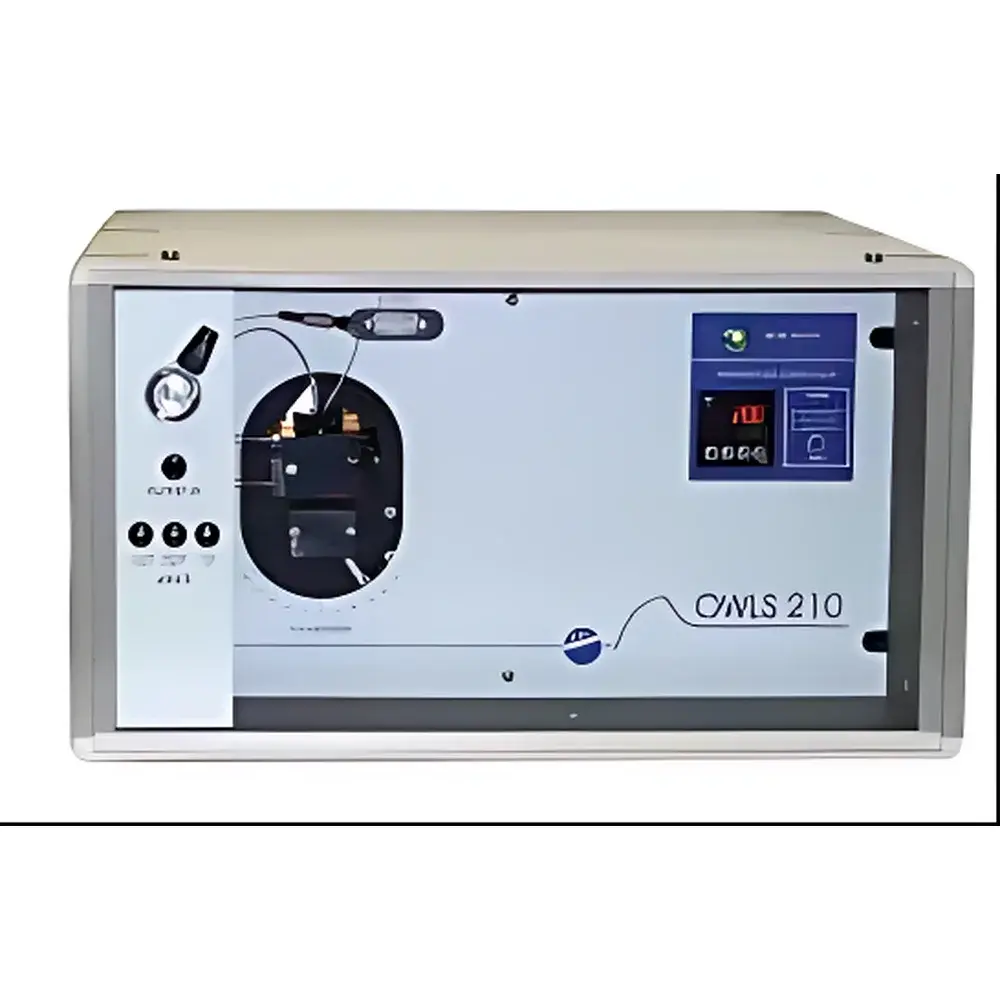
Biosense OWLS 210 Optical Waveguide Lightmode Spectroscopy Molecular Interaction Analyzer
| Origin | Imported |
|---|---|
| Manufacturer Type | Authorized Distributor |
| Model | OWLS 210 |
| Detection Range | DNA, proteins, lipids, peptides, antibodies, aptamers |
| Sample Volume Capacity | Up to 1 mL (flow cell) |
| Injection Volume | Adjustable via programmable syringe pump (typical range: 5–200 µL per injection) |
| Analysis Time Resolution | As low as 1 ms (with Biosense 2.5 software) |
| standard scanning | 1–5 s per measurement |
| Temperature Control Range | 10–80 °C (±0.1 °C stability) |
Overview
The Biosense OWLS 210 is a label-free, real-time molecular interaction analyzer based on Optical Waveguide Lightmode Spectroscopy (OWLS), a rigorously validated surface-sensitive optical technique rooted in integrated photonics. Unlike conventional label-dependent assays or resonance-based methods such as Surface Plasmon Resonance (SPR), OWLS operates by exciting guided modes in a planar titanium dioxide (TiO₂) waveguide layer using a grating-coupled, p-polarized He–Ne laser (632.8 nm). Changes in the effective refractive index (Neff) and propagation angle of the guided mode—induced by mass adsorption within the evanescent field decay length (~200–300 nm above the waveguide surface—are quantitatively resolved via angular interrogation. This enables simultaneous, model-independent determination of both adsorbed layer thickness (dA) and average refractive index (nA) using the Feijter equation, yielding absolute surface mass density (ng/cm²) with sub-1 ng/cm² detection limit. The system is engineered for precision kinetics and thermodynamics studies under physiologically relevant fluidic and thermal conditions, supporting GMP-compliant workflows through audit-trail-enabled software and traceable calibration protocols.
Key Features
- Label-free, real-time monitoring of biomolecular binding events without chemical modification or fluorescent tagging
- Dual-parameter output: simultaneous quantification of adsorbed mass density (ng/cm²) and layer thickness (nm), enabling structural inference beyond simple affinity assessment
- High thermal stability: Peltier-controlled microfluidic chamber with ±0.1 °C regulation across 10–80 °C, suitable for temperature-dependent binding studies and denaturation profiling
- Low-noise optical architecture: No intrinsic background resonance broadening—unlike SPR—resulting in superior signal-to-noise ratio and reproducible baseline stability
- Modular flow system: Compatible with standard HPLC-grade tubing and disposable sensor chips; supports sequential injection, continuous flow, and regeneration cycles
- Compliance-ready design: Software adheres to FDA 21 CFR Part 11 requirements for electronic records and signatures; includes user role management, audit trail logging, and data integrity validation
Sample Compatibility & Compliance
The OWLS 210 accommodates a broad spectrum of biomolecular analytes—including DNA oligonucleotides, recombinant proteins, monoclonal antibodies, membrane vesicles, synthetic peptides, and carbohydrate ligands—without requiring labeling or amplification. Sensor chips feature covalently immobilized carboxylated or amine-reactive dextran surfaces, enabling oriented coupling via EDC/NHS chemistry. For lipid bilayer studies, hydrophobic TiO₂ chips support spontaneous vesicle fusion and supported lipid bilayer (SLB) formation. All assay protocols are compatible with ISO/IEC 17025-aligned validation frameworks and referenced against ASTM E2924 (Standard Guide for Validation of Biomolecular Interaction Assays). Instrument performance verification follows internal SOPs traceable to NIST-certified refractive index standards.
Software & Data Management
Biosense 2.5 software provides full instrument control, kinetic modeling, and quantitative data analysis. It supports global fitting of association/dissociation phases to 1:1, bivalent, or heterogeneous binding models using nonlinear regression algorithms. Raw angular shift data are automatically converted to surface mass concentration using chip-specific calibration curves. All datasets include metadata stamps (operator ID, timestamp, temperature, flow rate, buffer composition), and export options comply with MIAME and MIAPE reporting guidelines. Data files are stored in vendor-neutral HDF5 format with embedded schema definitions, ensuring long-term archival integrity and third-party tool interoperability (e.g., Python-based PyOWLS libraries).
Applications
- Kinetic characterization of protein–protein, protein–DNA, and antibody–antigen interactions under native solution conditions
- Membrane biophysics: Real-time monitoring of lipid bilayer formation, peptide insertion, and pore-forming toxin activity
- Drug discovery: Primary screening of small-molecule inhibitors targeting protein–protein interfaces or nucleic acid secondary structures
- Toxicology: Quantitative assessment of nanoparticle–biomembrane adhesion and protein corona formation kinetics
- Environmental biosensing: Detection of pathogenic DNA sequences or mycotoxin-binding aptamers in complex matrices (e.g., serum, food extracts)
- Biomaterial safety evaluation: Adsorption kinetics of serum proteins onto implant coatings to predict immune response profiles
FAQ
How does OWLS differ fundamentally from SPR in terms of physical principle and data interpretation?
OWLS measures changes in guided-mode effective refractive index via angular interrogation of a dielectric waveguide; SPR relies on resonant energy transfer to surface plasmons at a metal–dielectric interface. OWLS yields two independent parameters (dA, nA) directly linked to mass and conformation; SPR outputs only one resonance unit (RU) requiring empirical calibration and offering no intrinsic thickness resolution.
Can OWLS 210 be used for kinetic analysis of low-affinity interactions (KD > 10 µM)?
Yes—its high time resolution (1 ms), low drift (<0.005°/h), and robust baseline recovery after regeneration enable reliable off-rate determination even for transient complexes, provided mass transport limitations are minimized via optimized flow rates and surface density control.
Is chip regeneration feasible between runs, and what protocols are recommended?
Regeneration is fully supported using mild chaotropic agents (e.g., 10 mM glycine–HCl, pH 2.0) or low-concentration SDS (0.05%), validated per chip lot. Regeneration efficacy is monitored in real time via return to baseline angular position with <1% residual signal deviation.
Does the system support GLP/GMP-compliant documentation workflows?
Yes—Biosense 2.5 includes electronic signature capture, automated report generation with digital seals, and immutable audit trails compliant with FDA 21 CFR Part 11 and EU Annex 11 requirements.




