
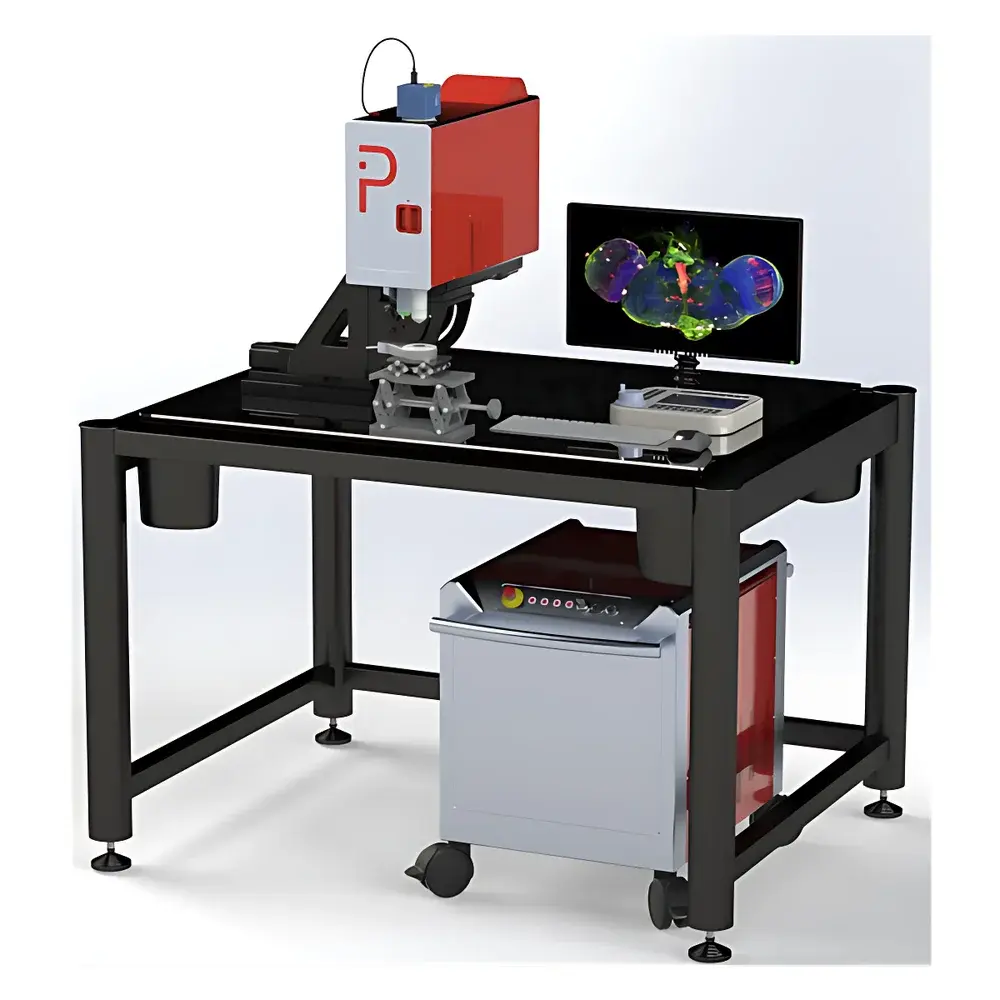
Prospect MPX Multimodal Multiphoton Microscope
| Brand | Prospect |
|---|---|
| Origin | Hungary |
| Manufacturer Type | Authorized Distributor |
| Origin Category | Imported |
| Model | MPX |
| Price | Upon Request |
Overview
The Prospect MPX Multimodal Multiphoton Microscope is an engineered platform for high-resolution, deep-tissue biological imaging based on near-infrared (NIR) multiphoton excitation. Unlike conventional confocal microscopy, the MPX leverages ultrafast pulsed lasers (typically Ti:sapphire or OPO-based) to induce simultaneous absorption of two or more photons—enabling intrinsic optical sectioning with reduced phototoxicity and enhanced penetration depth (up to 1 mm in scattering tissues). Its core architecture integrates galvanometric and resonant scanning mechanisms, supporting both point-scanning and line-scan modalities. Designed for flexibility in experimental design, the MPX serves as a unified platform for structural, functional, and dynamic imaging across neuroscience, developmental biology, immunology, and regenerative medicine.
Key Features
- Modular optical design enabling field-upgradeable configurations—from basic two-photon fluorescence (2PF) to full multimodal operation including second-harmonic generation (SHG), third-harmonic generation (THG), coherent anti-Stokes Raman scattering (CARS), and fluorescence lifetime imaging (FLIM).
- Interchangeable scan head mounting options: inverted, upright, or horizontal orientation—compatible with standard microscope frames and custom mechanical stages.
- Integrated laser coupling interface supporting multiple excitation wavelengths (680–1300 nm), synchronized pulse delivery, and automated wavelength tuning via motorized OPO control.
- Dual-channel non-descanned detection (NDD) with high-quantum-efficiency GaAsP photomultiplier tubes (PMTs), optimized for spectral unmixing and lifetime-resolved signal acquisition.
- Real-time hardware synchronization between scanning, laser pulsing, and external stimuli (e.g., optogenetic actuators, electrophysiology rigs, or microfluidic triggers).
- Robust mechanical architecture with low-drift thermal management and vibration-damped optical baseplate—designed for long-duration time-lapse experiments under physiological conditions.
Sample Compatibility & Compliance
The MPX platform accommodates diverse biological specimens without modification: live brain slices, intact zebrafish embryos, murine cortical tissue, organoids, 3D bioprinted constructs, and ex vivo human biopsy samples mounted in refractive-index-matched media. Its open-access optical path supports custom immersion objectives (water, silicone, or glycerol immersion), multi-position sample chambers, and environmental control integration (temperature, CO₂, humidity). From a regulatory standpoint, the system adheres to IEC 61000-6-3 (EMC emissions) and IEC 60825-1 (laser safety Class IV compliance). While not a medical device, its data acquisition architecture supports GLP-compliant workflows through audit-trail-enabled software logging and metadata-rich TIFF/OME-TIFF export—fully compatible with institutional LIMS and FDA 21 CFR Part 11–aligned validation protocols when deployed in preclinical research environments.
Software & Data Management
Control and analysis are managed through Prospect’s proprietary MPX Control Suite—a cross-platform application built on Qt/C++ with Python API extension support. The suite provides real-time image preview, adaptive dwell-time optimization, spectral fingerprinting, and batch processing pipelines for large-volume z-stack or time-series datasets. All raw acquisitions include embedded metadata (laser power, PMT gain, pixel dwell time, objective ID, temperature logs) compliant with the OME-XML schema. Export formats include lossless TIFF stacks, HDF5 containers for volumetric tensor storage, and JSON-serialized experiment parameters for reproducibility tracking. Integration with open-source tools such as FIJI/ImageJ, MATLAB, and Napari is supported via documented SDKs and plugin interfaces. Data integrity is maintained through SHA-256 checksum generation at acquisition time and optional network-attached storage (NAS) mirroring with versioned backups.
Applications
- Deep-tissue functional neuroimaging: Calcium dynamics in layer V pyramidal neurons during behavioral paradigms using GCaMP variants and red-shifted indicators (jRGECO1b).
- Organoid and bioprinted construct characterization: Structural maturation assessment via SHG collagen mapping and THG lipid droplet visualization in hepatic or cerebral organoids.
- Optogenetics-integrated physiology: Simultaneous all-optical interrogation—ChR2 activation paired with voltage-sensitive dye (VSD) or genetically encoded voltage indicator (GEVI) readout.
- Dynamic extracellular matrix remodeling: Longitudinal monitoring of fibrillar collagen reorganization in tumor spheroids using polarization-resolved SHG.
- High-content screening in 3D culture models: Automated multi-position acquisition across microwell plates containing microtissues, with integrated focus stabilization and drift correction.
FAQ
Is the MPX compatible with third-party lasers and detectors?
Yes—the MPX features standardized fiber-coupled input ports and TTL-sync interfaces for seamless integration with external ultrafast oscillators, amplifiers, and hybrid PMTs or SPAD arrays.
Can the system be upgraded from a basic 2P configuration to full multimodal capability post-purchase?
Absolutely. All MPX units ship with预留 optical pathways, detector bays, and firmware hooks; SHG/THG/CARS modules and FLIM electronics can be added without hardware replacement.
Does the software support automated experiment scheduling and remote operation?
Yes—MPX Control Suite includes scriptable acquisition sequences, REST API endpoints for lab automation systems, and secure web-based remote monitoring via TLS-encrypted WebSocket connections.
What maintenance is required for long-term stability?
Annual calibration of galvo alignment and PMT gain linearity is recommended; laser source maintenance follows OEM guidelines (typically every 12–18 months depending on usage intensity).
Is training and application support included with purchase?
Prospect provides on-site installation, operator certification workshops, and dedicated application scientist access for protocol development—available globally through authorized distribution partners.




