
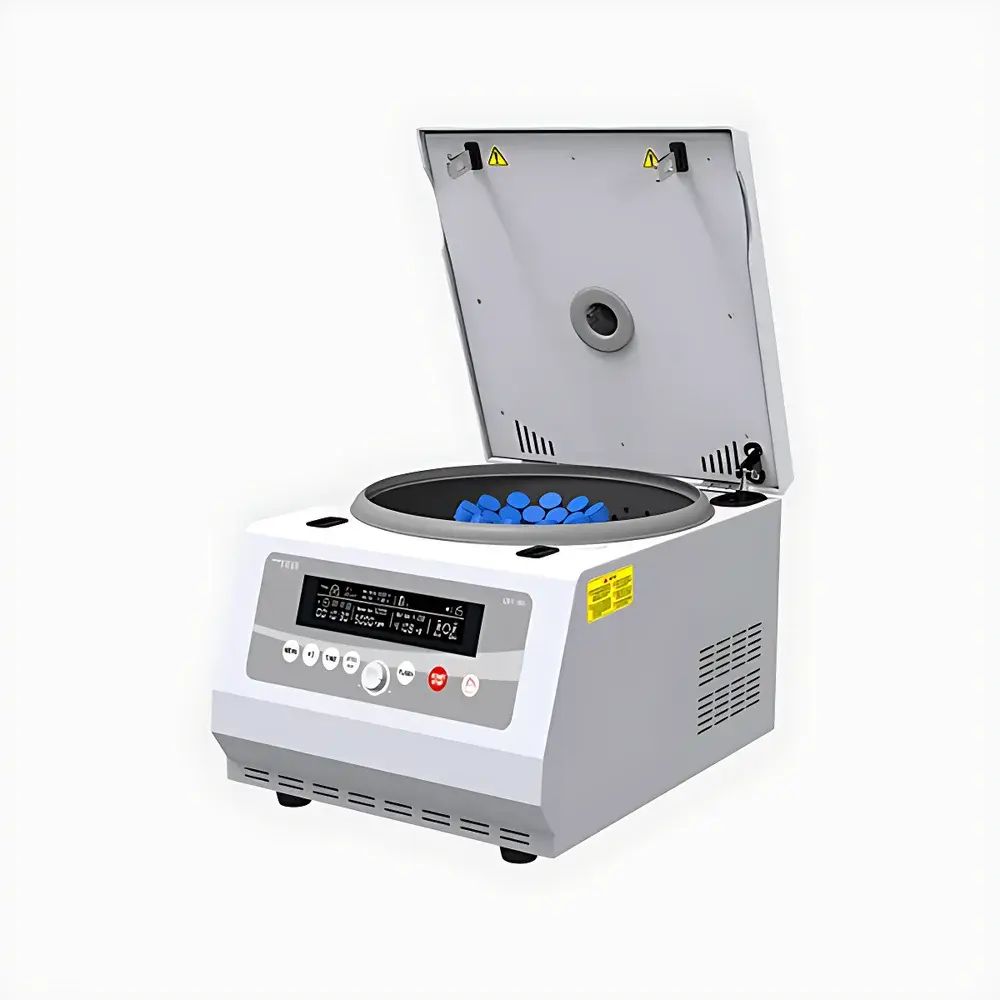
Titan LDC-4 Benchtop Low-Speed Centrifuge
| Brand | Titan |
|---|---|
| Origin | Shanghai, China |
| Manufacturer Type | Direct Manufacturer |
| Product Category | Domestic |
| Model | LDC-4 |
| Instrument Type | Benchtop Centrifuge |
| Speed Range | Up to 6,000 rpm |
| Max RCF | 5,350 × g |
| Max Capacity | 30 × 15 mL (horizontal rotor configuration) |
| Dimensions | 360 × 448 × 308 mm |
Overview
The Titan LDC-4 is a robust, benchtop low-speed centrifuge engineered for routine separation tasks in academic laboratories, clinical diagnostics support units, and quality control environments. Operating on the principle of sedimentation under controlled rotational force, the LDC-4 generates reproducible relative centrifugal forces (RCF) up to 5,350 × g at its maximum speed of 6,000 rpm—well within the operational envelope defined for low-speed centrifugation (typically < 10,000 rpm). Its horizontal rotor design enables uniform sample distribution and optimal pelleting of suspended particles in standard conical tubes (e.g., 15 mL polypropylene centrifuge tubes), making it especially suitable for cell harvesting, serum/plasma separation, precipitate recovery, and routine buffer exchange protocols. The unit complies with IEC 61010-1:2010 safety standards for laboratory electrical equipment and incorporates mechanical interlock systems to prevent lid opening during operation.
Key Features
- Benchtop footprint optimized for space-constrained lab benches (360 × 448 × 308 mm), with reinforced steel chassis and vibration-dampening feet for stable operation.
- Microprocessor-controlled brushless DC motor ensures precise speed regulation (±20 rpm accuracy across full range) and extended service life without carbon brush maintenance.
- Intuitive rotary encoder interface with LED display showing real-time rpm, RCF, time remaining, and acceleration/deceleration status.
- Programmable timer (1–99 minutes) with auto-stop and audible end-of-run alert; soft-braking deceleration profile minimizes resuspension of delicate pellets.
- Horizontally swinging bucket rotor accommodates up to thirty 15 mL conical tubes (maximum load: 450 g per run); rotor balance tolerance ±5 g per bucket pair.
- Double-layer safety lid with magnetic latch and automatic rotor recognition—operation disabled if lid is unlatched or rotor improperly seated.
Sample Compatibility & Compliance
The LDC-4 supports common laboratory tube formats including polypropylene (PP) and polycarbonate (PC) conical centrifuge tubes (10–15 mL), as well as glass test tubes (up to 20 mm diameter). It is not intended for use with sealed ultracentrifuge tubes, vacuum-sealed containers, or hazardous volatile solvents without prior risk assessment. All rotor assemblies are certified to ISO 15195:2019 for calibration traceability, and the instrument meets CE marking requirements under Directive 2014/30/EU (EMC) and 2014/35/EU (LVD). For GLP/GMP-aligned workflows, optional audit trail logging (via RS-232 interface) supports 21 CFR Part 11-compliant data integrity when integrated with validated laboratory information management systems (LIMS).
Software & Data Management
While the LDC-4 operates as a standalone instrument, its RS-232 serial port enables basic remote monitoring and parameter export to external PCs or lab networks. A dedicated PC utility (Windows-compatible, provided on USB drive) allows users to archive run logs—including date/time stamp, set parameters, actual RCF achieved, and fault codes—for internal QA documentation. No cloud connectivity or proprietary firmware updates are required; all firmware revisions are delivered via offline binary files with SHA-256 checksum verification. Calibration records and maintenance logs can be maintained manually using the included logbook template aligned with ISO/IEC 17025:2017 clause 7.7.
Applications
- Pre-analytical processing of whole blood specimens for serum or plasma isolation prior to immunoassay or clinical chemistry analysis.
- Harvesting mammalian or microbial cells from suspension cultures at mid-log phase without compromising membrane integrity.
- Clarification of crude lysates and supernatant fractionation in protein purification workflows (e.g., before column chromatography).
- Removal of insoluble aggregates from antibody solutions or nanoparticle dispersions during formulation development.
- Routine sedimentation of precipitated nucleic acid complexes following ethanol/isopropanol precipitation steps.
- Quality assurance testing of raw materials in pharmaceutical excipient manufacturing (e.g., viscosity-modifier suspensions).
FAQ
What is the maximum relative centrifugal force (RCF) achievable with the LDC-4?
The LDC-4 delivers a maximum RCF of 5,350 × g when operating at 6,000 rpm with the standard horizontal rotor loaded to capacity.
Does the LDC-4 support fixed-angle rotors?
No—the LDC-4 is configured exclusively with a horizontal (swinging-bucket) rotor optimized for high-capacity, low-sedimentation-rate applications; fixed-angle rotor compatibility is not supported.
Is rotor balancing required before each run?
Yes. Symmetrical loading is mandatory: opposing buckets must be balanced to within ±5 g; unbalanced loads may trigger automatic shutdown or cause excessive vibration.
Can the LDC-4 be used for clinical diagnostic sample preparation under CLIA or CAP guidelines?
Yes—provided that the instrument is included in the laboratory’s equipment qualification protocol (IQ/OQ/PQ), calibrated annually, and operated according to the manufacturer’s SOPs and local regulatory requirements.
What maintenance intervals are recommended for long-term reliability?
Routine cleaning of the rotor chamber and lid gasket is advised after each use; annual inspection of motor brushes (not applicable—brushless design), bearing integrity, and brake system performance is recommended by Titan’s technical service bulletin TS-LDC4-Rev.3.
Related Products



