
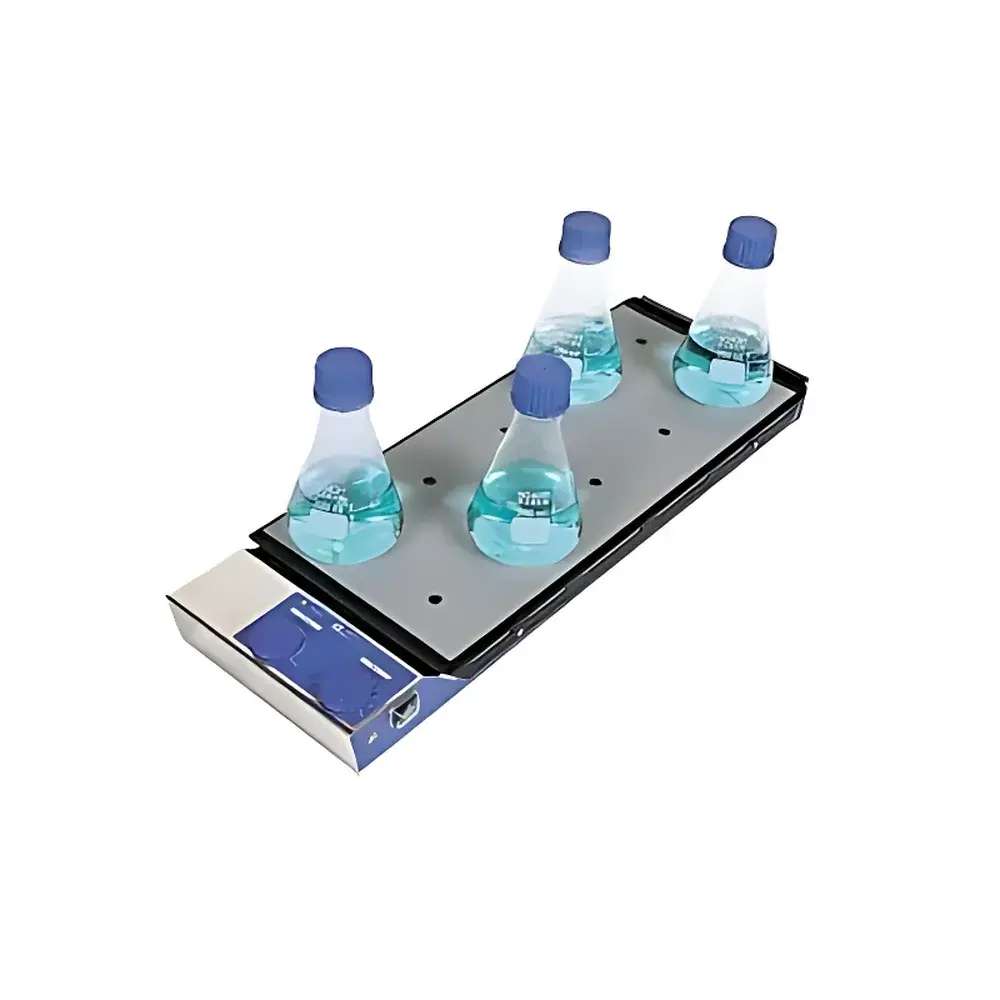
IKA RT10 10-Position Heating Magnetic Stirrer
| Brand | IKA |
|---|---|
| Origin | Germany |
| Model | RT10 |
| Instrument Type | Magnetic Stirrer |
| Max. Total Stirring Volume | 4 L (H₂O) |
| Speed Range | 0–1100 rpm |
| Temperature Control Range | Ambient to 120 °C |
| Heating Power | 375 W |
| Stirring Points | 10 |
| Max. Volume per Position | 0.4 L (H₂O) |
| Point Spacing | 90 mm |
| Speed Deviation per Position | ±5% |
| Stir Bar Max. Length | 30 mm |
| Plate Material | Silicone Rubber Coated |
| Plate Dimensions | 80 × 450 mm |
| Overall Dimensions | 198 × 65 × 552 mm |
| Weight | 4.2 kg |
| IP Rating | IP42 |
| Input Voltage | 230 / 115 / 100 V, 50/60 Hz |
| Ambient Operating Conditions | 5–40 °C, ≤80% RH |
| Temp. Stability | ±2 K |
| Max. Medium Temp. (dependent on vessel) | 70 °C |
Overview
The IKA RT10 is a precision-engineered 10-position heating magnetic stirrer designed for high-throughput laboratory workflows requiring parallel sample processing under identical thermal and mechanical conditions. It operates on the principle of rotating magnetic fields generated by individual coil assemblies beneath each of the ten independent stirring positions, driving standard PTFE- or glass-coated stir bars immersed in vessels. Unlike single-point units, the RT10 integrates synchronized speed control and uniform resistive heating across all positions—enabled by a shared microprocessor-controlled temperature regulation system and balanced power distribution architecture. This ensures minimal inter-position variability in both rotational dynamics and thermal delivery, making it suitable for applications demanding statistical reproducibility across replicates, such as kinetic assay development, dissolution testing, reagent synthesis screening, and standardized QC protocols in pharmaceutical and chemical laboratories.
Key Features
- Simultaneous operation of 10 independent stirring positions with synchronized speed control (0–1100 rpm) and uniform heating performance
- Silicone rubber-coated aluminum heating plate (80 × 450 mm) engineered for spatial temperature homogeneity (±2 K stability at setpoint)
- Dedicated thermal management system limiting maximum medium temperature to 70 °C (vessel-dependent) while allowing plate surface temperatures up to 120 °C
- Low-speed precision mode optimized for viscous or sensitive samples; high-torque motor design maintains consistent agitation even at low rpm
- Robust mechanical construction with IP42-rated enclosure for protection against splashes and solid ingress in routine lab environments
- Integrated safety features including overtemperature cut-off, stall detection, and automatic shutdown upon abnormal current draw
- Universal voltage compatibility (100–230 V, 50/60 Hz) supporting deployment across global laboratory infrastructures without external transformers
Sample Compatibility & Compliance
The RT10 accommodates standard round-bottom flasks, beakers, and vials (up to 0.4 L per position) using stir bars up to 30 mm in length. Its plate geometry and point spacing (90 mm center-to-center) allow use with common borosilicate glassware without interference. The device complies with DIN EN 60529 (IP42), IEC 61010-1 (Safety Requirements for Electrical Equipment for Measurement, Control, and Laboratory Use), and EU Directive 2014/30/EU (EMC Directive). While not inherently GLP/GMP-certified, its consistent performance profile supports documentation-driven workflows aligned with ISO/IEC 17025 and ASTM E2500-21 guidance for equipment qualification in regulated environments.
Software & Data Management
The RT10 operates via analog front-panel controls (rotary dials for speed and temperature, 1–10 scale) and does not include digital connectivity or embedded software. All operational parameters are manually set and monitored in real time. For laboratories requiring audit trails or electronic records, external data loggers compatible with analog voltage outputs (if retrofitted) or standalone thermal/stirring monitors may be deployed. No firmware updates or cloud integration are supported; calibration verification is performed using traceable thermocouples and tachometers per internal SOPs.
Applications
- Parallel dissolution testing of solid dosage forms under USP and Ph. Eur. 2.9.3 conditions
- High-throughput buffer preparation and pH equilibration across multiple reaction vessels
- Controlled heating and mixing during small-scale synthesis optimization studies
- Standardized microbial culture media preparation with uniform thermal history
- QC batch release testing requiring identical agitation profiles across replicate samples
- Environmental sample digestion protocols where consistent heating/mixing minimizes analyte loss or degradation
FAQ
Is the RT10 suitable for use with corrosive solvents?
Yes—provided appropriate chemically resistant stir bars (e.g., PTFE- or ETFE-coated) and solvent-compatible labware are used. The silicone-coated plate surface offers limited resistance to mild organic solvents but should be protected from prolonged exposure to strong acids or halogenated compounds.
Can individual positions be controlled separately?
No—the RT10 provides synchronized control only. All 10 positions operate at the same set speed and temperature simultaneously.
What is the recommended maintenance interval?
Visual inspection and cleaning of the plate surface after each use; annual verification of temperature accuracy and speed consistency using NIST-traceable standards is advised for regulated applications.
Does the unit support external temperature probe feedback?
No—the RT10 uses built-in plate-sensing thermostats only and lacks input ports for external Pt100 or thermocouple probes.
Is the RT10 compliant with FDA 21 CFR Part 11?
No—it has no electronic data capture, user authentication, or audit trail functionality; compliance must be achieved through procedural controls and external documentation systems.



