
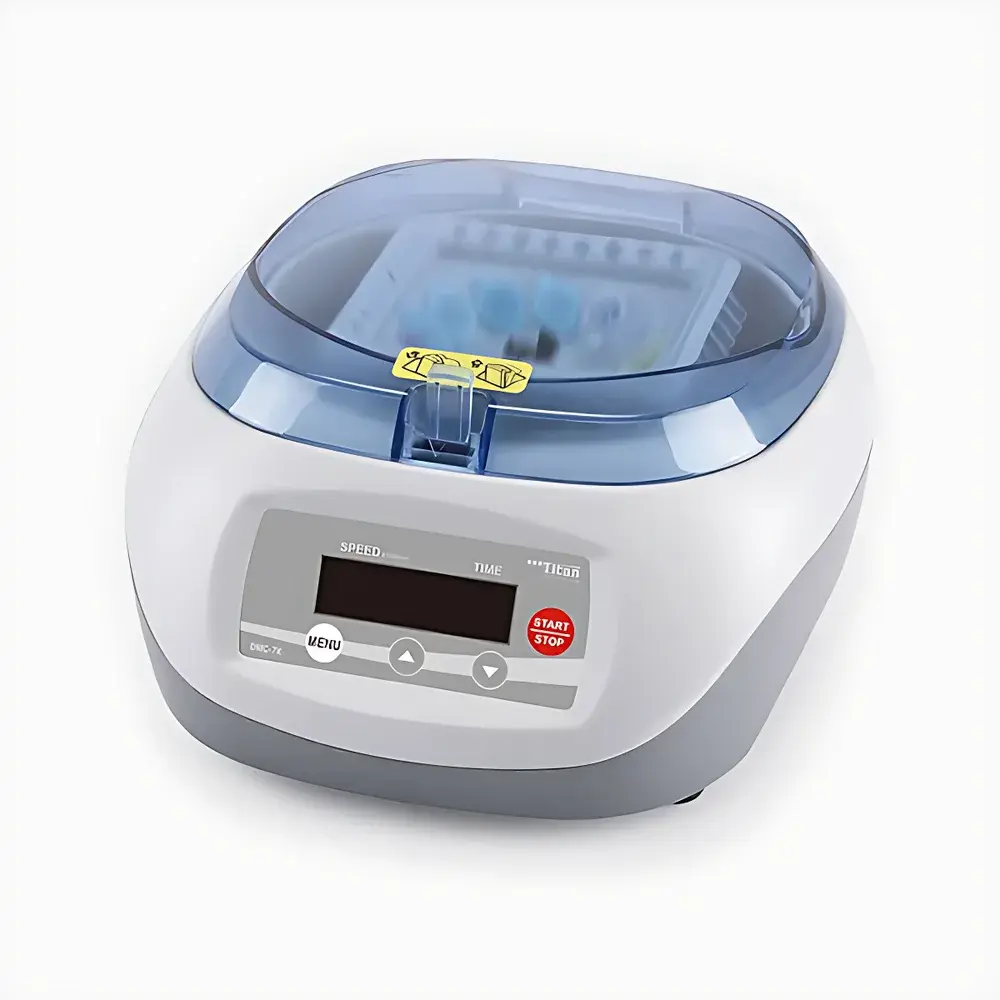
Titan DMC-7K Digital Mini High-Capacity Centrifuge
| Brand | Titan |
|---|---|
| Origin | Shanghai, China |
| Manufacturer Type | Direct Manufacturer |
| Product Category | Domestic |
| Model | DMC-7K |
| Instrument Type | Palm-Sized Centrifuge |
| Speed Range | Low-Speed Centrifuge (up to 7000 rpm) |
| Function | General-Purpose Centrifuge |
| Configuration | Fixed-Angle Rotor |
| Maximum Capacity | 12 × 1.5/2.0 mL Tubes |
| Maximum Speed | 7000 rpm |
| Maximum RCF | 3286 × g |
| Dimensions (L×W×H) | 194 × 229 × 120 mm |
Overview
The Titan DMC-7K Digital Mini High-Capacity Centrifuge is a compact, benchtop-ready low-speed centrifuge engineered for routine sample separation in academic laboratories, clinical diagnostics support settings, and quality control environments. Utilizing fixed-angle rotor geometry and brushless DC motor technology, it delivers stable rotational dynamics at speeds up to 7000 rpm—generating a maximum relative centrifugal force (RCF) of 3286 × g. Its design prioritizes operational safety, thermal stability, and consistent rotor balance across repeated cycles. Unlike high-speed or ultracentrifuge systems, the DMC-7K operates within the low-speed centrifugation range (typically <10,000 rpm), making it ideal for pelleting cells, precipitating macromolecules, clarifying suspensions, and separating phase-separated aqueous/organic mixtures where excessive shear or heat generation must be avoided.
Key Features
- Digital LED display with real-time rpm and time monitoring—enabling precise parameter verification prior to run initiation.
- Brushless DC motor ensuring extended service life, minimal maintenance, and consistent torque delivery across the full speed range (500–7000 rpm in 100-rpm increments).
- Integrated imbalance detection system that automatically halts operation if rotor load asymmetry exceeds safe thresholds—compliant with IEC 61010-2-020 safety requirements for laboratory centrifuges.
- Compact footprint (194 × 229 × 120 mm) optimized for space-constrained workbenches; weighs under 3.2 kg for easy repositioning without compromising structural rigidity.
- Fixed-angle aluminum rotor (included) accommodating twelve 1.5 mL or 2.0 mL microcentrifuge tubes—certified for autoclaving at 121 °C for 20 minutes to support GLP-aligned cleaning protocols.
- No external refrigeration unit required; passive cooling design maintains ambient-temperature operation during standard 10-minute runs, minimizing thermal impact on temperature-sensitive biological samples.
Sample Compatibility & Compliance
The DMC-7K supports standard polypropylene and polycarbonate microcentrifuge tubes (1.5/2.0 mL), including certified PCR-grade and low-binding variants. It is not intended for use with hazardous, volatile, or corrosive solvents outside ISO 8573-1 Class 3 air purity guidelines. The device conforms to CE marking requirements under Directive 2014/30/EU (EMC) and 2014/35/EU (LVD), and its mechanical construction aligns with EN 61010-1:2010 for electrical safety in laboratory equipment. While not classified as a medical device per EU MDR 2017/745, it may be deployed in ISO 15189-accredited clinical labs for pre-analytical specimen preparation when validated per internal SOPs.
Software & Data Management
As a stand-alone analog-digital hybrid instrument, the DMC-7K does not feature embedded software, network connectivity, or data export functionality. All operational parameters are set manually via tactile push-button interface, and runtime is tracked using an integrated mechanical timer (0–99 min, 10-sec resolution). This architecture eliminates cybersecurity risks associated with connected lab instruments and simplifies audit readiness under FDA 21 CFR Part 11—since no electronic records are generated, no electronic signature or audit trail configuration is required. For laboratories requiring traceable run logs, manual entry into LIMS or paper-based logbooks remains the recommended practice.
Applications
- Routine pelleting of mammalian cells (e.g., HEK293, CHO-K1) post-harvest at 3000–5000 rpm for 5–10 min.
- Clarification of bacterial lysates prior to chromatographic purification or SDS-PAGE analysis.
- Separation of serum from whole blood in point-of-care or field-deployable testing workflows.
- Concentration of viral vectors or exosomes in early-stage bioprocess development (when combined with appropriate tube coatings).
- Phase separation in solvent extraction protocols (e.g., phenol-chloroform RNA isolation), where rapid, reproducible settling is required without emulsion formation.
FAQ
Is the DMC-7K suitable for continuous operation?
No—it is rated for intermittent duty cycles only. Maximum recommended run duration is 15 minutes per cycle, followed by a minimum 5-minute cooldown period to prevent motor overheating.
Can I use PCR strip tubes or 0.2 mL tubes in this centrifuge?
No—the rotor is dimensionally optimized for individual 1.5/2.0 mL tubes only. Adapters for smaller formats are not available or validated.
Does the unit include a lid lock mechanism?
Yes—a mechanical interlock prevents lid opening while the rotor is spinning above 300 rpm, meeting EN 61010-2-020 Clause 7.3.2 requirements for rotor containment.
Is rotor balancing mandatory before each run?
Yes. Symmetrical loading of all 12 positions—or use of counterbalancing dummy tubes—is required to maintain RCF accuracy and avoid vibration-induced measurement drift.
What is the expected service lifetime under normal lab use?
With proper cleaning, balanced loading, and adherence to duty-cycle limits, the brushless motor and rotor assembly are rated for ≥10,000 operational hours or 50,000 run cycles, whichever occurs first.
Related Products



