
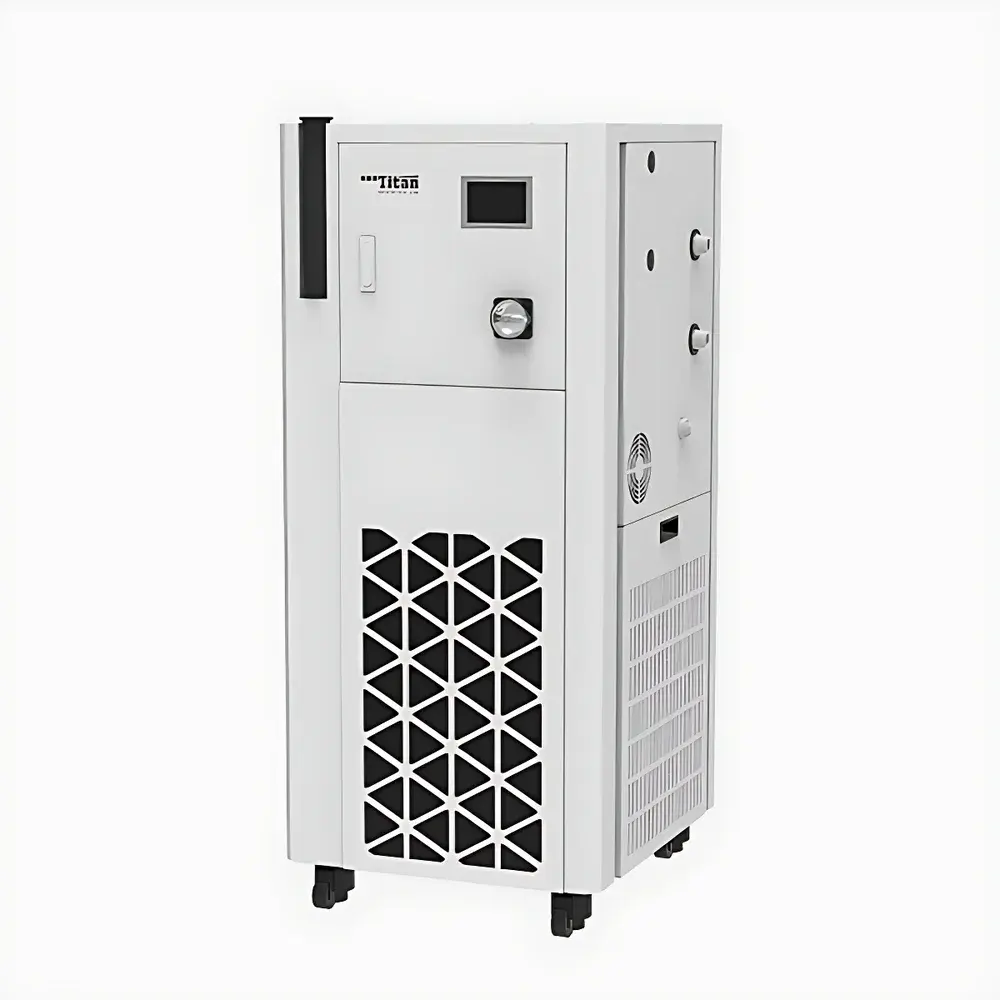
Titan HLD-55S Dynamic High-Low Temperature Circulating Chiller
| Brand | Titan |
|---|---|
| Origin | Shanghai, China |
| Manufacturer Type | Direct Manufacturer |
| Instrument Type | Integrated Circulating Chiller |
| Cooling Method | Air-Cooled |
| Temperature Range | –45 °C to +250 °C |
| Cooling Capacity | 5500 W (Heating Capacity: 6000 W) |
| Temperature Stability | ±0.1 °C |
| Circulation Pump Pressure | 6 bar |
| Circulation Flow Rate | 60 L/min |
| Reservoir Volume | 10 L |
| Operation Mode | Continuous Duty |
Overview
The Titan HLD-55S is an integrated dynamic high-low temperature circulating chiller engineered for precision thermal control in demanding laboratory and pilot-scale applications. Utilizing a dual-mode refrigeration-heating system with independent compressor and electric resistance heating circuits, it delivers seamless, bidirectional temperature regulation across an exceptionally wide operational range—from cryogenic –45 °C to high-temperature +250 °C. Its air-cooled architecture eliminates dependency on external cooling water infrastructure, making it suitable for flexible deployment in QC labs, material testing environments, and R&D facilities where space, utility constraints, or mobility are critical considerations. The unit operates continuously under full load, maintaining thermal stability within ±0.1 °C—achievable through PID-controlled feedback loops, high-resolution platinum RTD sensors (Pt100), and adaptive power modulation of both cooling and heating stages.
Key Features
- Integrated dual-function design: simultaneous refrigeration and heating in a single compact chassis, eliminating need for separate hot/cold units or external heat exchangers.
- Air-cooled condensing system with intelligent fan speed control—reduces ambient noise, improves energy efficiency, and enables operation in standard laboratory HVAC environments without chilled water supply.
- High-flow, high-pressure circulation loop: 60 L/min flow rate at up to 6 bar pressure ensures effective thermal transfer to externally connected reactors, jacketed vessels, calorimeters, or analytical instrumentation requiring robust fluid dynamics.
- 10-liter stainless steel reservoir with level sensor, anti-corrosion coating, and integrated filtration—compatible with water, water-glycol mixtures (up to 50% v/v), and low-viscosity silicone oils (cSt ≤ 50).
- Digital touchscreen interface with real-time graphing, programmable ramp/soak profiles, and event logging—supports up to 10 user-defined temperature programs with multi-step sequences.
- Robust mechanical architecture: reinforced frame, vibration-dampened compressor mount, and IP20-rated electrical enclosure compliant with IEC 61000-6-3 for electromagnetic compatibility.
Sample Compatibility & Compliance
The HLD-55S is designed to interface with a broad spectrum of external equipment including jacketed glass reactors (1–50 L), DSC and TGA sample chambers, rheometer temperature blocks, and laser-based optical benches. Its fluid path materials—316 stainless steel pump head, EPDM seals, and PTFE-lined reservoir—are chemically resistant to common heat transfer fluids and compatible with GLP/GMP workflows. The unit conforms to IEC 61010-1 (Safety Requirements for Electrical Equipment for Measurement, Control, and Laboratory Use) and meets CE marking requirements for EMC and Low Voltage Directive compliance. Optional audit-trail-enabled firmware supports 21 CFR Part 11 readiness when paired with validated networked data acquisition systems.
Software & Data Management
Titan’s proprietary ChillerLink™ software (Windows/macOS compatible) enables remote monitoring, parameter configuration, and real-time data export via USB or Ethernet. Logged parameters—including setpoint, actual bath temperature, pump status, compressor duty cycle, and error codes—are timestamped and stored in CSV format with configurable retention policies. The system supports Modbus TCP integration for SCADA-level interoperability in automated lab environments. All configuration changes and operational events are recorded with user ID and time stamp—facilitating traceability during internal audits or regulatory inspections aligned with ISO/IEC 17025 or ASTM E2500 practices.
Applications
- Controlled-rate thermal cycling of polymer samples prior to DSC or DMA analysis.
- Stabilization of high-power laser diodes and photodetectors requiring sub-0.2 °C thermal drift over extended durations.
- Temperature conditioning of catalyst beds in fixed-bed microreactors operating between –30 °C and +200 °C.
- Calibration of thermocouples, RTDs, and infrared pyrometers across extended temperature spans per ASTM E220 and ISO 17025 calibration protocols.
- Thermal stress testing of electronic assemblies and battery modules under programmable thermal shock profiles.
FAQ
What heat transfer fluids are recommended for operation at –45 °C?
A 40% propylene glycol / 60% deionized water mixture (freezing point ≈ –47 °C) is validated for continuous use. Silicone oil (cSt 10–20) may be used above –20 °C but requires viscosity verification at low temperatures.
Can the HLD-55S maintain ±0.1 °C stability while delivering 60 L/min at 250 °C?
Yes—stability specification applies across the full temperature range under rated flow and load conditions, verified per internal Titan Test Protocol TP-HLD-03 using NIST-traceable reference thermometers.
Is external pressure relief required when connecting to closed-loop reactor jackets?
No—the integrated pressure relief valve (set at 6.5 bar) and expansion tank accommodate thermal expansion; however, ASME-compliant external relief remains mandatory for reactor-side safety per jurisdictional code requirements.
Does the unit support RS-485 or analog 4–20 mA output for PLC integration?
Standard configuration includes Modbus RTU over RS-485; optional 4–20 mA analog outputs (temperature and flow) are available upon request with factory calibration certificate.
What is the mean time between failures (MTBF) for the compressor under continuous operation?
Based on accelerated life testing and field data from 2021–2023 deployments, MTBF exceeds 25,000 hours at 80% nominal load and ambient ≤30 °C—consistent with ISO 13381-1 reliability prediction methodology.



