
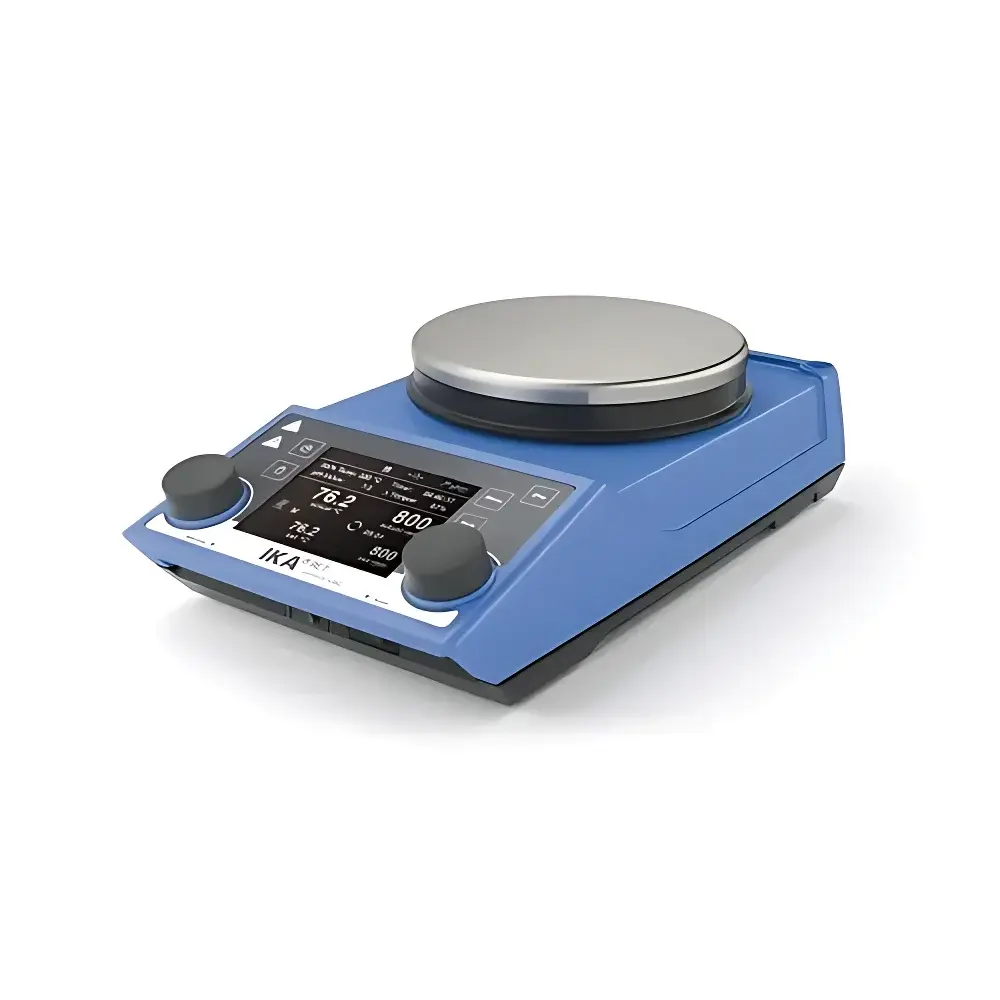
IKA RET control-visc Advanced Heating Magnetic Stirrer with Integrated Precision Weighing and Dual-Mode Temperature Control
| Brand | IKA |
|---|---|
| Origin | Germany |
| Model | RET control-visc |
| Maximum Stirring Volume | 20 L |
| Speed Range | 50–1700 rpm |
| Temperature Control Range | Ambient to 340 °C |
| Integrated Weighing Capacity | 0–5000 g (±1 g <50 g |
| Heating Power | 600 W |
| Plate Material | Stainless Steel 1.4301 (Ø135 mm) |
| Communication Interfaces | RS232, USB |
| Safety Temperature Limit | Adjustable 50–350 °C |
| External Temperature Sensor Support | PT100 |
| IP Rating | IP42 |
| Dimensions | 160 × 97 × 280 mm |
| Weight | 2.8 kg |
Overview
The IKA RET control-visc is an advanced heating magnetic stirrer engineered for precision, safety, and operational autonomy in demanding laboratory environments. Unlike conventional stirrers, it integrates three core functional domains—magnetic agitation, programmable thermal control, and high-resolution mass measurement—within a single compact platform. Its operation relies on a brushless DC motor driving rotation via magnetic coupling, enabling stable torque delivery across the full speed range (50–1700 rpm) while minimizing mechanical wear and electromagnetic interference. Thermal regulation employs a dual-loop architecture: the primary heating circuit controls plate surface temperature up to 340 °C using a stainless steel 1.4301 hotplate, while an optional external PT100 probe enables closed-loop sample temperature feedback with ±0.2 K accuracy. The built-in weighing module—calibrated to ISO/IEC 17025 traceable standards—provides real-time mass monitoring (0–5000 g) with resolution-dependent accuracy (±1 g below 50 g; ±5 g above), supporting gravimetric reaction monitoring, reagent dosing validation, and solvent evaporation studies. Designed for unattended operation, the system complies with DIN EN 60529 (IP42) for dust and drip resistance and incorporates redundant safety mechanisms including adjustable overtemperature cutoff (50–350 °C), stir bar displacement detection, and automatic cooldown hold (display persists until plate ≤50 °C).
Key Features
- Integrated high-precision weighing module (0–5000 g) with BNC interface for concurrent pH electrode integration
- Dual-mode temperature control: rapid-heating mode (7 K/min in 1 L water) and high-stability mode (±0.1 K setpoint deviation)
- TFT display with multilingual UI (English, German, French, Spanish, Chinese) and intuitive parameter navigation
- Intelligent safety architecture: adjustable safety temperature limit, automatic stir bar jump detection, and lockable keypad
- Real-time torque trend visualization and viscosity change profiling via motor current analysis
- Programmable timing functions—including countdown, interval stirring, and multi-step ramp-hold sequences
- RS232 and USB interfaces for remote parameter configuration, data logging, and firmware updates under Windows/Linux environments
- Stainless steel hotplate (DIN 1.4301) with optimized thermal uniformity and chemical resistance
Sample Compatibility & Compliance
The RET control-visc accommodates standard laboratory glassware (e.g., beakers, flasks, jacketed reactors) up to 20 L volume when used with appropriately sized stir bars (max. 80 mm). Its elevated temperature capability supports applications involving high-boiling solvents (e.g., ethylene glycol, silicone oils) and solid-state synthesis precursors. The device meets essential regulatory requirements for GLP-compliant laboratories: audit-trail-capable USB data export, user-accessible calibration logs, and deterministic response to safety events (e.g., error code E02 for sensor disconnection, E07 for overheating). It adheres to IEC 61010-1 for electrical safety and carries CE marking per EU Directive 2014/30/EU (EMC) and 2014/35/EU (LVD). While not FDA 21 CFR Part 11–certified out-of-the-box, its timestamped parameter logs and immutable error records support validation protocols under GMP Annex 11 when deployed with controlled documentation practices.
Software & Data Management
Data acquisition and instrument control are supported via IKA’s proprietary labworldsoft® software (v5.0+), compatible with Windows 10/11 and Linux LTS kernels. The software enables synchronized recording of speed, plate temperature, sample temperature (with PT100), torque-derived viscosity trends, and real-time mass values at user-defined intervals (100 ms–60 s resolution). All datasets are exported in CSV or Excel-compatible formats with embedded metadata (instrument ID, operator tag, timestamp, calibration status). USB firmware updates preserve configuration integrity through signed binary verification. RS232 communication supports SCPI-like command syntax for integration into custom LabVIEW or Python-based automation frameworks. Audit trails include operator login timestamps, parameter modification history, and safety event logs—all stored locally on the instrument’s non-volatile memory.
Applications
- Kinetic studies requiring simultaneous temperature ramping, mass loss tracking, and viscosity evolution (e.g., polymerization, sol-gel transitions)
- Gravimetric titration setup where reagent addition is triggered by real-time mass thresholds
- Thermal stability testing of catalysts or APIs under inert atmosphere (when used with sealed vessels and gas inlets)
- QC/QA workflows validating dissolution rates per USP , where temperature consistency and agitation uniformity are critical
- Materials science labs performing controlled solvent evaporation for thin-film deposition or nanoparticle synthesis
- Teaching laboratories leveraging the TFT interface and multilingual prompts to standardize undergraduate experimental protocols
FAQ
Does the integrated weighing function require periodic recalibration?
Yes—annual recalibration against NIST-traceable weights is recommended. The unit supports internal calibration using supplied test masses (not included) and stores calibration coefficients with date/time stamps.
Can the PT100 probe control both sample and bath temperature simultaneously?
No—the system supports one active external sensor at a time. However, the dual-head probe option allows physical separation of sensing points; software interprets input as either sample or medium temperature based on user assignment.
Is the USB interface compatible with macOS?
Direct instrument control is limited to Windows and Linux via labworldsoft®. macOS users may access logged CSV files but cannot perform real-time control without third-party serial-to-USB drivers and custom scripting.
What happens during power interruption?
All active parameters reset to factory defaults upon restart. No volatile settings are retained; however, calibration data and error logs persist in EEPROM.
How is torque-derived viscosity calculated?
Viscosity trends are estimated from motor current draw under constant speed, normalized against baseline calibration curves obtained with reference fluids (e.g., ISO VG 32, 100, 220 oils). Absolute viscosity requires separate rheometric validation.



