
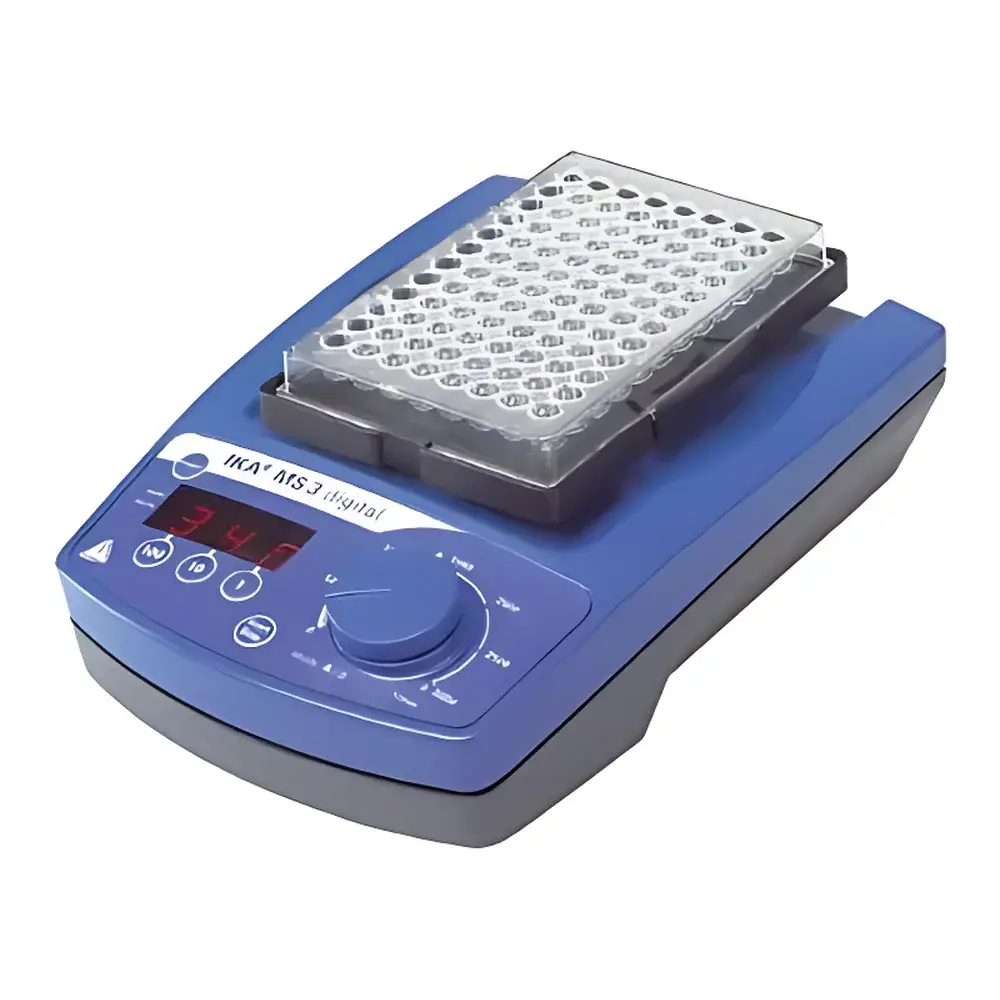
IKA MS3 Digital Orbital Shaker
| Brand | IKA |
|---|---|
| Origin | Germany |
| Model | MS3 Digital |
| Oscillation Frequency | 0–3000 rpm |
| Orbit Diameter | 4.5 mm |
| Temperature Range | 5–40 °C |
| Platform Quantity | 1 |
| Max Load Capacity (incl. fixture) | 0.5 kg |
| Input Power | 20 W |
| Dimensions (W×D×H) | 148 × 63 × 205 mm |
| Weight | 2.9 kg |
| Protection Rating | IP21 |
| Operating Humidity | ≤80 % RH |
| Voltage | 100–240 V, 50/60 Hz |
| Timer Range | 1/60–999 min |
| Display | LED |
| Operating Modes | Continuous, Timed, and Pulse (Touch-Start) |
| Compatibility | Microplates (e.g., 96-well), small vials, test tubes |
| Housing Material | Die-cast zinc alloy |
Overview
The IKA MS3 Digital Orbital Shaker is a compact, benchtop orbital shaker engineered for precision mixing in life science laboratories where space efficiency, reproducibility, and operational flexibility are critical. It operates on the principle of controlled circular motion—generating a consistent 4.5 mm orbit diameter—to induce homogeneous suspension, resuspension, or gentle agitation of biological samples. Designed for applications requiring low-to-moderate shear stress—including cell culture maintenance, ELISA plate incubation, antibody labeling, and reagent homogenization—the MS3 delivers stable rotational performance across its full speed range (200–3000 rpm), with fine incremental control and real-time digital feedback via an integrated LED display. Its die-cast zinc alloy housing ensures mechanical rigidity and long-term thermal stability, while the fully sealed drive mechanism minimizes vibration transmission to adjacent instrumentation—critical in shared lab environments.
Key Features
- Digital LED interface with intuitive rotary knob for precise speed and timer adjustment
- Three operational modes: continuous run, programmable timed operation (1 second to 999 minutes), and pulse (touch-start) mode for rapid, transient agitation
- Intelligent pad detection system (Mode A): automatically recognizes standard IKA microplate adapters to enable full-speed operation (up to 3000 rpm); non-standard fixtures limit speed to 1300 rpm for safety compliance
- Mode B bypasses pad detection, permitting unrestricted 3000 rpm operation with any compatible platform—ideal for custom fixtures or specialized vessels
- Robust 8 W output brushless motor delivering high torque at low speeds and exceptional speed stability (< ±2% deviation across load range)
- IP21-rated enclosure suitable for standard laboratory environments (5–40 °C ambient, ≤80% RH)
- Zero external cooling requirements; 100% duty cycle capability supports unattended overnight protocols
Sample Compatibility & Compliance
The MS3 accommodates a wide range of sample formats via interchangeable platforms—including standard 96-well microplates (flat-bottom and U/V-shaped), PCR strips, 1.5–2.0 mL microcentrifuge tubes, and small glass vials (up to Ø16 mm). Its 0.5 kg maximum load capacity (including fixture mass) ensures safe, balanced operation under all specified conditions. The device conforms to DIN EN 60529 (IP21 ingress protection), IEC 61000-6-3 (EMC emission limits), and IEC 61000-6-2 (immunity standards). While not intrinsically temperature-controlled, it is routinely deployed within certified cold rooms (5 °C) and incubator cabinets (up to 40 °C), maintaining functional integrity per ISO/IEC 17025 environmental monitoring guidelines. No regulatory certification (e.g., FDA 21 CFR Part 11) applies to standalone shakers; however, its deterministic timer logic and non-volatile speed memory support GLP-compliant record-keeping when integrated into validated workflows.
Software & Data Management
The MS3 operates as a stand-alone instrument without embedded firmware-based data logging or network connectivity. All parameter settings—including speed setpoint, timer duration, and active mode—are retained in non-volatile memory following power cycling. The LED display provides real-time readouts of current rpm and remaining time, eliminating ambiguity during protocol execution. For traceability in regulated environments, users may document operational parameters manually or integrate the shaker into broader LIMS or ELN systems via external timers or process logs. Though RS232 and analog output interfaces are absent, the device’s mechanical reliability and repeatable performance characteristics make it suitable for inclusion in IQ/OQ validation packages under GMP-aligned quality systems.
Applications
- ELISA and immunoassay plate agitation during incubation and wash steps
- Suspension of adherent mammalian cells prior to passaging or harvesting
- Homogenization of bacterial cultures in liquid media for OD600 measurement
- Antibody conjugation and antigen-antibody binding kinetics studies
- Pre-analytical sample preparation for HPLC, mass spectrometry, or NGS library construction
- Buffer equilibration and reagent reconstitution in molecular biology workflows
- Quality control testing of diagnostic kits requiring standardized mixing profiles
FAQ
Does the MS3 support temperature-controlled operation?
No—the MS3 is a non-thermostatic shaker. It must be placed inside externally regulated environments (e.g., refrigerated chambers or incubators) if temperature-sensitive protocols are required.
Can the MS3 accommodate deep-well plates or 384-well formats?
It is optimized for standard 96-well plates and small-volume tubes. Deep-well or 384-well plates require verified third-party adapters and load verification to remain within the 0.5 kg mass limit and maintain balance.
Is the pulse (touch-start) function programmable?
No—the pulse mode is manual only: pressing the start button initiates one 1-second agitation cycle at the currently selected speed.
What maintenance is required for long-term reliability?
No routine lubrication or calibration is needed. Wipe the platform and housing with 70% ethanol between uses; inspect the rubber isolation feet periodically for compression fatigue.
How does the pad detection system affect method transfer between labs?
When using Mode A with certified IKA pads, speed limits are enforced consistently across instruments—supporting inter-laboratory reproducibility. Mode B offers full flexibility but requires explicit documentation of fixture type in SOPs.




