
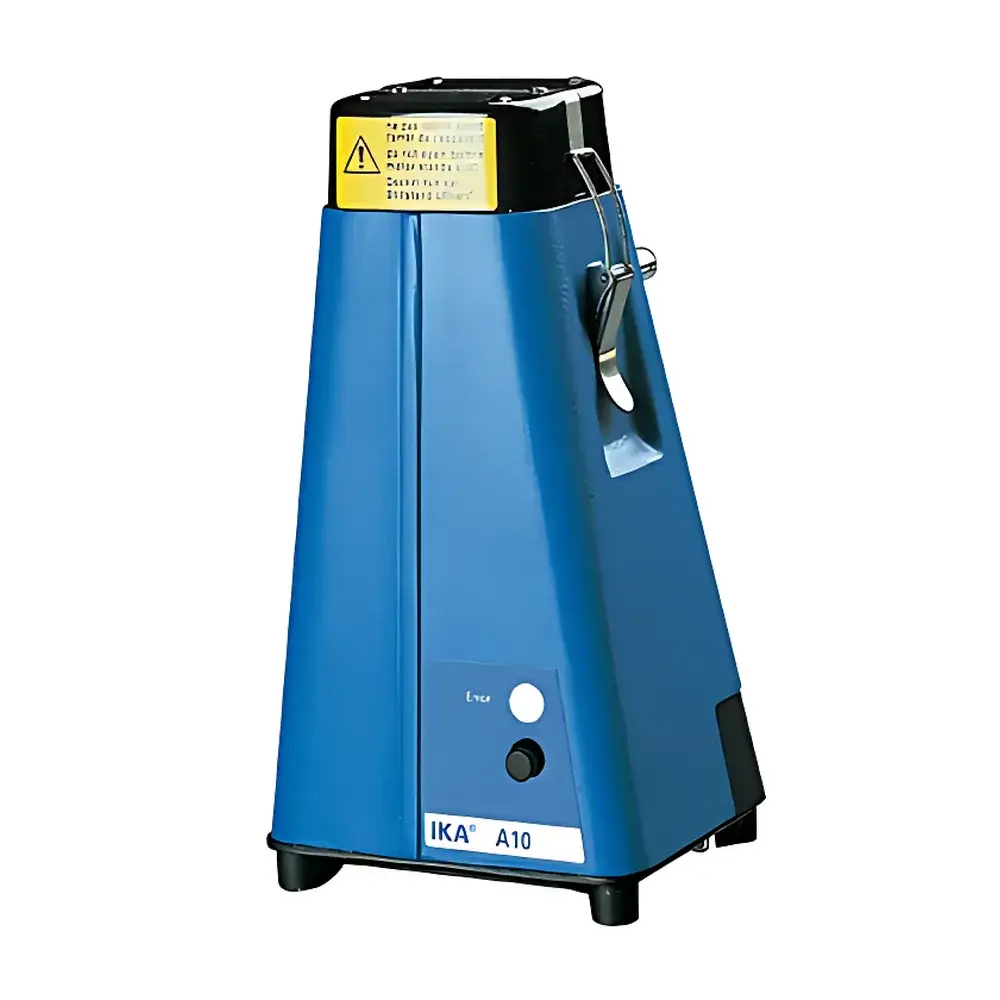
IKA A10 Analytical Grinder
| Origin | Germany |
|---|---|
| Manufacturer Type | Authorized Distributor |
| Origin Category | Imported |
| Model | A10 |
| Motor Input Power | 180 W |
| Motor Output Power | 80 W |
| Max. Speed | 20,000 rpm |
| Max. Tip Speed | 57 m/s |
| Max. Sample Volume | 50 mL |
| Max. Feed Hardness | 5 Mohs |
| Max. Feed Size | 6 mm |
| Rotor/Cutting Tool Material | Stainless Steel 1.4034 |
| Grinding Chamber Material | Stainless Steel 1.4301 |
| Duty Cycle | 5 min ON / 10 min OFF |
| Chamber Cooling | Water-cooled (yes) |
| Dry Ice Cooling Support | Yes |
| Liquid Nitrogen Cooling Support | No |
| Dimensions (W × H × D) | 120 × 225 × 105 mm |
| Weight | 2.2 kg |
| Ambient Temperature Range | 5–40 °C |
| Relative Humidity Limit | 80 % |
| Protection Class | IP21 |
| Voltage | 220–240 V |
| Frequency | 50/60 Hz |
Overview
The IKA A10 Analytical Grinder is a compact, high-speed batch grinder engineered for reproducible, controlled size reduction of heterogeneous solid samples in research, quality control, and routine laboratory environments. It operates on a dual mechanical principle—combining high-velocity impact and shear forces generated by a rotating rotor against fixed cutting edges within a precision-machined stainless-steel grinding chamber. Designed for dry grinding applications, the A10 delivers consistent particle size distribution across brittle, semi-ductile, and fibrous materials—including pharmaceutical tablets, plant tissues, polymers, ceramics, and food matrices—without requiring cryogenic assistance in most standard use cases. Its modular architecture supports rapid tooling changes and accommodates strict hygiene and cross-contamination prevention protocols common in GLP-compliant labs.
Key Features
- Three interchangeable cutting tools (standard, fine, and coarse) optimized for distinct material classes and target particle size ranges
- Integrated water-jacketed grinding chamber enabling active temperature management during extended operation
- Optional dry ice cooling capability to suppress thermal degradation of thermolabile compounds (e.g., enzymes, volatile organics)
- Electronically monitored overload protection system that automatically halts operation upon excessive load or motor strain
- Quick-release chamber design with tool-free disassembly—facilitating full visual inspection, manual cleaning, and residue verification per ISO 17025 and FDA guidance
- Robust housing constructed from corrosion-resistant stainless steel (1.4301) and hardened rotor components (1.4034), ensuring long-term dimensional stability and resistance to abrasive wear
- Compact footprint (120 × 225 × 105 mm) and low mass (2.2 kg) suitable for benchtop deployment in space-constrained analytical laboratories
Sample Compatibility & Compliance
The A10 accepts feed particles up to 6 mm in diameter and handles materials with hardness up to 5 Mohs—covering graphite, limestone, chalk, dried herbs, starches, and many polymer granules. It is not intended for metals, alloys, or minerals exceeding this hardness threshold. All wetted surfaces comply with EU Directive 2002/72/EC for food-contact materials and meet requirements for extractables testing under USP . The device conforms to DIN EN 60529 (IP21 ingress protection), EN 61000-6-3 (EMC emission limits), and EN 61000-6-2 (immunity standards). While it lacks RS-232 or analog outputs, its mechanical reliability and traceable operational parameters support integration into validated workflows under ISO/IEC 17025 and GMP Annex 11 frameworks where manual data recording is permitted.
Software & Data Management
The IKA A10 operates as a standalone electromechanical instrument without embedded firmware, touchscreen interface, or digital connectivity. Operational parameters—including runtime, speed, and duty cycle—are manually controlled via front-panel switches. This design minimizes software validation burden and aligns with laboratories maintaining legacy instrumentation policies or those prioritizing deterministic, non-programmable hardware for critical sample preparation steps. Batch records may be maintained externally using LIMS-integrated templates compliant with 21 CFR Part 11 when paired with electronic lab notebooks (ELNs) that capture operator ID, timestamp, sample ID, and post-grinding sieve analysis results.
Applications
- Preparation of homogenized powders for X-ray diffraction (XRD) and scanning electron microscopy (SEM) sample mounting
- Routine comminution of pharmaceutical dosage forms prior to content uniformity or dissolution testing (per USP & Ph. Eur. guidelines)
- Reduction of botanical samples for phytochemical extraction and HPLC analysis
- Fragmentation of composite materials for elemental analysis by ICP-OES or XRF
- Standardization of reference material particle size distributions in metrology labs accredited to ISO/IEC 17025
- Supporting ASTM D5630 (plastic ash content) and ASTM D792 (density of plastics) sample prep protocols
FAQ
Can the IKA A10 be used for cryogenic grinding with liquid nitrogen?
No—the grinding chamber is not rated for direct liquid nitrogen immersion or pressurized cryogenic gas flow. Dry ice cooling is supported via external placement around the chamber jacket.
Is the A10 suitable for grinding heat-sensitive biological samples?
Yes, provided dry ice cooling is applied and processing time remains within the 5-minute duty limit; users should validate thermal stability of target analytes via post-grind assay correlation.
Does the A10 comply with Good Manufacturing Practice (GMP) requirements?
It meets core mechanical and material safety criteria referenced in EU GMP Annex 15 and FDA Process Validation Guidance; however, formal qualification (IQ/OQ/PQ) must be performed by the end user per site-specific SOPs.
What maintenance intervals are recommended for routine operation?
Inspect rotor balance and chamber sealing every 50 operating hours; replace cutting tools after 200–300 batches depending on material abrasiveness, as verified by particle size distribution trending.
Can the A10 be integrated into automated sample preparation lines?
Not natively—it lacks programmable logic controller (PLC) interfaces or industrial communication protocols (e.g., Modbus, EtherNet/IP); integration requires external robotic handling and manual loading/unloading cycles.



