
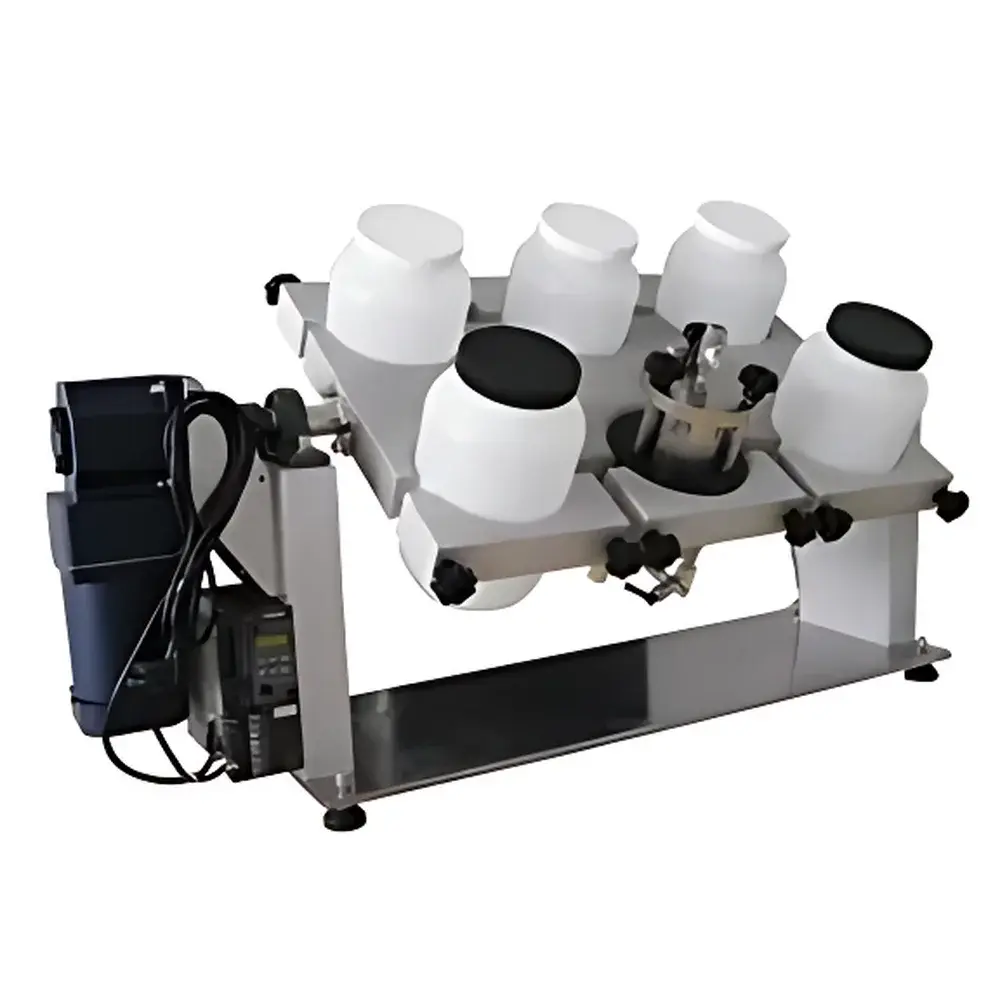
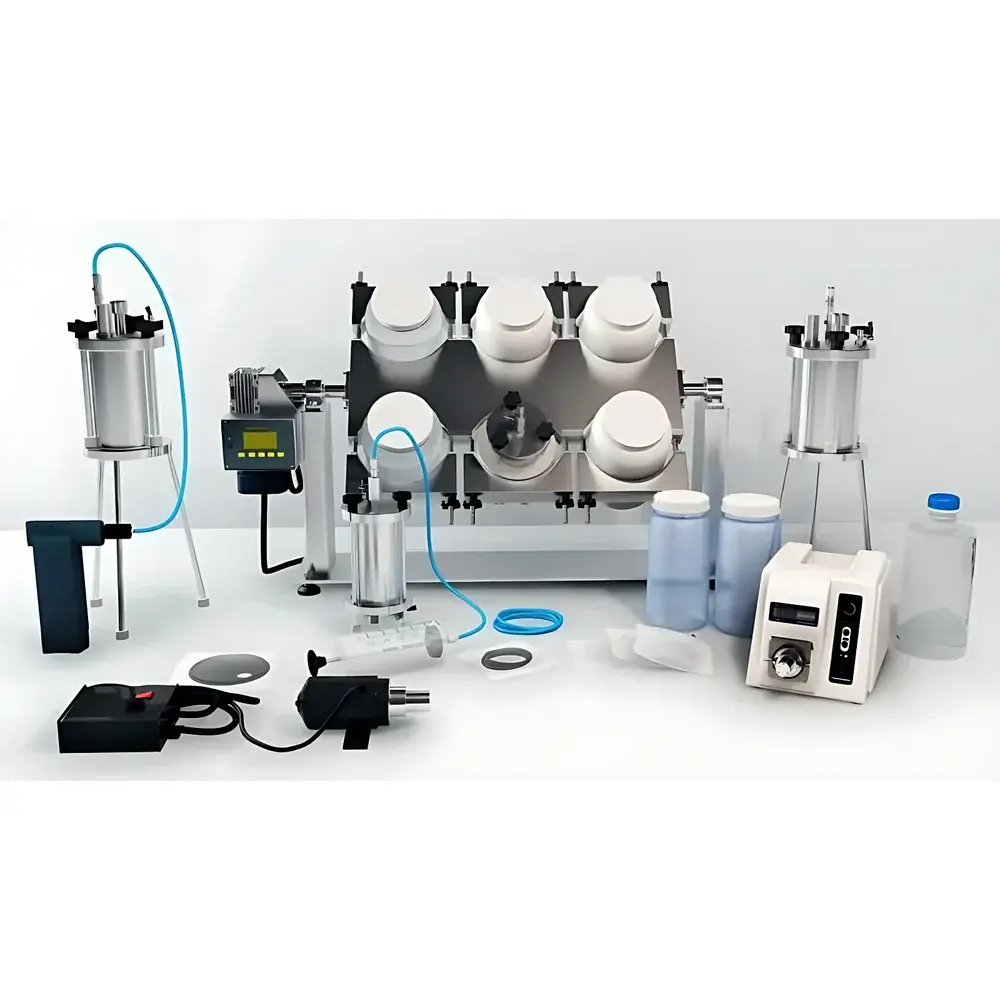
ENV-12 Tumbling Leaching Apparatus for Solid Waste Toxicity Testing
| Brand | Environ Lab |
|---|---|
| Origin | USA |
| Model | ENV-12 |
| Capacity | 12 sample vessels |
| Rotation Speed | 30 ± 2 rpm |
| Tumbling Angle | 30° ± 2° |
| Timer Range | 0.1–999.9 h |
| Vessel Volume | 1 L (standard HDPE or stainless-steel options) |
| Compliance | ASTM D3987, EPA Method 1311 (TCLP), EPA Method 1312 (SPLP), ISO 14669 |
Overview
The ENV-12 Tumbling Leaching Apparatus is an engineered laboratory system designed to simulate the physicochemical leaching behavior of hazardous constituents from solid waste matrices under controlled, standardized conditions. It operates on the tumbling oscillation principle—where sample-containing vessels rotate end-over-end along a fixed horizontal axis at a precise angle and speed—to replicate the dynamic contact between solid waste and infiltrating aqueous phases in landfills or surface environments. This methodology ensures uniform agitation, consistent solid–liquid interaction, and minimal particle segregation—critical factors for reproducible extraction of metals, organic compounds, and semi-volatile contaminants. As a core instrument in regulatory toxicity characteristic leaching procedure (TCLP) and synthetic precipitation leaching procedure (SPLP) testing, the ENV-12 delivers metrologically traceable results aligned with U.S. EPA, ASTM, and ISO frameworks for hazardous waste classification and environmental risk assessment.
Key Features
- Robust dual-axis drive mechanism ensuring stable, low-vibration tumbling motion across extended operation cycles (up to 999.9 hours)
- Precision-machined stainless-steel frame with corrosion-resistant coating for long-term durability in acidic and saline leaching environments
- Programmable digital timer with 0.1-hour resolution and automatic shut-off function for unattended operation
- Adjustable tumbling angle (30° ± 2°) and rotational speed (30 ± 2 rpm) to meet method-specific requirements per EPA 1311, EPA 1312, and ASTM D3987
- Modular vessel holder accommodating twelve 1-L leaching vessels—compatible with standard HDPE, borosilicate glass, or passivated stainless-steel containers per analyte compatibility guidelines
- Integrated safety interlock system that halts rotation if access door is opened during operation
- CE-marked electrical architecture compliant with IEC 61000-6-3 (EMC) and IEC 61000-6-2 (immunity) standards
Sample Compatibility & Compliance
The ENV-12 supports leaching of heterogeneous solid matrices including municipal solid waste ash, contaminated soils, mining tailings, incinerator residues, and industrial sludges. Sample preparation follows strict protocols: particles are sieved to ≤9.5 mm (per TCLP), homogenized, and equilibrated to moisture content prior to leaching. The apparatus accommodates both acidic (pH 4.93 ± 0.05 acetic acid buffer for TCLP) and neutral/synthetic precipitation (pH 5.6 ± 0.2 for SPLP) leachants. All operational parameters—including rotation profile, temperature stability (ambient ± 2°C), and vessel sealing integrity—are documented to satisfy GLP audit requirements and support 21 CFR Part 11–compliant data traceability when paired with validated LIMS integration.
Software & Data Management
While the ENV-12 operates as a stand-alone electromechanical platform, its timing and cycle parameters are fully recordable via external lab notebooks or integrated electronic logbooks. For laboratories implementing full digital workflows, the device’s timer output signal (TTL-compatible) can be interfaced with LIMS or ELN systems to auto-log start/stop timestamps, operator ID, and batch identifiers. Firmware revision history, calibration logs, and preventive maintenance records are maintained per ISO/IEC 17025 clause 7.7 and ASTM E2655 guidance on equipment qualification. No proprietary software is required; however, validation documentation packages—including IQ/OQ templates aligned with FDA and EU Annex 11 expectations—are available upon request.
Applications
- Determination of leachable concentrations of regulated metals (e.g., Pb, Cd, Cr, Hg, As) and volatile organics (e.g., benzene, chloroform, tetrachloroethylene) for RCRA hazardous waste listing
- Performance evaluation of stabilization/solidification (S/S) treatments by comparing pre- and post-treatment leachate profiles
- Site-specific risk assessment for landfill liner design and leachate collection system modeling
- Regulatory compliance testing for waste acceptance criteria (WAC) under EU Landfill Directive 1999/31/EC
- Research into pH-dependent speciation and redox-controlled mobilization of trace elements in geochemical systems
FAQ
What leaching methods does the ENV-12 support?
The apparatus is validated for EPA Method 1311 (TCLP), EPA Method 1312 (SPLP), ASTM D3987, and ISO 14669. Custom rotation profiles may be configured for research-grade leaching studies.
Is vessel material selection critical for analyte recovery?
Yes. HDPE is recommended for metal analysis to minimize adsorption; glass or stainless steel is preferred for organic analytes to prevent plasticizer interference.
Does the ENV-12 require routine calibration?
Rotation speed and timer accuracy must be verified annually using NIST-traceable tachometers and time standards per ISO/IEC 17025 Section 6.5.
Can it be used for sequential or multi-stage leaching experiments?
Yes—vessels may be manually exchanged between stages, and the timer supports discrete interval programming for multi-phase extractions.
What maintenance is required to ensure long-term performance?
Biannual inspection of drive belts, bearing lubrication, and electrical connections is recommended; full service intervals are specified in the OEM technical manual (Rev. 4.2, 2023).
Related Products







