
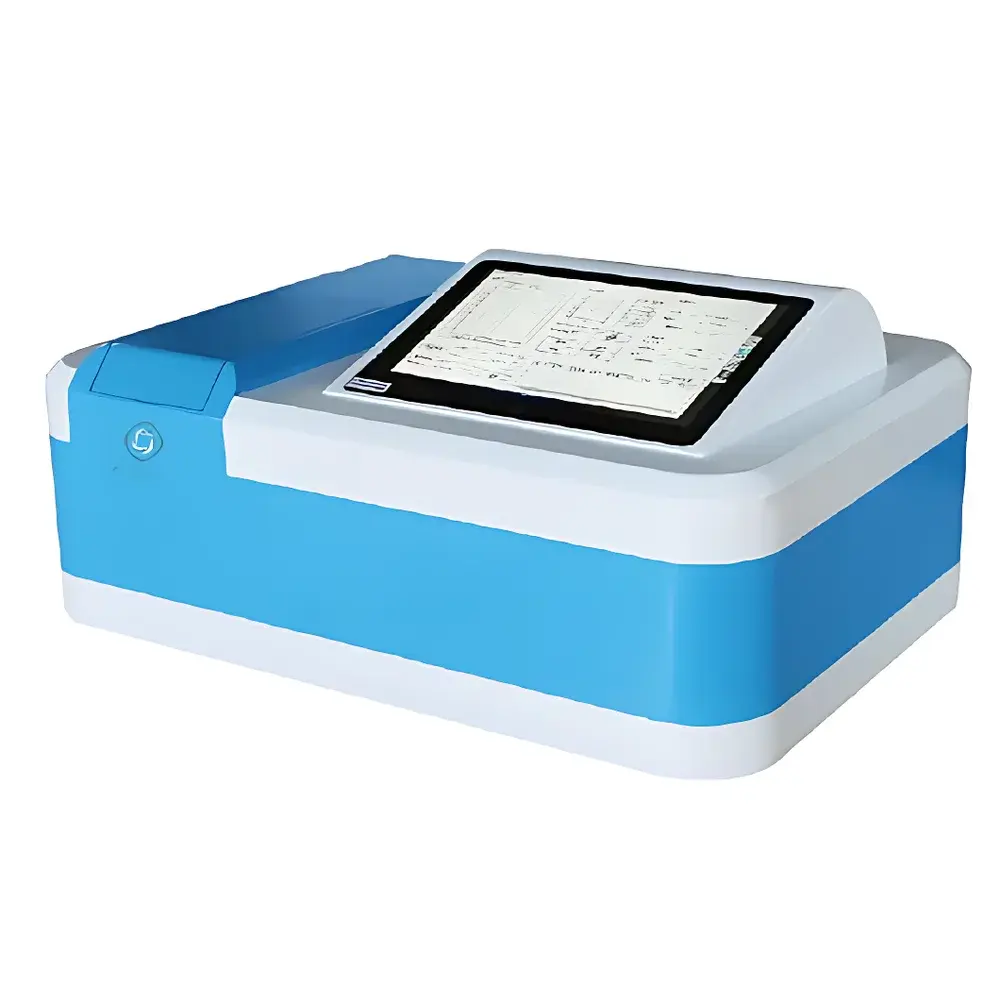
Sipo Environment OIL-IR-2100 Infrared Spectrophotometric Oil Content Analyzer
| Brand | Sipo Environment |
|---|---|
| Origin | Tianjin, China |
| Model | OIL-IR-2100 |
| Instrument Type | Laboratory Benchtop Analyzer |
| Principle | Infrared Absorption Spectrophotometry (Triple-Wavelength Method) |
| Measurement Range | 0–800 mg/L |
| Detection Limit | 0.02 mg/L |
| Accuracy | <1% RSD |
| Spectral Resolution | 1 cm⁻¹ |
| Scan Speed | Full-spectrum scan in 30 s |
| Operating System | Embedded Windows 10 (10.0-inch touchscreen tablet) |
| Connectivity | Bluetooth 4.2, USB 3.0, RS-232/RS-485 |
| Optical Source | Electrically Modulated IR Source (Lifespan ≥5000 h) |
| Housing Material | ABS with EMI shielding, impact-resistant and corrosion-resistant finish |
| Baseline Stability | Real-time zero-point auto-adjustment (dual-signal acquisition: light-on & light-off) |
Overview
The Sipo Environment OIL-IR-2100 is a laboratory-grade infrared spectrophotometric oil content analyzer engineered for precise, interference-resistant quantification of total petroleum hydrocarbons (TPH) and mineral oil in aqueous matrices, including surface water, wastewater, leachate, and solvent extracts. It operates on the fundamental principle of infrared absorption spectroscopy—specifically, the triple-wavelength absorbance differential method at characteristic C–H stretching vibration bands near 2960 cm⁻¹ (CH₃), 2930 cm⁻¹ (CH₂), and 2870 cm⁻¹ (CH₃ symmetric)—enabling direct concentration calculation without mandatory reliance on calibration curves. This approach conforms to internationally recognized methodologies aligned with ASTM D7066-20 (Standard Test Method for Determination of Oil and Grease and Selected Petroleum Hydrocarbons in Water by Infrared Spectrophotometry) and ISO 9377-2:2000 (Water quality — Determination of hydrocarbon oil index — Part 2: Infrared spectrometric method). The instrument integrates a thermoelectrically stabilized, electrically modulated mid-infrared source to suppress thermal drift and ensure long-term photometric stability—critical for regulatory compliance in environmental testing laboratories operating under GLP or ISO/IEC 17025 frameworks.
Key Features
- Triple-wavelength quantitative algorithm: Simultaneous acquisition and real-time computation of absorbance at three discrete IR bands, eliminating baseline dependency and minimizing matrix interference from alcohols, ketones, or organic solvents.
- Dual-mode operation: Full-spectrum scanning (30 s per scan, 1 cm⁻¹ resolution) for spectral diagnostics and method validation; rapid non-dispersive mode (2 s per measurement) for high-throughput routine analysis.
- Embedded dual-OS software platform: Pre-installed Windows 10 tablet (10.0-inch capacitive touchscreen) supports both CCl₄-based and C₂Cl₄-based extraction protocols per US EPA Method 1664A and Chinese HJ 637-2018, with automatic unit conversion for edible oil fume (mg/m³) and soil oil content (mg/kg).
- Advanced optical stabilization: Real-time baseline correction via synchronized light-on/light-off signal acquisition; eliminates zero drift caused by ambient temperature fluctuation or detector aging.
- Robust mechanical architecture: Injection-molded ABS housing with integrated EMI shielding, chemical-resistant surface treatment, and shock-absorbing structural design—suitable for shared lab environments with variable electromagnetic loads.
- Modular connectivity: Native support for Bluetooth 4.2 (for wireless peripheral pairing), USB 3.0 (high-speed data export), and industrial RS-232/RS-485 interfaces (for SCADA integration or LIMS synchronization).
Sample Compatibility & Compliance
The OIL-IR-2100 accepts liquid samples extracted using standardized solvents—including tetrachloroethylene (per EPA 1664B), carbon tetrachloride (per older ISO protocols), or alternative halogenated solvents validated per laboratory SOPs. It accommodates standard 4-cm pathlength quartz or KBr cells and supports solvent purity verification via transmittance monitoring at 3030 cm⁻¹ (aromatic C–H band) to flag contamination. Instrument performance meets the repeatability and detection limit requirements of HJ 637-2018 (China’s national standard for petroleum hydrocarbons in water), and its optical design facilitates audit-ready traceability under ISO/IEC 17025:2017 Clause 6.4.1 (Equipment Verification) and FDA 21 CFR Part 11-compliant data integrity when paired with validated third-party LIMS software.
Software & Data Management
The embedded analytical suite provides full spectral visualization (absorbance vs. wavenumber), automated peak identification, statistical reporting (mean, SD, CV%), and secure data archiving with time-stamped metadata. All measurement sessions generate immutable .CSV and .SPC files compliant with ASTM E1382-95 (Standard Guide for Computerized Spectral Data Exchange). Audit trails record user logins, parameter changes, calibration events, and result exports—enabling retrospective review for regulatory inspections. Remote control via external PC is supported through a dedicated SDK (Software Development Kit), allowing integration into centralized QA/QC dashboards or automated report generation pipelines.
Applications
- Regulatory wastewater discharge monitoring (TPH compliance per local environmental protection bureaus)
- Groundwater remediation site assessment and plume tracking
- Industrial effluent characterization in petrochemical, metalworking, and food processing facilities
- Soil leachate and sediment pore water analysis in ecological risk assessments
- Validation of oil-water separation efficiency in treatment plants
- Research-grade hydrocarbon speciation studies requiring spectral fidelity and reproducible baseline subtraction
FAQ
Does the OIL-IR-2100 require daily recalibration?
No—its electrically modulated source and real-time baseline correction enable stable operation over multi-day runs; however, quarterly verification with certified reference standards (e.g., NIST-traceable mineral oil in CCl₄) is recommended per ISO/IEC 17025.
Can it quantify polycyclic aromatic hydrocarbons (PAHs) separately?
No—it measures total extractable petroleum hydrocarbons (EPH) as a class; PAH-specific quantification requires GC-MS or HPLC-UV analysis.
Is the instrument compatible with LIMS systems?
Yes—via RS-232/RS-485 serial output or USB-hosted CSV export; optional OPC UA gateway available for enterprise-level integration.
What maintenance is required beyond lamp replacement?
Annual optical alignment verification and cell cleaning with spectroscopic-grade solvent; no moving parts or consumable optics are present.
Does it support method validation documentation per GLP guidelines?
Yes—the software logs all critical parameters, operator IDs, timestamps, and raw spectra, fulfilling ALCOA+ (Attributable, Legible, Contemporaneous, Original, Accurate, Complete, Consistent, Enduring, Available) data integrity principles.
Related Products







