
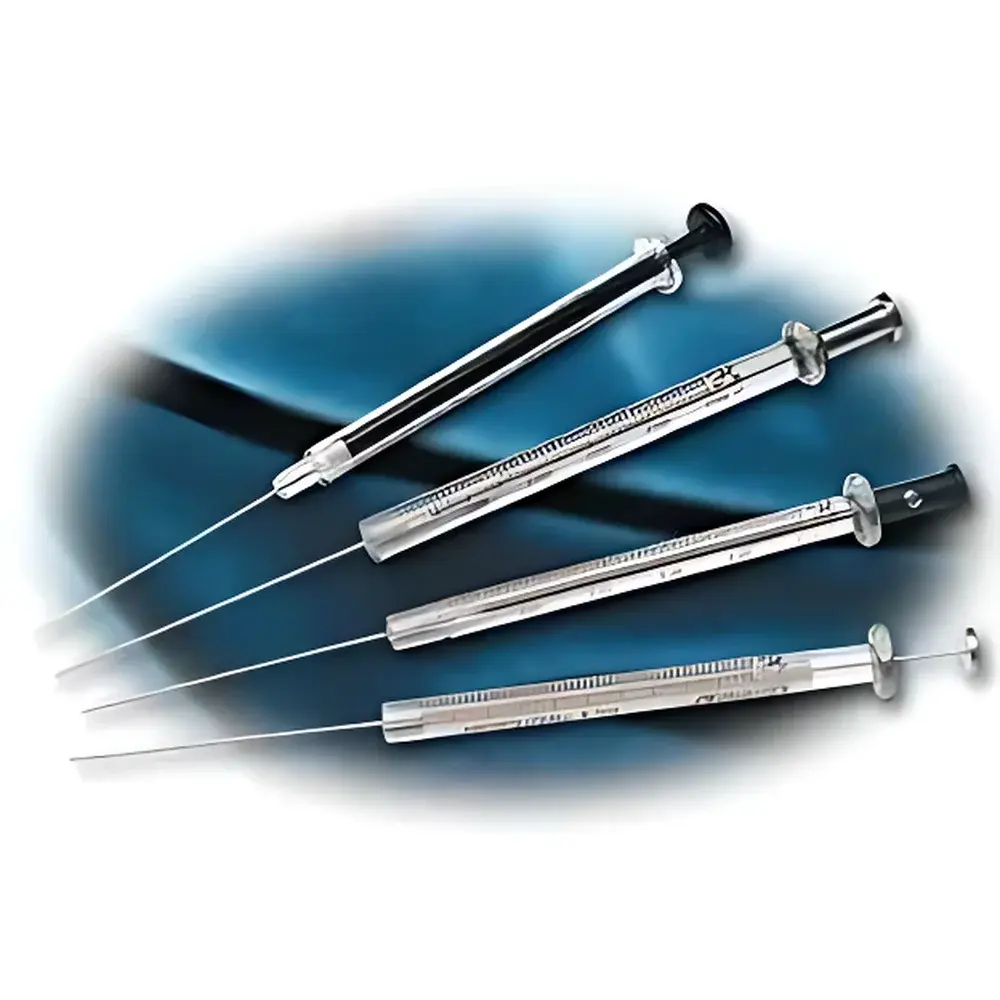
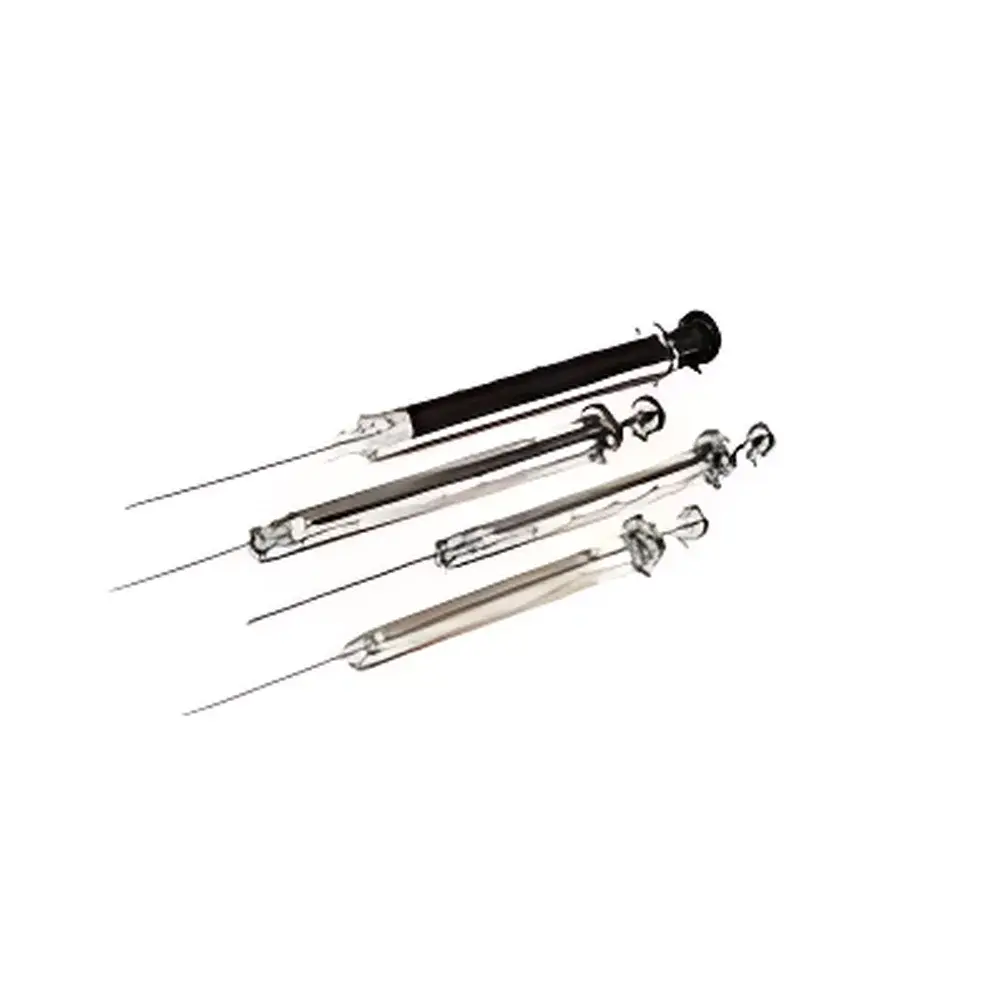
HAMILTON 500 µL Fixed-Needle Liquid Chromatography Syringe
| Brand | HAMILTON |
|---|---|
| Origin | USA |
| Model | 500 µL |
| Needle Type | Fixed-Needle, Standard |
| Volume Accuracy | ±1% (per ASTM D3747) |
| Needle Gauge | 22s |
| Hub Type | Luer Lock |
| Sterility | Non-sterile, Individually Packed |
| Compliance | ISO 8536-4, USP <381>, FDA 21 CFR Part 11 Ready (when used with compliant autosampler software) |
Overview
The HAMILTON 500 µL Fixed-Needle Liquid Chromatography Syringe is a precision-engineered manual or autosampler-compatible injection device designed for high-reproducibility sample introduction in high-performance liquid chromatography (HPLC), ultra-high-performance liquid chromatography (UHPLC), and preparative LC systems. Built on HAMILTON’s legacy of microfluidic accuracy since 1959, this syringe operates on a glass-barrel + stainless-steel plunger + fixed-needle architecture optimized for minimal carryover, consistent dead-volume control, and mechanical stability across repeated actuation cycles. Its 500 µL nominal capacity supports both routine QC injections and method development workflows requiring larger volume sampling—without compromising volumetric fidelity. The syringe is calibrated to ASTM D3747 standards for volumetric accuracy and traceable to NIST-certified reference standards.
Key Features
- High-precision borosilicate glass barrel with laser-etched graduation marks (0.5–500 µL, 5 µL increments) and black enamel scale for enhanced readability under lab lighting conditions.
- Stainless-steel needle (22s gauge, 51 mm length) permanently bonded to the barrel using epoxy-free, solvent-resistant hermetic sealing—eliminating needle wobble and ensuring axial alignment critical for valve seating in Rheodyne-type and Waters U6K injectors.
- Luer-Lock hub interface ensures secure, leak-tight connection to autosampler arms, manual plungers, or custom manifolds; compatible with industry-standard 0.17 mm inner diameter PEEK or fused silica transfer lines.
- Fixed-needle configuration minimizes system variability in autosampler timing routines—critical for GLP/GMP-regulated environments where method transfer and instrument qualification require deterministic dwell volume behavior.
- Individually packaged in ISO Class 7 cleanroom conditions; non-sterile but residue-free, validated for compatibility with acetonitrile, methanol, water, and 0.1% TFA mobile phases.
Sample Compatibility & Compliance
This syringe is validated for use with aqueous, organic, and mixed-phase samples typical in pharmaceutical assay, environmental analysis, and food safety testing. It exhibits no measurable adsorption or leaching when handling proteins (<10 kDa), small-molecule APIs, chiral compounds, and ion-pairing reagents. All materials comply with ISO 8536-4 (glass syringes for medical and laboratory use) and USP (syringes for pharmaceutical applications). When integrated into validated autosampler platforms (e.g., Waters ACQUITY, Agilent 1290, Thermo Vanquish), the syringe supports audit-trail-enabled operation under FDA 21 CFR Part 11 requirements via electronic log capture of injection events, operator IDs, and calibration timestamps.
Software & Data Management
While the syringe itself is hardware-only, its dimensional consistency enables seamless integration with chromatography data systems (CDS) such as Empower, Chromeleon, and OpenLab CDS. System setup files can define precise “syringe draw volume” and “inject volume” parameters—including overfill compensation (e.g., 510 µL draw for 500 µL injection)—to minimize air entrapment and ensure full-cycle priming. Method validation reports may include syringe-specific carryover assessments (per ICH Q2(R2)) using blank-injection sequences at ≤0.05% relative standard deviation across n=6 replicates.
Applications
- Routine HPLC/UHPLC quantitation of active pharmaceutical ingredients (APIs) per USP monographs.
- Method development for gradient elution requiring variable injection volumes (e.g., 10–500 µL range exploration).
- Preparative LC fraction collection where reproducible large-volume loading improves column utilization efficiency.
- Calibration curve preparation in environmental labs analyzing pesticides or PFAS compounds by LC-MS/MS.
- QC release testing in biologics manufacturing where syringe-to-syringe variability must remain below ±0.8% RSD (per internal SOPs aligned with ISO/IEC 17025).
FAQ
Is this syringe compatible with Waters U6K and Rheodyne 7725i injectors?
Yes—its fixed-needle geometry and Luer-Lock hub meet the mechanical interface specifications of both injector families. Needle protrusion depth is calibrated to 14.5 ± 0.2 mm for optimal rotor seal engagement.
What is the recommended cleaning protocol between injections?
Rinse three times with 200 µL of mobile phase (or stronger solvent if analyte is hydrophobic), followed by two air-dry cycles using nitrogen purge. Avoid ultrasonic cleaning, which may compromise needle bond integrity.
Does HAMILTON provide NIST-traceable calibration certificates?
Certificates are available upon request (extra charge); each batch undergoes volumetric verification against NIST SRM 2822 reference standards, with uncertainty ≤±0.6% (k=2).
Can this syringe be used for gas chromatography?
No—this is a liquid-phase syringe. GC applications require gas-tight plungers and different needle geometries (e.g., HAMILTON 80000 series). Use only LC-rated syringes in liquid chromatographic workflows.
What is the expected service life under routine QC usage?
With proper handling and cleaning, mechanical integrity is maintained for ≥5,000 actuations; glass barrel fracture risk increases significantly after repeated lateral loading or forced plunger retraction beyond zero mark.





