
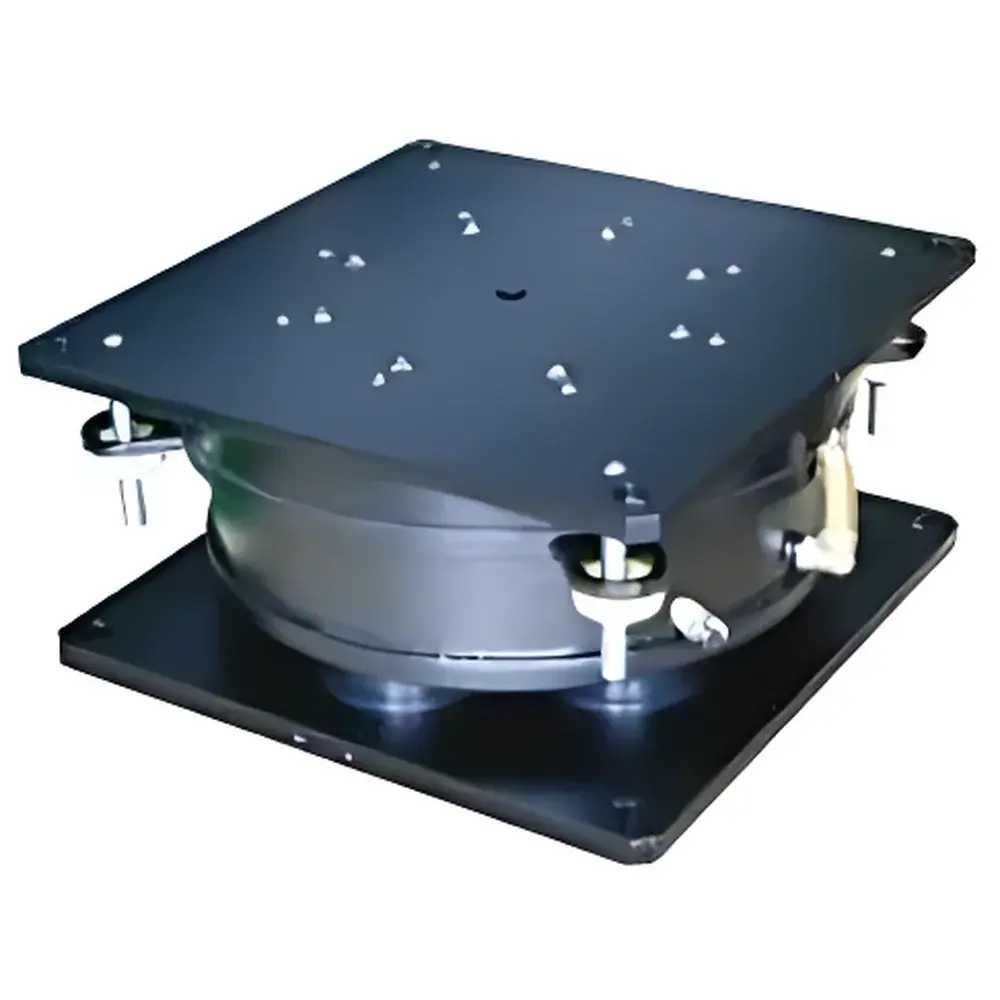
GPM Vibration Isolator
| Origin | South Korea |
|---|---|
| Manufacturer Type | Distributor |
| Origin Category | Imported |
| Model | GPM Vibration Isolator |
| Pricing | Upon Request |
Overview
The GPM Vibration Isolator is a high-performance, air-spring-based passive vibration isolation system engineered for precision optical and metrological applications. It operates on the principle of pneumatic compliance—utilizing compressed air within elastomeric bellows to establish low dynamic stiffness, thereby achieving effective attenuation of ground-borne vibrations across a broad frequency spectrum (typically 0.5–10 Hz). Unlike active systems, the GPM requires no external power or feedback control, making it inherently stable, maintenance-free, and immune to electronic noise or control-loop instability. Its design prioritizes mechanical simplicity, long-term drift resistance, and thermal insensitivity—critical attributes for uninterrupted operation in cleanroom environments, semiconductor fabrication facilities, and advanced microscopy laboratories. The isolator is optimized for static and quasi-static loads, particularly where sub-micron positional stability and nanoradian angular repeatability are required.
Key Features
- Air-spring passive isolation architecture with adjustable air pressure for fine-tuned natural frequency tuning (typical range: 0.7–1.5 Hz)
- Integrated leveling and height adjustment mechanism enabling precise horizontal alignment without external shims or tools
- Low-profile, compact footprint suitable for integration beneath small- to medium-sized optical tables (up to 1.2 m × 1.2 m) and metrology platforms
- Load capacity scalable via modular configuration—standard units support 50–500 kg per isolator, with custom configurations available
- Bottom-mounted circular rubber mounting base provides supplementary damping and micro-vibration decoupling when full isolation is not engaged or during system commissioning
- Corrosion-resistant aluminum alloy housing and stainless steel fasteners ensure compatibility with ISO Class 5–7 cleanroom protocols
Sample Compatibility & Compliance
The GPM Vibration Isolator is validated for use with sensitive instrumentation requiring stringent mechanical stability, including scanning electron microscopes (SEM), atomic force microscopes (AFM), laser interferometers, coordinate measuring machines (CMM), and photolithography alignment stages. It complies with mechanical interface standards per ISO 10816-1 (vibration severity evaluation) and supports traceable installation per SEMI S2/S8 safety and ergonomics guidelines. While not certified to ISO 14001 or ISO 9001 as a standalone component, its integration into larger systems aligns with GLP/GMP infrastructure requirements when deployed with documented calibration and environmental monitoring (e.g., ISO/IEC 17025-compliant validation protocols). No electromagnetic emissions are generated, eliminating RF interference concerns in EMI-sensitive optical measurement setups.
Software & Data Management
As a purely mechanical passive device, the GPM Vibration Isolator does not incorporate embedded electronics, firmware, or digital interfaces. Consequently, it requires no driver installation, software licensing, or cybersecurity configuration. Its performance verification is conducted using industry-standard modal analysis tools (e.g., LMS Test.Lab, BK Connect) and laser Doppler vibrometry (LDV) per ASTM E1876. Installation documentation includes ISO 20486-compliant vibration transmissibility curves and resonant mode maps. For audit readiness, users may integrate third-party real-time vibration monitoring systems (e.g., PCB Piezotronics accelerometers with NI CompactDAQ) to log baseline and operational floor spectra—supporting FDA 21 CFR Part 11-compliant data integrity when paired with validated acquisition software.
Applications
- Semiconductor and LCD manufacturing: wafer inspection stations, mask alignment systems, and thin-film thickness metrology
- High-resolution optical metrology: white-light interferometry, Fizeau cavity stabilization, and optical coherence tomography (OCT) source platforms
- Nanoscale imaging: AFM cantilever signal fidelity enhancement, TEM sample stage stabilization, and near-field scanning optical microscopy (NSOM)
- Laser-based processing: ultrafast laser micromachining workstations, UV lithography beam delivery mounts, and holographic optical element (HOE) characterization rigs
- Precision motion systems: air-bearing stage support for nanopositioning systems requiring <10 nm RMS vertical displacement under ambient floor vibration
FAQ
What is the typical natural frequency range achievable with the GPM isolator?
The GPM achieves a tunable vertical natural frequency between 0.7 Hz and 1.5 Hz depending on applied load and regulated air pressure.
Can the GPM be used in vacuum or inert-gas environments?
No—the air-spring bellows require ambient atmospheric pressure for operation; vacuum-compatible alternatives require custom engineering.
Is recalibration required after repositioning or load change?
Yes—air pressure must be readjusted to restore optimal natural frequency; a calibrated pressure gauge and quick-connect fittings are supplied for field tuning.
Does the rubber mounting base affect isolation performance?
When engaged, the rubber base bypasses the air-spring function and serves only as a mechanical buffer—it is intended for transport or temporary non-isolation operation, not steady-state use.
What is the maximum allowable static load per unit?
Standard GPM units are rated for 500 kg; higher-load variants up to 1,200 kg are available upon request with reinforced bellows and extended stroke.



