
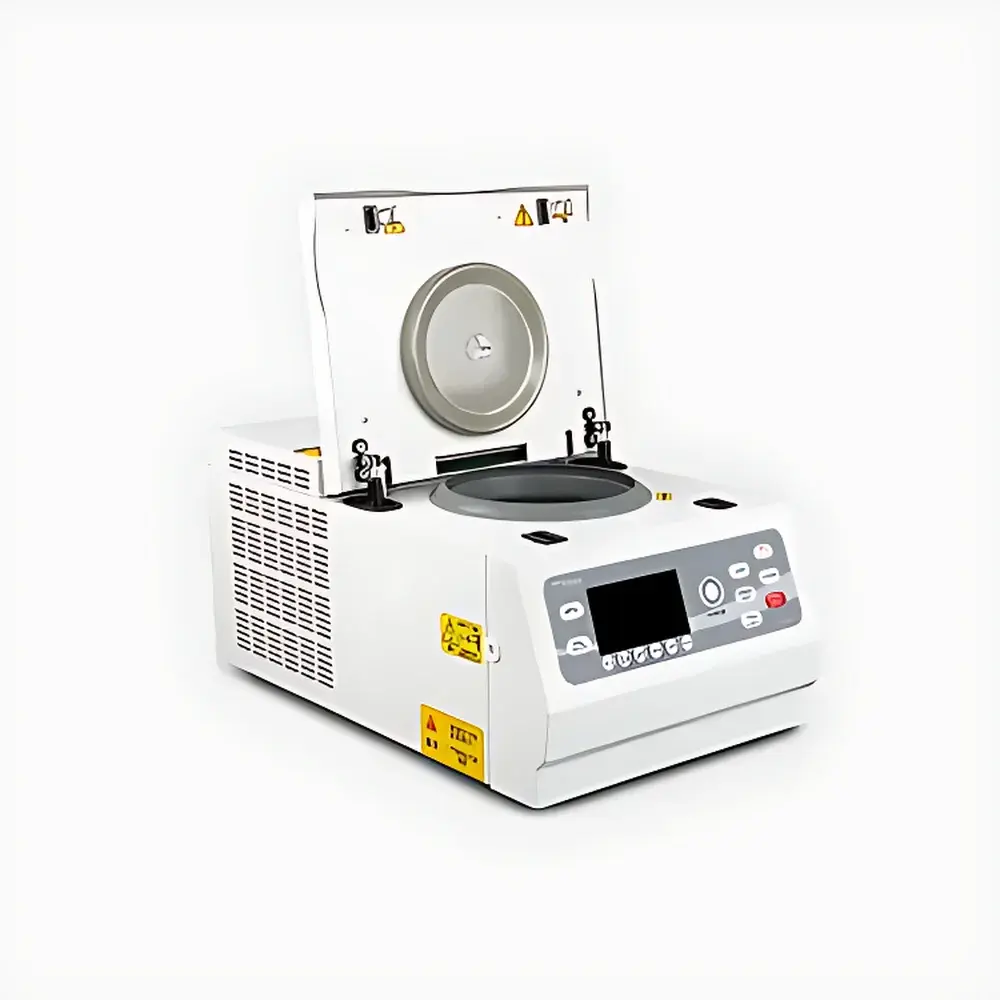
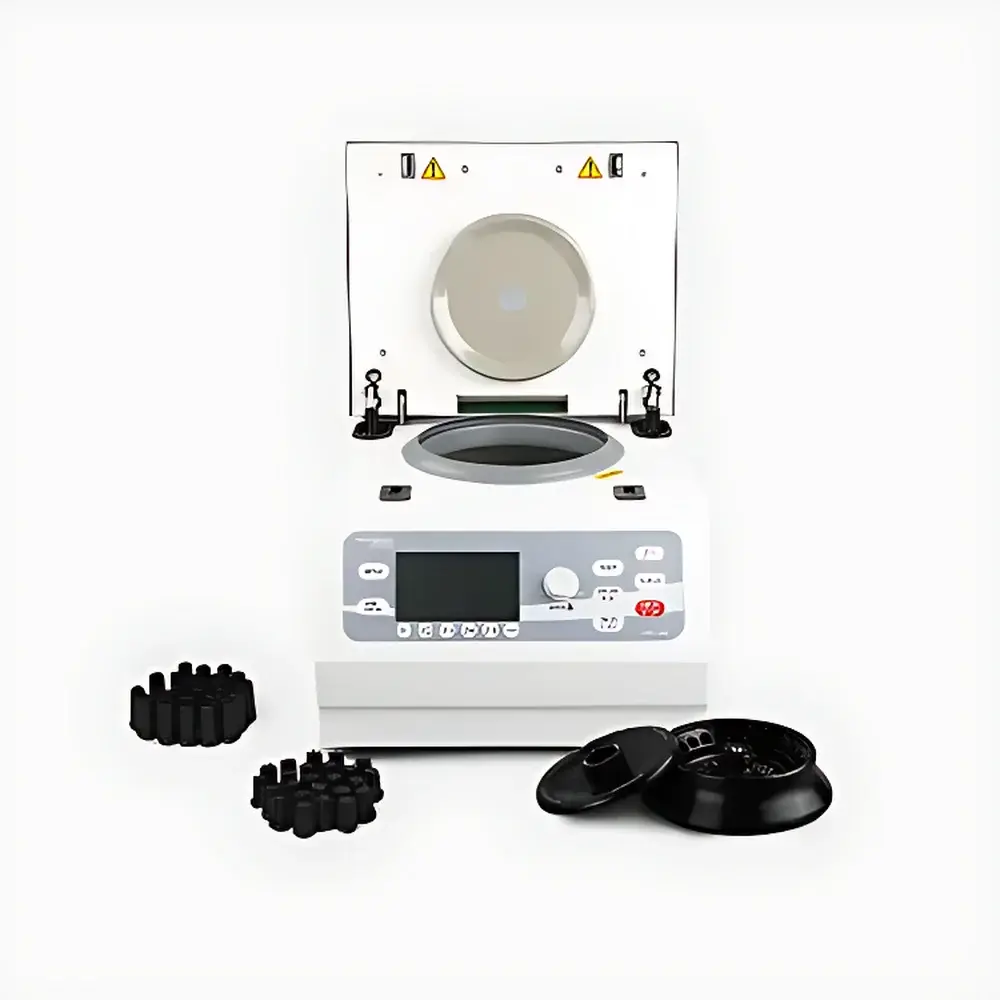
Titan HRC-16K Benchtop High-Speed Refrigerated Centrifuge
| Brand | Titan |
|---|---|
| Origin | Shanghai, China |
| Manufacturer Type | Direct Manufacturer |
| Instrument Type | Benchtop Centrifuge |
| Speed Range | High-Speed (10,000–30,000 rpm) |
| Function | Refrigerated Centrifugation |
| Configuration | Fixed-Angle Rotor |
| Application Class | Biomolecular Separation |
| Max Capacity | 5 × 10 mL tubes |
| Max Speed | 16,000 rpm |
| Max RCF | 23,470 × g |
| Dimensions (W × D × H) | 360 × 600 × 280 mm |
Overview
The Titan HRC-16K is a precision-engineered benchtop high-speed refrigerated centrifuge designed for reliable, temperature-controlled separation of biomolecular samples in research, clinical, and quality control laboratories. Operating on the principle of sedimentation under controlled gravitational force (RCF), the HRC-16K delivers consistent rotor acceleration and deceleration profiles optimized for nucleic acid isolation, protein purification, organelle fractionation, and viral pellet recovery. Its integrated refrigeration system maintains sample temperatures between –20 °C and +40 °C during operation—critical for preserving thermolabile macromolecules and preventing enzymatic degradation. The unit complies with IEC 61010-1 safety standards for laboratory electrical equipment and incorporates dual-stage compressor cooling with pre-cool functionality to reduce thermal equilibration time prior to run initiation.
Key Features
- High-performance brushless frequency-controlled motor ensuring stable speed regulation across the full operating range (200–16,000 rpm) with ±10 rpm speed accuracy at maximum setting
- Intelligent refrigeration architecture featuring PID-controlled temperature management and real-time ambient compensation to maintain setpoint stability within ±1 °C over extended runs
- Robust aluminum-alloy fixed-angle rotor (included as standard) rated for continuous operation at 16,000 rpm and validated for 5 × 10 mL conical tubes (e.g., 15 mL Falcon-style)
- Microprocessor-based control panel with intuitive LCD interface supporting programmable ramp/deceleration profiles, timed runs (1 min to 99 hr 59 min), and automatic rotor identification via embedded RFID tag
- Triple-layer safety system: lid interlock with mechanical and electronic redundancy, imbalance detection with auto-shutdown (<±2 g mass differential), and rotor lifetime tracking based on cumulative run hours and stress cycles
- Low-noise design (≤65 dB[A] at 16,000 rpm) achieved through balanced rotor dynamics and vibration-damping chassis construction, suitable for shared lab environments
Sample Compatibility & Compliance
The HRC-16K accommodates common low-volume tube formats used in molecular biology workflows—including polypropylene conical tubes (10–15 mL), PCR strip tubes (0.2 mL), and microcentrifuge tubes (1.5–2.0 mL)—when paired with optional adapter rotors (sold separately). All rotor assemblies are certified to ISO 15197:2013 for rotational mechanical integrity and undergo factory-balanced certification per ISO 21501-4. The instrument supports GLP-compliant documentation requirements through audit-trail-capable parameter logging (timestamped speed, temperature, duration, rotor ID) stored internally for ≥1,000 runs. While not FDA 21 CFR Part 11–certified out-of-the-box, its data export function (via USB port) enables integration into validated LIMS or ELN platforms meeting GxP regulatory expectations.
Software & Data Management
The HRC-16K operates autonomously via its embedded firmware without external PC dependency. All operational parameters—including target speed, temperature setpoint, run time, acceleration/deceleration rates, and rotor-specific safety limits—are configurable and stored in non-volatile memory. Run history is retained with full metadata (date/time, rotor ID, user-defined protocol name, actual RCF, final temperature) and exportable as CSV files for traceability. Optional Titan CentriLink™ PC software (v3.2+) provides remote monitoring, multi-unit fleet management, and customizable report generation aligned with ISO/IEC 17025 documentation templates. Firmware updates are delivered via encrypted USB key to ensure version control and cybersecurity compliance.
Applications
- Isolation of plasmid DNA, genomic DNA, and RNA from bacterial, mammalian, and plant lysates
- Clarification of cell lysates prior to chromatographic analysis or electrophoresis
- Purification of extracellular vesicles (exosomes) and lipoprotein fractions (HDL/LDL/VLDL)
- Concentration of dilute protein solutions and antibody preparations
- Preparative centrifugation of subcellular organelles (mitochondria, nuclei, lysosomes) using density gradient media
- Routine QC testing of biopharmaceutical intermediates where temperature-sensitive aggregation must be minimized
FAQ
What is the minimum required clearance around the centrifuge for proper ventilation?
A minimum of 10 cm clearance on all sides—and 20 cm above the unit—is required to ensure unobstructed airflow through the rear-mounted condenser and top exhaust grille.
Can the HRC-16K accommodate 50 mL conical tubes?
No. The standard rotor is configured for 5 × 10 mL tubes. A separate 4 × 50 mL swing-bucket rotor (model HRC-SB50) is available as an accessory, but requires recalibration and validation prior to use.
Does the unit support automatic rotor recognition for safety interlocks?
Yes. Each Titan-certified rotor contains a passive RFID tag read automatically upon lid closure; unrecognized or expired rotors trigger immediate lockout.
Is the refrigeration system compatible with operation in ambient environments up to 35 °C?
Yes. The dual-stage compressor and oversized condenser enable stable temperature maintenance at setpoints down to –20 °C even at 35 °C ambient, verified per IEC 60068-2-14 thermal shock testing.
How is rotor lifetime monitored and reported?
The onboard controller logs cumulative operational hours and calculates mechanical stress cycles based on speed, temperature, and acceleration profiles; alerts appear when 85% of rated service life is reached.



