
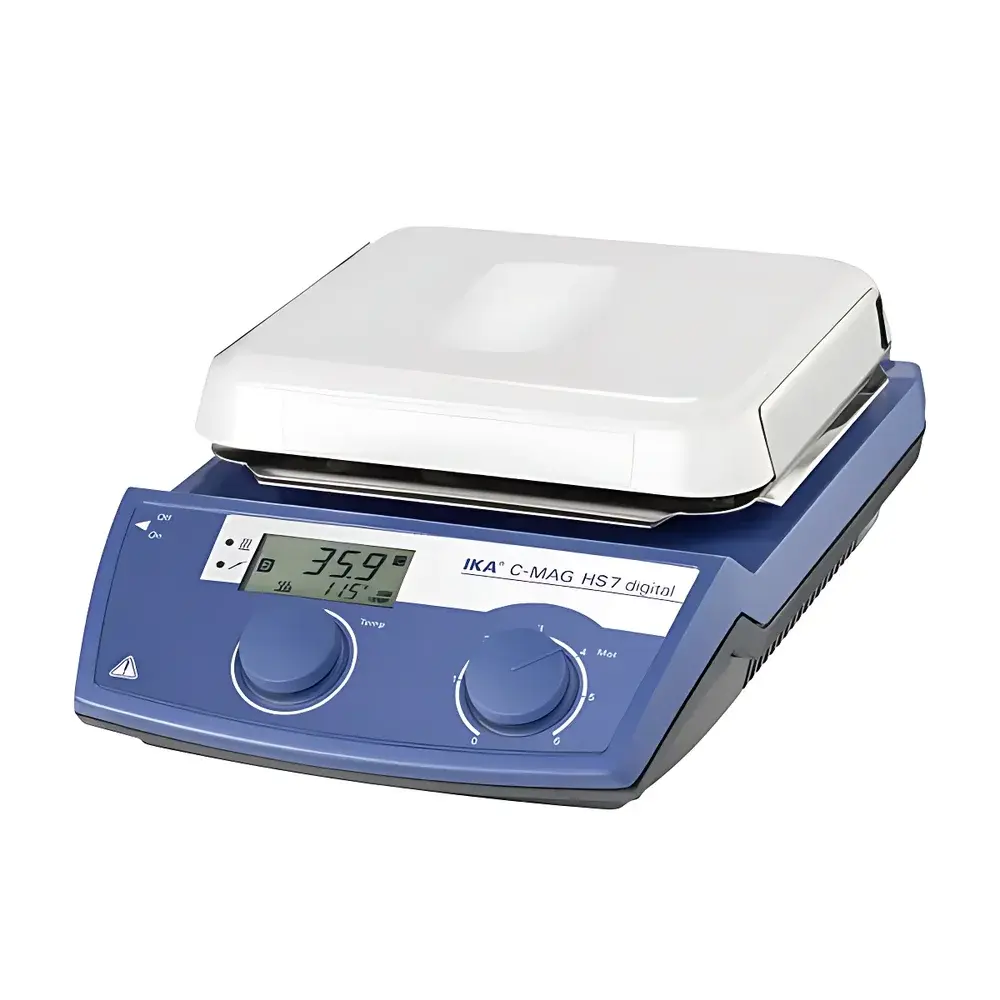
IKA C-MAG HS7 digital Heating Magnetic Stirrer
| Brand | IKA |
|---|---|
| Origin | Germany |
| Model | C-MAG HS7 digital |
| Maximum Stirring Volume | 10 L (H₂O) |
| Speed Range | 100–1500 rpm |
| Heating Temperature Range | 50–500 °C |
| Heating Power | 1000 W |
| Plate Material | Chemically Resistant Ceramic |
| Plate Dimensions | 180 × 180 mm |
| External Temperature Sensor Interface | PT1000 |
| Temperature Control Accuracy (with PT1000) | ±0.5 K |
| Medium Temperature Stability | ±0.5 K |
| Temperature Measurement Resolution | 0.1 K |
| Safety Cut-off Temperature | 550 °C |
| IP Rating | IP21 |
| Input Voltage | 230 / 120 / 100 V, 50/60 Hz |
| Net Weight | 5 kg |
| Operating Ambient | 5–40 °C, ≤80% RH |
Overview
The IKA C-MAG HS7 digital is a high-performance heating magnetic stirrer engineered for precision temperature-controlled mixing in research laboratories, quality control environments, and industrial R&D settings. Based on the Couette flow principle, it employs a rotating magnetic field to drive PTFE- or glass-coated stirring bars within vessels—enabling homogeneous mixing without mechanical shaft penetration. Its integrated ceramic heating plate delivers rapid, uniform thermal energy transfer while resisting corrosion from acids, bases, and organic solvents. Designed for compliance with DIN EN 60529 (IP21), this unit meets international safety standards for laboratory equipment operating under controlled environmental conditions (5–40 °C, ≤80% RH). The device supports both open-vessel and sealed-system applications—including reaction flasks, beakers, and jacketed reactors—making it suitable for synthesis, dissolution testing, buffer preparation, and viscosity calibration workflows.
Key Features
- Ceramic-coated heating plate (180 × 180 mm) offering exceptional chemical resistance and long-term thermal stability
- Adjustable speed range from 100 to 1500 rpm with analog dial control and real-time LCD display of setpoint and actual values
- Heating capability from 50 to 500 °C with continuous, stepless regulation and ±1 K accuracy at the plate surface
- Integrated PT1000 sensor port enabling direct immersion temperature feedback for medium-specific control (±0.5 K stability, 0.1 K resolution)
- Three operational modes: Standard (full parameter access), Safety (restricted max temperature/speed), and Lock (prevents accidental adjustment during operation)
- Elevated control panel design minimizes risk of liquid ingress during splashing or condensation events
- Overtemperature protection circuit with fixed cut-off at 550 °C and visual thermal warning indicator (flashing LED)
- Energy-efficient architecture consuming up to 20% less power than comparable units—aligned with ISO 50001 energy management principles
Sample Compatibility & Compliance
The C-MAG HS7 digital accommodates standard laboratory glassware including round-bottom flasks (up to 10 L capacity), beakers, crystallization dishes, and custom reactor vessels. It supports stirring bar lengths up to 80 mm and is compatible with PTFE-, glass-, and AlNiCo-based magnetic stir bars. For regulated environments, the instrument’s design facilitates adherence to GLP and GMP documentation requirements through traceable temperature logging (when paired with external data acquisition systems). While not inherently 21 CFR Part 11 compliant, its stable thermal output and repeatable speed profiles support validation protocols per ASTM E2911 (Standard Guide for Validation of Thermal Processing Equipment) and ISO/IEC 17025 clause 5.4.2 (Equipment Verification).
Software & Data Management
This stand-alone unit does not include embedded software or network connectivity. However, its analog control interface and PT1000 sensor output are compatible with third-party data loggers (e.g., Omega OM-DAQPRO, Testo 176 T4) for time-stamped recording of speed, plate temperature, and medium temperature. When used with validated external systems, full audit trails—including operator ID, timestamp, parameter changes, and error codes—can be generated to satisfy FDA-regulated documentation needs. All displayed parameters—including dynamic error codes (e.g., “E1” for sensor disconnection, “E3” for overtemperature)—are documented in the user manual per IEC 61000-4-3 immunity standards.
Applications
- Precise dissolution testing of pharmaceutical actives under USP and conditions
- Controlled heating and mixing during polymerization reactions requiring narrow thermal windows
- Buffer equilibration for HPLC mobile phase preparation with minimized evaporation loss
- Calibration of viscometers using Newtonian reference fluids at defined shear rates and temperatures
- Accelerated stability studies per ICH Q1A(R2), where consistent thermal input across multiple vessels is critical
- Preparation of homogeneous catalyst suspensions in fine chemical synthesis
FAQ
Does the C-MAG HS7 digital support external temperature probes other than PT1000?
No—the unit is designed exclusively for PT1000 Class A sensors (DIN IEC 751), ensuring traceable calibration and ±0.2 K deviation tolerance.
Can this stirrer be used inside a fume hood with reduced airflow?
Yes; its IP21 rating and convection-independent heating mechanism allow safe operation in ventilated enclosures, provided ambient temperature remains within 5–40 °C.
Is the ceramic plate resistant to hydrofluoric acid?
No—while highly resistant to most common reagents, HF will etch alumina-based ceramics; alternative PTFE-coated hotplates are recommended for HF applications.
What is the self-heating effect after one hour at maximum temperature?
At ambient 22 °C, the housing surface temperature rise is limited to ≤28 °C after 60 minutes of continuous operation at 500 °C.
How is speed accuracy verified during IQ/OQ qualification?
Speed consistency is confirmed using a calibrated tachometer (e.g., Extech 461923) against the LCD readout across the full 100–1500 rpm range, with deviation limits set at ±2% of setpoint per ISO/IEC 17025 Annex A.3.
Related Products



