
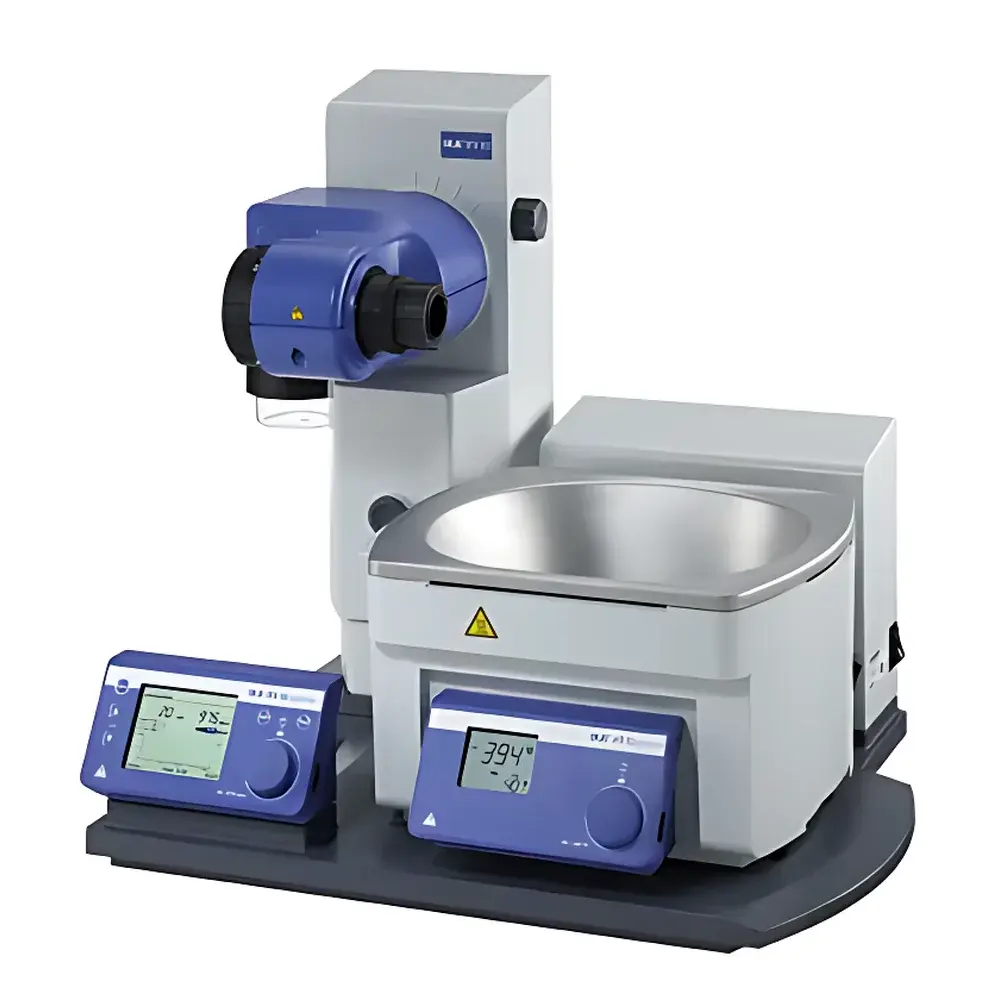
IKA RV10 Control FLEX Rotary Evaporator
| Origin | Germany |
|---|---|
| Manufacturer Type | Authorized Distributor |
| Origin Category | Imported |
| Model | RV10 Control FLEX |
| Pricing | Upon Request |
| Motor Type | DC |
| Speed Range | 20–280 rpm |
| Lift Mechanism | Motorized |
| Lift Travel | 140 mm |
| Heating Bath Temperature Range | Ambient to 180 °C |
| Heating Power Output | 1300 W |
| Temperature Control Accuracy | ±1 K |
| Bath Capacity | 3 L |
| Built-in Vacuum Controller | Yes |
| Vacuum Adjustment Range | 1050–1 mbar |
| Vacuum Measurement Range | 1050–1 mbar |
| Vacuum Measurement Accuracy | ±2 mbar |
| Dimensions (W×D×H) | 500 × 430 × 410 mm |
| Weight | 21.5 kg |
| Ambient Operating Temperature | 5–40 °C |
| Max. Relative Humidity | 80 % |
| Protection Class | IP20 |
| RS232 Interface | Yes |
| USB Interface | Yes |
| Input Voltage | 220–240 V |
| Frequency | 50/60 Hz |
| Total Power Consumption | 1400 W |
Overview
The IKA RV10 Control FLEX Rotary Evaporator is an advanced, fully integrated laboratory system engineered for precision solvent removal, concentration, and gentle sample recovery under reduced pressure. Based on the fundamental principle of rotary evaporation—where a rotating flask increases surface area while simultaneous vacuum lowers boiling points—the RV10 Control FLEX implements closed-loop process control via integrated vacuum regulation, programmable heating, and real-time distillation curve monitoring. Designed for reproducible operation in regulated R&D, QC, and teaching laboratories, it complies with core safety and operational standards including DIN EN 60529 (IP20 enclosure), IEC 61010-1 (safety requirements for electrical equipment), and supports audit-ready workflows compatible with GLP and GMP environments when paired with labworldsoft® software.
Key Features
- Integrated vacuum controller with digital display, enabling precise vacuum setpoint adjustment (1–1050 mbar) and real-time feedback (±2 mbar accuracy)
- Automated distillation by volume or time, with programmable distillation capacity and auto-boiling point recognition for adaptive process optimization
- Motorized vertical lift (140 mm travel) with position memory and safety interlock to prevent overextension or collision
- Heating bath with 3 L capacity, temperature range from ambient to 180 °C, and ±1 K control stability; automatic thermal shutdown on fault detection
- Large color graphical display showing dynamic distillation curves, parameter status, and multilingual UI (English, German, French, Spanish, Chinese)
- USB and RS232 interfaces for bidirectional communication with labworldsoft®—enabling remote start/stop, parameter logging, and export of timestamped CSV data
- Built-in solvent database (user-expandable) with preloaded thermodynamic properties to guide safe vacuum/temperature pairing and prevent bumping or decomposition
- Post-run automation: automatic venting, cooling water shutoff, and heating bath deactivation—reducing manual intervention and operator error
- Embedded cooling water flow monitor with alarm threshold to prevent condenser dry-out during extended runs
Sample Compatibility & Compliance
The RV10 Control FLEX accommodates standard ground-glass jointed glassware (e.g., 1 L, 2 L, and 3 L round-bottom flasks) and is compatible with a broad spectrum of organic solvents, aqueous solutions, and heat-sensitive extracts. Its sealed vacuum path and inert PTFE-coated components minimize cross-contamination and corrosion. From a regulatory perspective, the instrument’s deterministic control logic, parameter traceability (via labworldsoft®), and electronic audit trail capabilities align with documentation requirements under FDA 21 CFR Part 11 when configured with appropriate user access controls and electronic signature modules. It meets CE marking requirements and conforms to ISO/IEC 17025 recommendations for equipment qualification in accredited testing laboratories.
Software & Data Management
labworldsoft® serves as the central platform for method development, execution, and data archival. Users can store and recall complete distillation protocols—including rotation speed, bath temperature ramp profiles, vacuum gradients, and endpoint criteria—as named methods. All operational parameters, timestamps, and measured vacuum/temperature values are logged automatically and exportable in CSV or PDF formats. The software supports multi-user permission levels, electronic signatures, and change history tracking—facilitating compliance with GLP, ISO 9001, and internal SOP frameworks. No cloud dependency is required; local network deployment ensures data sovereignty and IT security alignment.
Applications
- Solvent removal in natural product isolation and synthetic chemistry workflows
- Concentration of protein solutions, enzyme preparations, and nucleic acid fractions without denaturation
- Purification of thermally labile compounds (e.g., terpenes, cannabinoids, vitamins) using low-temperature vacuum distillation
- Parallel sample processing in pharmaceutical stability studies and formulation development
- Teaching applications in undergraduate organic chemistry labs requiring repeatable, observable phase-change kinetics
- Residual solvent analysis (RSA) sample prep prior to GC or HPLC injection
FAQ
Does the RV10 Control FLEX support automated method validation?
Yes—when used with labworldsoft®, users can define, execute, and document full validation protocols including repeatability checks, calibration verification, and system suitability tests.
Can vacuum setpoints be programmed as part of a multi-step distillation sequence?
Yes. The instrument supports up to 10-step vacuum ramps synchronized with temperature and rotation profiles.
Is the heating bath temperature calibrated traceable to national standards?
The unit includes factory calibration documentation; end-users may perform in-house verification using NIST-traceable PT100 probes.
What maintenance is required for long-term vacuum system reliability?
Routine inspection of the vacuum seal integrity, periodic cleaning of the vapor duct, and annual verification of the vacuum sensor drift are recommended per IKA Technical Bulletin TB-RV10-02.
How does the automatic boiling point recognition function operate?
It analyzes real-time temperature and pressure differentials across the condenser and vapor path to detect inflection points indicative of phase transition onset—without requiring prior solvent input.



