
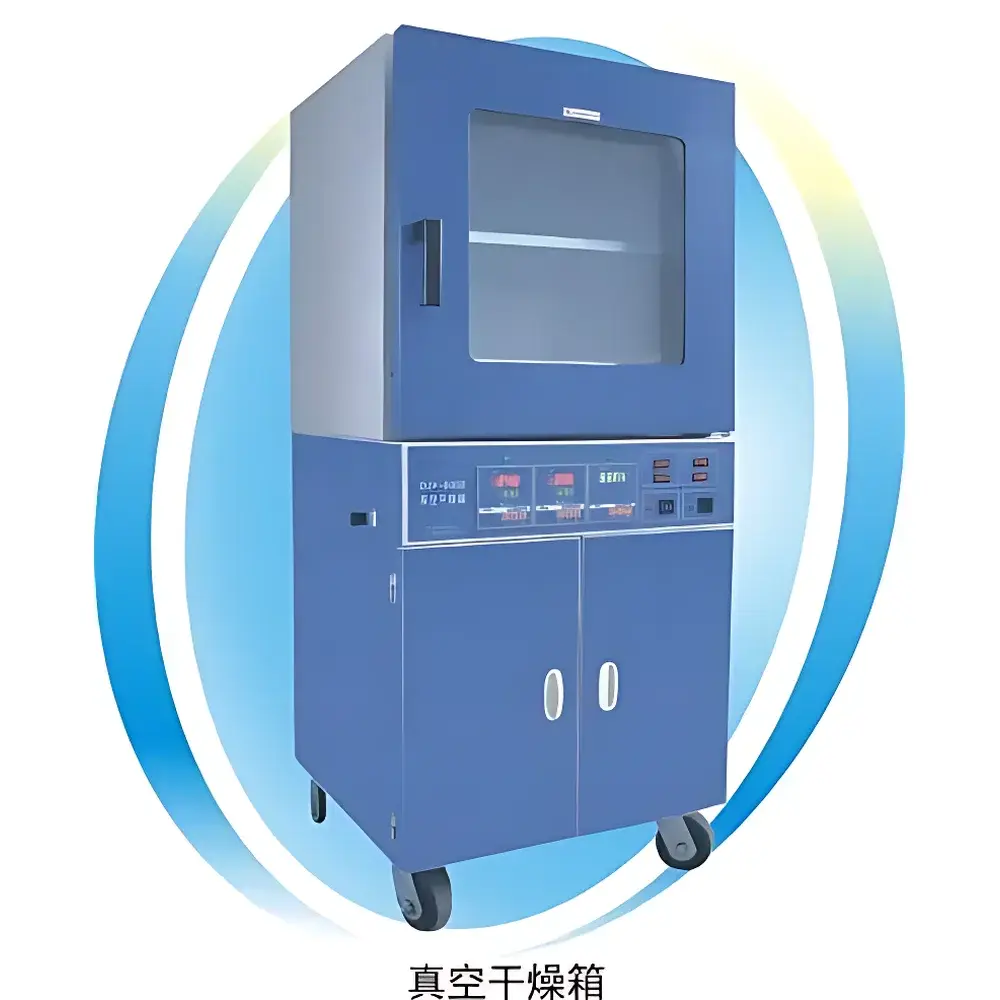
YIHENG BPZ-LC Series Programmable Vacuum Drying Oven with Digital Vacuum Control
| Brand | YIHENG |
|---|---|
| Origin | Shanghai, China |
| Model | BPZ-LC Series (BPZ-6033LC to BPZ-6500LC) |
| Power Supply | AC220V/380V, 50 Hz |
| Temperature Range | RT+10°C to 200°C |
| Temperature Resolution | 0.1°C |
| Temperature Uniformity | ±1°C |
| Ultimate Vacuum | 133 Pa |
| Chamber Material | Mirror-Finished 1Cr18Ni9Ti Stainless Steel |
| Vacuum Control Range | 1.0×10⁻¹ Pa to 1.0×10⁵ Pa |
| Control Accuracy | ±1% of setpoint |
| Vacuum Sensor Type | Silicon Piezoresistive Pressure Transducer |
| Programmable Stages | 30-segment (including ramp/soak and slope modes) |
| Vacuum Cycling | Up to 99 cycles, programmable min/max vacuum setpoints |
| Viewing Window | Tempered double-layer safety glass |
| Door Seal | Integrated silicone rubber gasket with adjustable compression |
| Inert Gas Port | Standard N₂/Ar inlet fitting |
| Shelf Configuration | 2–4 stainless steel shelves, some models with independent temperature control |
Overview
The YIHENG BPZ-LC Series is a high-precision, microprocessor-controlled vacuum drying oven engineered for laboratories requiring reproducible, oxygen-free thermal processing under programmable vacuum conditions. Unlike conventional convection ovens, the BPZ-LC operates on the principle of reduced-pressure evaporation—lowering the partial pressure of volatile components to enable solvent removal at significantly lower temperatures. This principle is essential for thermolabile compounds, hygroscopic powders, nanomaterials, pharmaceutical intermediates, and moisture-sensitive electronic components. The system integrates dual-critical control loops: a PID-based temperature regulation system (RT+10°C to 200°C, ±1°C uniformity) and a closed-loop digital vacuum control architecture using a calibrated silicon piezoresistive sensor. This enables stable, drift-compensated vacuum maintenance across the full operational range (1.0×10⁻¹ Pa to 1.0×10⁵ Pa), eliminating manual valve manipulation and ensuring compliance with GLP-aligned process documentation requirements.
Key Features
- Programmable 30-segment temperature profile capability—including both platform (soak) and slope (ramp) modes—enabling precise control over heating rate, dwell time, and cooling kinetics.
- Digital vacuum regulation with ±1% setpoint accuracy; real-time LED display of absolute pressure; programmable vacuum cycling (min/max limits, up to 99 iterations) to accelerate moisture diffusion in porous or layered samples.
- Mirror-polished 1Cr18Ni9Ti stainless steel chamber (electropolished finish) ensures corrosion resistance, non-contaminating surface properties, and ease of cleaning—critical for ISO 17025-accredited labs and GMP environments.
- Double-layer tempered safety glass door with adjustable mechanical latching and integrated silicone gasket provides unobstructed visual monitoring while maintaining vacuum integrity down to 133 Pa.
- Inert gas purging port (standard N₂ or Ar compatibility) allows controlled atmosphere operation—essential for preventing oxidation during annealing, catalyst activation, or battery electrode drying.
- Independent shelf-level temperature control (available on select models) supports multi-sample parallel processing with differential thermal profiles within a single chamber.
Sample Compatibility & Compliance
The BPZ-LC accommodates a broad spectrum of sample types—including lyophilized biologics, ceramic green bodies, polymer composites, metal-organic frameworks (MOFs), and semiconductor wafers—without risk of thermal degradation or oxidative side reactions. Its inert-gas-compatible design aligns with ASTM E145-22 (Standard Specification for Gravity-Convection and Forced-Ventilation Ovens) and supports validation protocols per USP (Assessment of Pharmaceutical Quality Attributes). The vacuum control system meets IEC 61000-6-3 electromagnetic compatibility standards, and its pressure transducer calibration traceability conforms to ISO/IEC 17025 requirements. Full audit trail functionality (via optional RS485/Modbus interface) satisfies FDA 21 CFR Part 11 data integrity expectations when paired with compliant LIMS or ELN platforms.
Software & Data Management
While the BPZ-LC operates as a standalone instrument via its front-panel interface, it supports external data logging and remote supervision through industry-standard communication protocols. Optional analog output (4–20 mA) enables integration into SCADA systems for centralized facility monitoring. For advanced process documentation, the oven’s serial interface permits timestamped export of vacuum pressure, chamber temperature, and program stage status—structured in CSV format for post-run analysis in MATLAB, Python (pandas), or LabVIEW. All critical parameters—including vacuum cycle count, cumulative exposure time at defined pressure bands, and temperature deviation logs—are retained in non-volatile memory for retrospective review during internal audits or regulatory inspections.
Applications
- Pharmaceutical R&D: Residual solvent removal from active pharmaceutical ingredients (APIs) without polymorphic transition or racemization.
- Materials Science: Debinding of metal injection molded (MIM) parts, pre-sintering drying of ceramic slurries, and moisture conditioning of lithium-ion battery cathodes.
- Electronics Manufacturing: Degassing of encapsulants prior to curing, moisture extraction from PCB assemblies before conformal coating.
- Academic Research: Controlled dehydration of hydrogels, solvent exchange in aerogel synthesis, and thermal stabilization of perovskite thin films.
- Quality Control Labs: Moisture content determination per ISO 554 and ASTM D2297, replacing gravimetric methods where sample volatility or oxidation risk exists.
FAQ
What vacuum level can the BPZ-LC achieve, and how is it measured?
The system achieves an ultimate vacuum of ≤133 Pa, verified using an integrated silicon piezoresistive pressure transducer calibrated against NIST-traceable references. Absolute pressure is displayed in real time on the front-panel LED.
Can the BPZ-LC perform multi-step vacuum-temperature sequences?
Yes—its 30-segment programmable controller supports synchronized ramp/soak profiles with vacuum cycling logic, allowing users to define discrete pressure bands and temperature targets for each step.
Is the chamber suitable for corrosive solvents like chlorinated hydrocarbons?
The 1Cr18Ni9Ti stainless steel construction offers excellent resistance to most organic solvents; however, prolonged exposure to halogenated acids or strong oxidizers requires evaluation per ASTM G31 immersion testing guidelines.
Does the system comply with FDA 21 CFR Part 11 for electronic records?
The base unit does not include built-in electronic signature or audit trail features, but its optional serial interface enables third-party software integration that can meet Part 11 requirements when deployed within validated IT infrastructure.
How is temperature uniformity validated across the working volume?
Uniformity is verified per ISO 15502 Annex B using nine calibrated PT100 probes placed at standardized locations (center + six face centers + two corners); typical deviation remains within ±1°C at 100°C steady state.



