
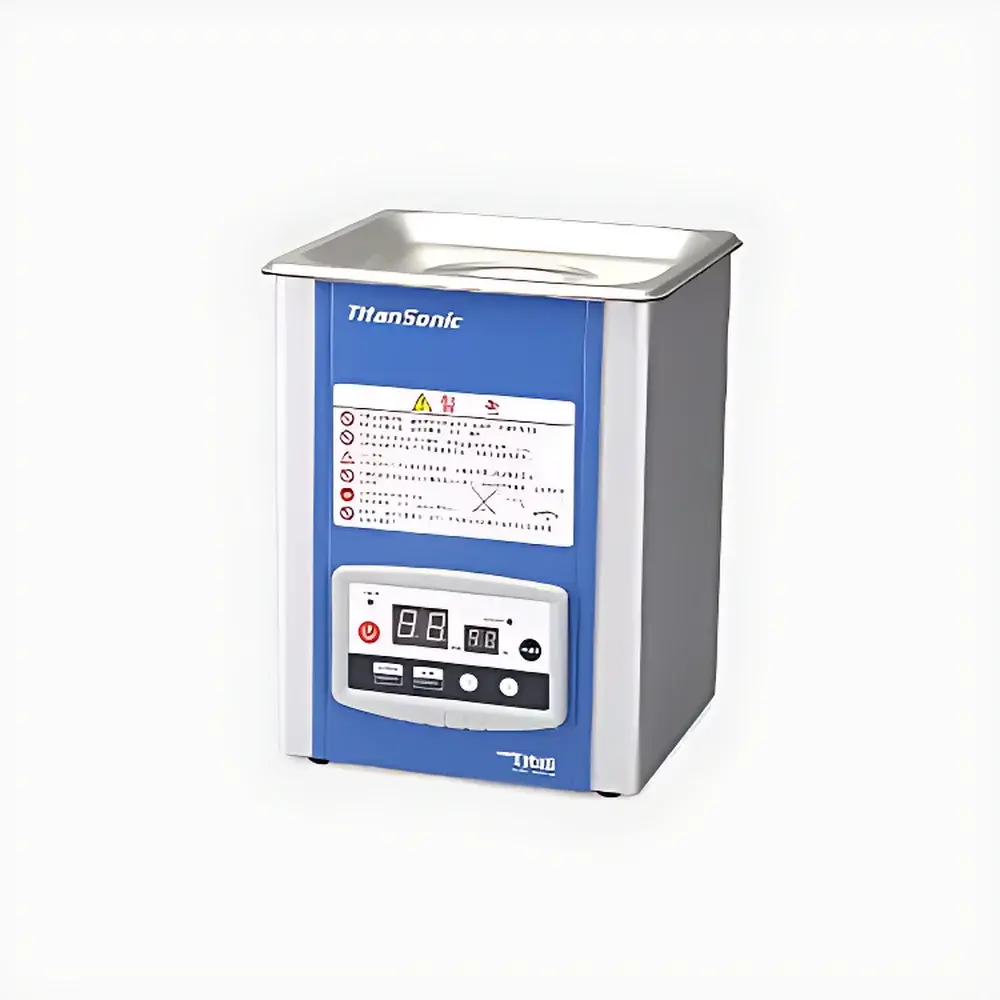
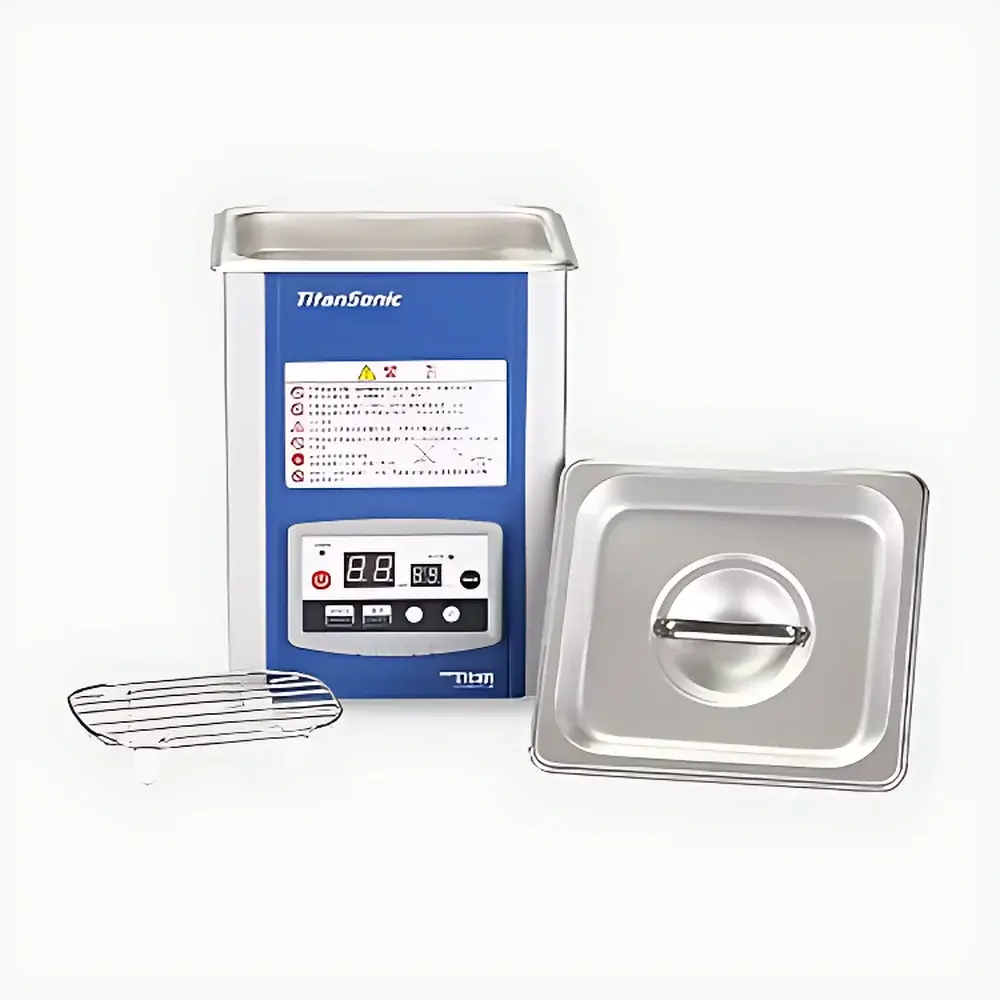
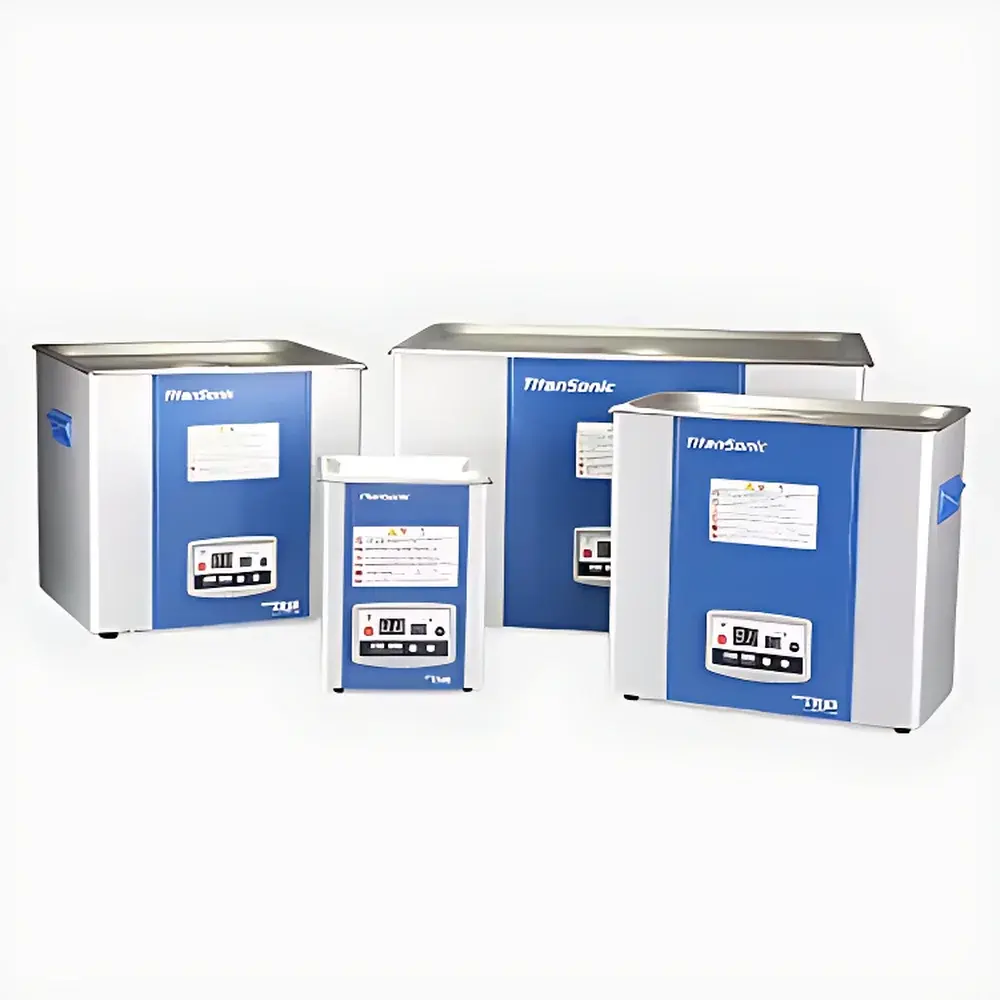
Titan UC-2H 2L Heated Ultrasonic Cleaner
| Brand | Titan |
|---|---|
| Origin | Shanghai, China |
| Manufacturer Type | Manufacturer |
| Product Category | Domestic |
| Model | UC-2H |
| Instrument Type | Specialized |
| Capacity | 2 L |
| Ultrasonic Frequency | 35 kHz |
| Ultrasonic Power | 50 W |
| Temperature Range | 20–69 °C (adjustable) |
| Timer Range | 1–99 min (adjustable) |
| Sound-Dampening Lid | Included |
Overview
The Titan UC-2H is a compact, benchtop heated ultrasonic cleaner engineered for precision cleaning of delicate laboratory components—including glassware, pipette tips, microcentrifuge tubes, optical lenses, and small metal or ceramic parts. It operates on the principle of acoustic cavitation: high-frequency sound waves (35 kHz) generate microscopic vacuum bubbles in the cleaning solvent, which collapse violently upon reaching a critical size, releasing localized energy that dislodges particulate contaminants, organic residues, and biofilms without mechanical abrasion. Integrated heating (20–69 °C) enhances solvent activity—particularly for viscous or waxy soils—while maintaining thermal stability within ±2 °C across the tank volume. Its 2-liter stainless steel tank (304 grade) features rounded corners to minimize dead zones and ensure uniform energy distribution. Designed for routine QC labs, academic research facilities, and small-scale production environments, the UC-2H meets foundational requirements for reproducible cleaning validation under GLP-aligned workflows.
Key Features
- Controlled Thermal-Ultrasonic Synergy: Independent digital regulation of temperature (20–69 °C, ±2 °C accuracy) and ultrasonic duty cycle ensures optimal cleaning kinetics for diverse soil types—from dried protein films to silicone lubricants.
- Precision Timer with Auto-Shutoff: Programmable 1–99 minute operation with audible end-of-cycle alert and automatic power cutoff prevents overexposure and solvent evaporation.
- Acoustically Optimized Tank Geometry: 2 L capacity with seamless 304 stainless steel construction and chamfered internal corners minimizes standing wave interference and promotes consistent cavitation density.
- Integrated Sound-Dampening Lid: Hinged, transparent acrylic lid attenuates airborne noise by ≥15 dB(A) while allowing real-time visual monitoring of cleaning action and preventing solvent splash or vapor loss.
- Stable 35 kHz Transducer Array: Piezoelectric transducers mounted on the tank base deliver uniform energy output at 50 W nominal power—sufficient for light-to-moderate contamination loads without inducing excessive microjet erosion on fragile substrates.
- Benchtop Ergonomics & Safety Compliance: Non-slip rubber feet, recessed controls, and overtemperature/overcurrent protection circuits conform to IEC 61010-1 safety standards for laboratory electrical equipment.
Sample Compatibility & Compliance
The UC-2H accommodates standard laboratory vessels up to 120 mm in height and 80 mm in diameter, including volumetric flasks, beakers, cuvettes, and watch glasses. It is compatible with aqueous alkaline, neutral, and mild acidic cleaning solutions—as well as low-boiling solvents such as isopropanol and ethanol—provided flash point exceeds 40 °C and vapor concentration remains below occupational exposure limits (OSHA PEL). While not certified for sterile processing per ISO 13485 or FDA 21 CFR Part 820, the unit supports cleaning steps preceding autoclaving or ethylene oxide sterilization. Its programmable parameters enable documentation of cleaning cycles (time, temp, duration), facilitating traceability in ISO/IEC 17025-accredited laboratories where cleaning validation is part of method qualification.
Software & Data Management
The UC-2H operates via an embedded microcontroller with LED-based interface—no external software or PC connectivity is required. All operational parameters (set temperature, elapsed time, active status) are displayed in real time. Though it lacks USB or Ethernet ports, its deterministic timer and thermal control support manual logbook entry compliant with ALCOA+ principles (Attributable, Legible, Contemporaneous, Original, Accurate, Complete, Consistent, Enduring, Available). For laboratories implementing electronic lab notebooks (ELN), cycle metadata can be manually recorded alongside sample IDs and cleaning objectives to satisfy audit readiness for ISO 17025 Clause 7.8 (Reporting of Results) and FDA 21 CFR Part 11 Annex A (electronic records integrity).
Applications
- Cleaning of HPLC vials, GC autosampler trays, and syringe filters prior to analytical use
- Removal of flux residues from printed circuit boards during electronics R&D prototyping
- Preparation of TEM grids and SEM stubs for contaminant-free imaging
- Routine decontamination of reusable pipette tips and electrophoresis combs
- Supporting ASTM D2616 (Standard Practice for Ultrasonic Cleaning of Metal Parts) for non-critical components
- Validation of cleaning efficacy in pharmaceutical pre-formulation studies per USP “Cleaning and Sanitization”
FAQ
Is the UC-2H suitable for cleaning delicate optical components such as quartz cuvettes or microscope slides?
Yes—its 35 kHz frequency and moderate 50 W power output minimize surface pitting risk when used with low-surfactant aqueous solutions and controlled dwell times (typically 3–5 minutes at 40 °C).
Can the unit maintain temperature stability during extended cycles (e.g., >30 minutes)?
Yes—the PID-controlled heater compensates for ambient heat loss; temperature deviation remains within ±2 °C over 99-minute operation in typical lab environments (20–25 °C, <60% RH).
Does the sound-dampening lid interfere with ultrasonic performance?
No—the acrylic lid is acoustically transparent at 35 kHz and designed to reflect minimal energy back into the tank; cavitation intensity is unaffected per ASTM E1248-18 verification protocols.
What maintenance is required for long-term reliability?
Routine rinsing of the tank after each use, periodic descaling with 5% citric acid solution (if using hard water), and annual inspection of transducer adhesion integrity are recommended.
Is the UC-2H CE-marked or RoHS-compliant?
As a domestically marketed instrument intended for non-regulated laboratory use, it complies with China’s CCC certification requirements; CE marking is not applied, but RoHS-restricted substances are absent per manufacturer’s material declaration.



