
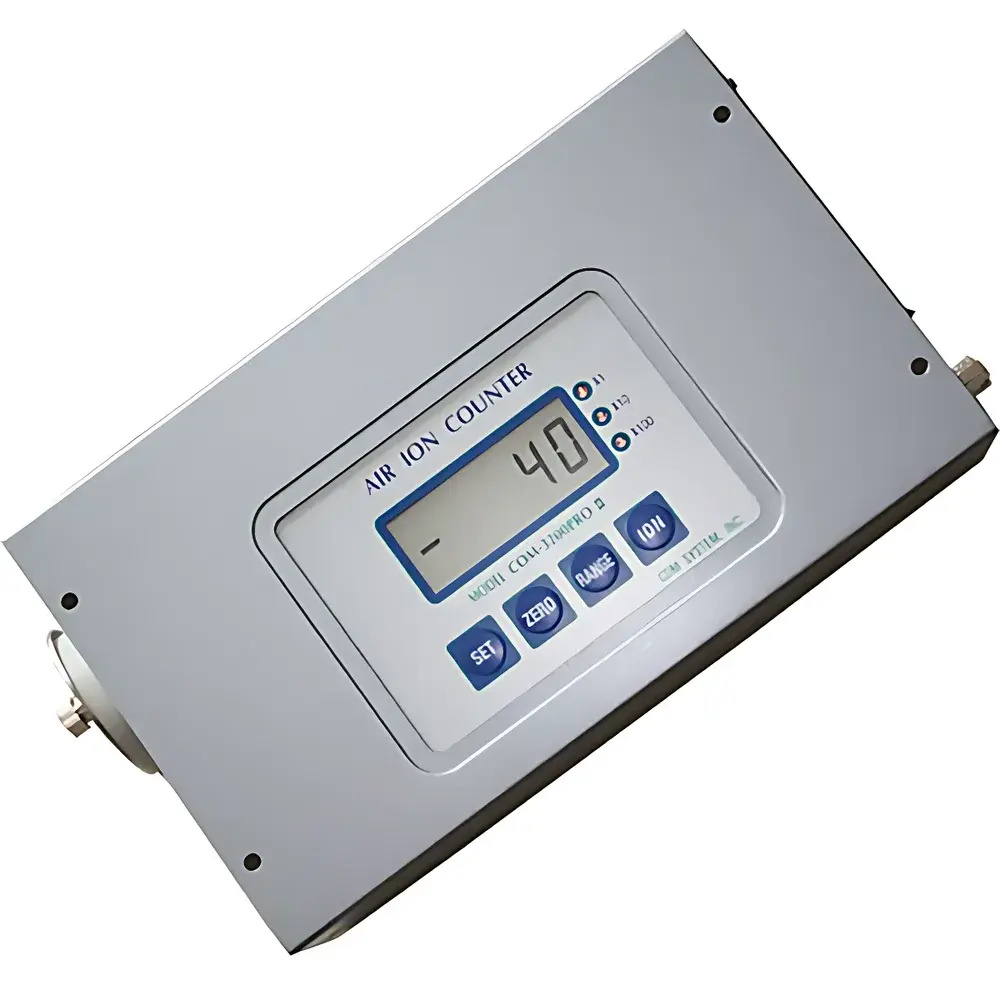
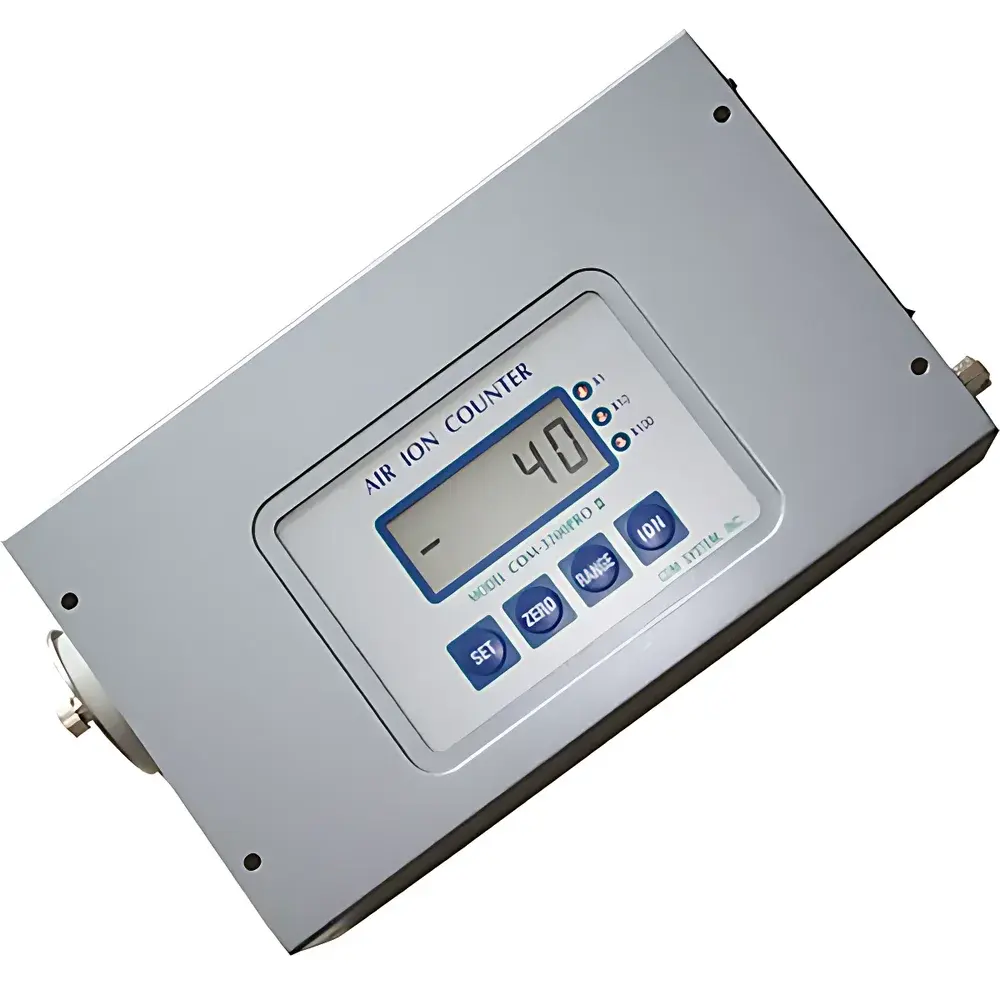
PKSAIR COM3200PROII Air Negative Ion Detector
| Brand | PKSAIR |
|---|---|
| Origin | Japan |
| Model | COM3200PROII |
| Detection Principle | Coaxial Double-Cylinder Capacitive Electrometer |
| Measurement Range | 0–2×10⁶ ions/cm³ (3-range auto-scaling) |
| Display | 7-segment, 4½-digit LCD |
| Power Supply | AC 100–240 V + rechargeable internal battery (≥7 h operation) |
| Dimensions | 45 × 112 × 188 mm (W×D×H, excl. protrusions) |
| Weight | 0.995 kg |
| Operating Environment | 5–35 °C, 0–85 % RH |
| Drift | ±5 %/24 h |
| Built-in Sensors | Temperature & Relative Humidity |
| Interface | RS-232 (with USB adapter included) |
| Compliance | JIS B 7751 Draft Standard for Air Ion Density Measurement |
| Data Software | Windows-compatible analysis software with logging, graphing, and export (CSV/PDF) |
Overview
The PKSAIR COM3200PROII Air Negative Ion Detector is a precision-engineered, portable electrometer designed for quantitative measurement of unipolar and bipolar air ion concentrations in ambient environments. It operates on the coaxial double-cylinder capacitive collection principle—defined in the JIS B 7751 Draft Standard for Air Ion Density Measurement—as a metrologically traceable alternative to planar electrode configurations. This geometry minimizes electrostatic interference, eliminates edge-field distortion, and ensures high reproducibility across varying airflow conditions. Unlike consumer-grade sensors relying on corona discharge or passive diffusion, the COM3200PROII employs active aspiration via a regulated axial fan with touch-actuated control and adaptive speed modulation—enhancing sensitivity to both negative (O₂⁻, CO₃⁻, NO₃⁻) and positive (H⁺(H₂O)ₙ, Na⁺) ions without cross-saturation. Its compact form factor (45 × 112 × 188 mm), integrated temperature/humidity compensation, and dual-power architecture (AC mains + sealed Li-ion battery) make it suitable for field-deployed environmental audits, longitudinal ecological studies, and indoor air quality (IAQ) validation under ISO 16000-28 and WHO IAQ guidelines.
Key Features
- Coaxial double-cylinder collector design per JIS B 7751 draft specification—providing superior signal-to-noise ratio and reduced positional dependence versus flat-plate detectors
- Three-range auto-scaling measurement: R1 (0–2×10⁴ ions/cm³), R2 (0–2×10⁵ ions/cm³), R3 (0–2×10⁶ ions/cm³), displayed on a 4½-digit, 7-segment LCD with automatic unit multiplier (×1, ×10, ×100)
- Touch-sensitive fan control with intelligent airflow regulation—optimized for laminar intake across variable ambient wind speeds (0.1–3 m/s), improving detection threshold stability
- Onboard temperature (5–35 °C) and relative humidity (0–85 % RH) sensing with real-time compensation applied to ion density calculations
- Dual power system: universal AC input (100–240 V, 50/60 Hz) and rechargeable internal battery supporting ≥7 hours of continuous operation in standalone mode
- Integrated RS-232 serial interface with included DB9-to-USB adapter—enabling direct connection to Windows-based acquisition systems
- IP54-rated enclosure with ergonomic carry case and optional tripod mount—validated for outdoor deployment in forest canopies, waterfall plumes, and urban green spaces
Sample Compatibility & Compliance
The COM3200PROII is calibrated for gaseous-phase ion detection in atmospheric air, with validated performance across natural and semi-controlled environments—including forest understories (where terpene oxidation generates O₂⁻), near waterfalls (water droplet fragmentation yields H₃O⁺ and OH⁻), and indoor spaces with ion-emitting materials (e.g., tourmaline ceramics, corona-wire emitters). It complies with the methodology framework outlined in the JIS B 7751 Draft Standard, which specifies sampling volume flow rate (≥0.1 L/min), electrode geometry tolerances (±0.02 mm), and drift limits (≤±5 % over 24 h at constant T/RH). While not certified to IEC 61000-4-x immunity standards, its shielded analog front-end and galvanically isolated digital interface meet baseline EMC requirements for laboratory and field use. No sample preparation, consumables, or gas calibration standards are required.
Software & Data Management
The instrument ships with PKSAIR IonLog Pro v3.x—a Windows-native application supporting real-time data streaming, time-stamped logging (UTC-sync capable), multi-channel overlay (ion count + T/RH), and statistical reporting (min/max/avg/std dev per session). Raw datasets export to CSV for integration with MATLAB, Python (Pandas), or LIS platforms. The software maintains full audit trails: user login timestamps, parameter change logs, and firmware version metadata—supporting GLP-aligned documentation per ISO/IEC 17025 Clause 7.7. Data files are digitally signed and include embedded instrument ID and calibration certificate reference numbers. No cloud upload or telemetry is enabled by default; all processing occurs locally unless explicitly configured.
Applications
- Ecological monitoring: Quantifying ion gradients across elevation transects in protected forests, correlating with VOC emissions and photosynthetic activity
- Tourism infrastructure assessment: Validating ion enhancement claims for wellness resorts, spa facilities, and “negative ion therapy” installations
- Building science: Benchmarking ion generation efficacy of HVAC-integrated ionizers against ASHRAE 62.1 ventilation rate equivalency models
- Regulatory support: Generating defensible datasets for municipal air quality ordinances referencing ion concentration as a proxy for particulate scavenging efficiency
- Academic research: Supporting controlled chamber studies on ion-mediated aerosol coagulation kinetics under ISO 16000-37 protocols
FAQ
What ion polarity does the COM3200PROII measure?
It measures both negative and positive air ions simultaneously using polarity-switching bias voltage on the inner cylinder electrode—no manual polarity reversal is required.
Is calibration traceable to a national metrology institute?
Factory calibration is performed against a NIST-traceable reference ion generator (Model IG-2000, ±3 % uncertainty at 1×10⁵ ions/cm³); calibration certificates include as-found/as-left data and measurement uncertainty budgets.
Can the device operate in high-humidity rainforest environments?
Yes—its sealed sensor head and condensation-resistant thermal management allow continuous operation up to 85 % RH at 35 °C; however, prolonged exposure >90 % RH may require periodic desiccant maintenance.
Does the software comply with FDA 21 CFR Part 11 requirements?
IonLog Pro supports electronic signatures, audit trails, and role-based access control—but requires on-site validation by the end-user’s QA team to achieve full Part 11 compliance.
What is the recommended recalibration interval?
Annual recalibration is advised under ISO/IEC 17025; more frequent verification (e.g., quarterly) is recommended when used in high-dust or high-ozone environments.
Related Products







