
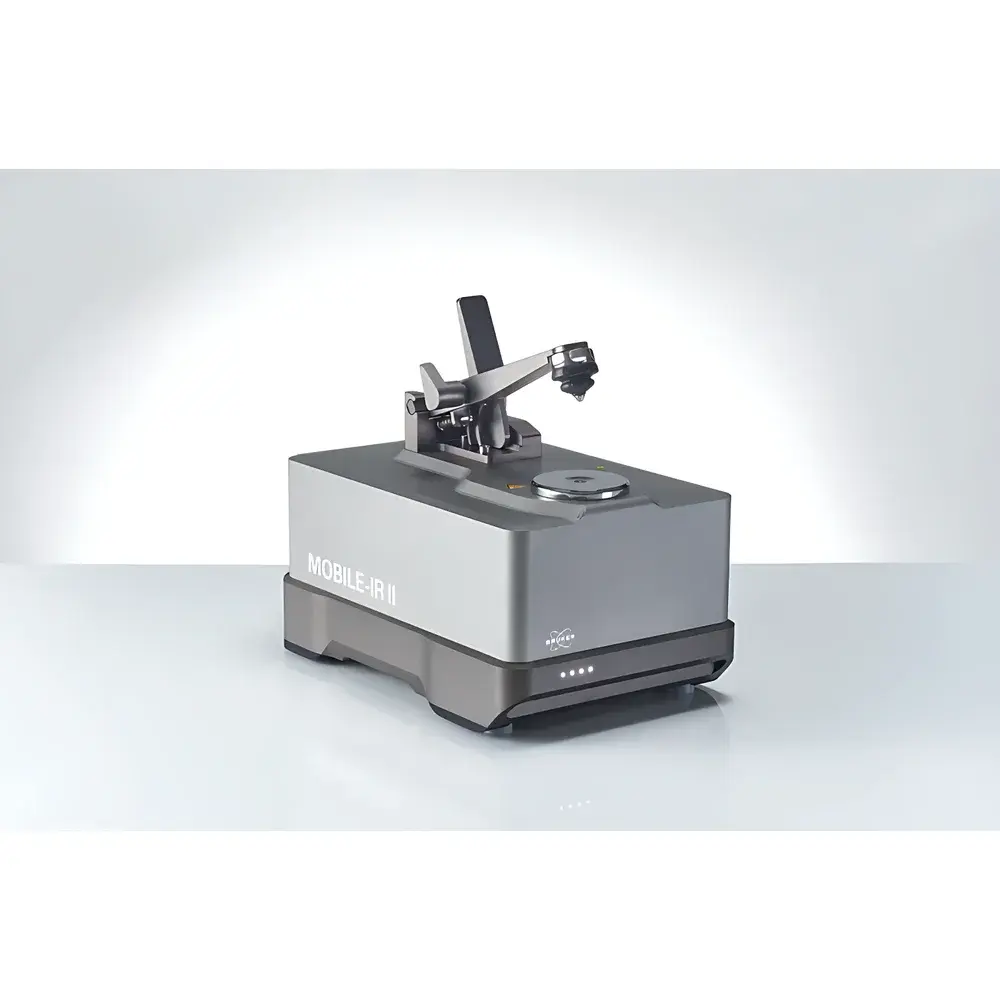
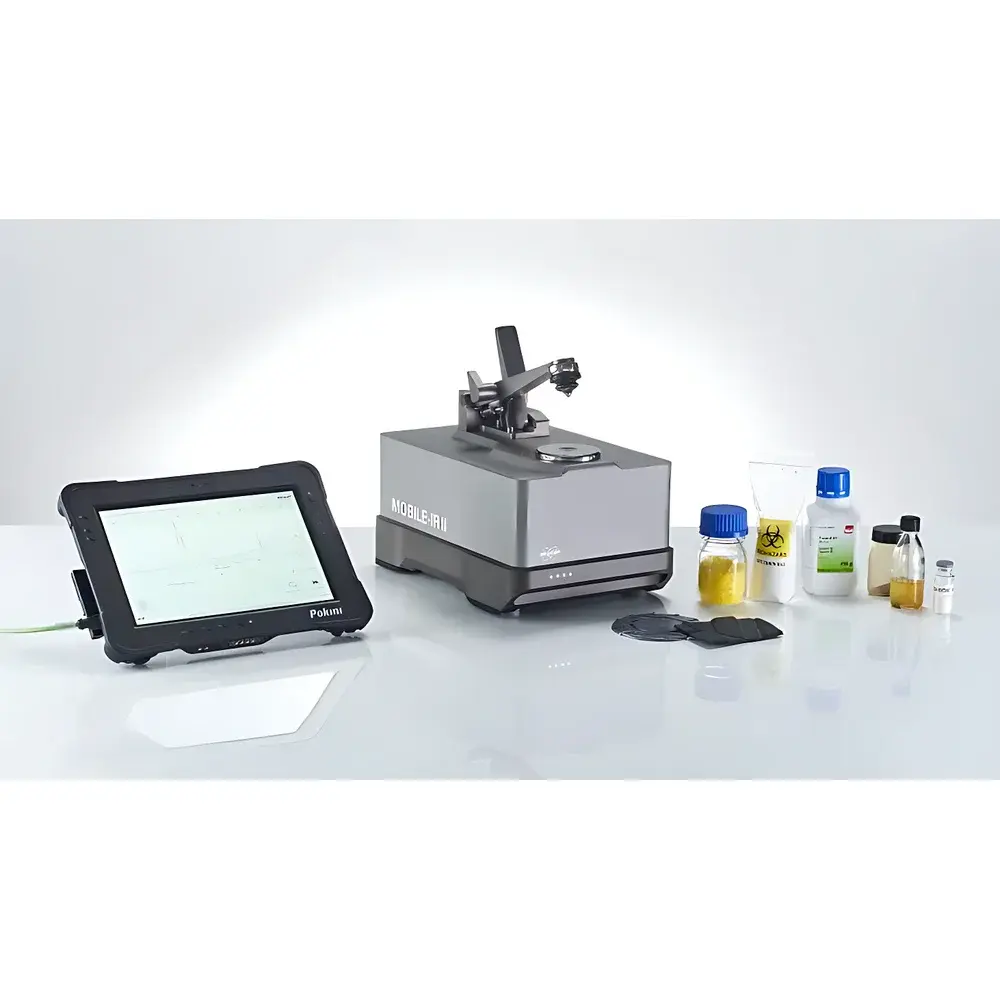
Bruker MOBILE-IR II Portable Fourier Transform Infrared (FT-IR) Spectrometer
| Brand | Bruker |
|---|---|
| Origin | Germany |
| Instrument Type | Portable |
| FT-IR Architecture | Interferometric (Michelson-type) |
| Wavenumber Range | 6000 – 670 cm⁻¹ |
| Detector | Thermoelectrically Cooled MCT (TE-MCT), No Liquid Nitrogen Required |
| Enclosure Rating | IP65 (Instrument Body), IP67 (Carrying Case) |
| Light Source | CenterGlow™ Broadband IR Source (Lifespan >5 years) |
| Interferometer | RockSolid™ Dynamic Alignment-Free Design (Lifespan >10 years) |
| Laser | Solid-State Diode Laser (Lifespan >10 years) |
| ATR Accessory | Heated Diamond Crystal |
| Power Supply | Integrated Rechargeable Lithium Battery (Field-Operable, Grid-Independent) |
| Software Platform | OPUS TOUCH™ (Touch-Optimized, Role-Based Workflow Interface) |
Overview
The Bruker MOBILE-IR II is a ruggedized, fully portable Fourier Transform Infrared (FT-IR) spectrometer engineered to deliver laboratory-grade spectral performance in demanding field environments. Unlike conventional benchtop or semi-portable IR systems, the MOBILE-IR II employs a true interferometric architecture based on Bruker’s proprietary RockSolid™ dynamic alignment-free interferometer—ensuring long-term optical stability without recalibration under mechanical stress or thermal fluctuation. Its core measurement principle relies on Michelson interferometry, where infrared radiation from the CenterGlow™ broadband source is split, recombined after path-length modulation, and converted into an interferogram via fast Fourier transformation. This enables high-fidelity spectral acquisition across a broad wavenumber range of 6000–670 cm⁻¹ with consistent resolution and signal-to-noise ratio—critical for reliable molecular fingerprinting in real-world conditions.
Key Features
- IP65-rated instrument housing and IP67-certified transport case—fully protected against dust ingress and temporary immersion in water.
- Thermoelectrically cooled mercury cadmium telluride (TE-MCT) detector—eliminates dependency on liquid nitrogen while maintaining high sensitivity and low noise in ambient temperature operation.
- Integrated heated diamond ATR (Attenuated Total Reflection) accessory—enables direct, non-destructive analysis of solids, pastes, gels, and viscous liquids with minimal sample preparation.
- Self-contained lithium-ion battery system—supports continuous operation for multiple hours in off-grid scenarios, including remote field deployments and emergency response operations.
- RockSolid™ interferometer with monolithic mirror mount and passive thermal compensation—guarantees >10-year operational lifetime with no moving parts requiring maintenance or realignment.
- CenterGlow™ IR source and solid-state diode laser—engineered for >5 and >10 years of stable output, respectively, reducing downtime and consumable costs.
- OPUS TOUCH™ software interface—designed for intuitive gesture-based control, role-specific workflows (e.g., “First Responder”, “QC Technician”), and one-touch spectral acquisition and library matching.
Sample Compatibility & Compliance
The MOBILE-IR II supports diverse sample forms—including powders, tablets, polymers, coatings, biological tissues, and hazardous materials—via its heated diamond ATR module. It complies with international standards relevant to field-deployable analytical instrumentation, including IEC 60529 (IP rating), MIL-STD-810G (shock and vibration resistance), and ISO/IEC 17025 requirements for method validation in accredited laboratories. When used with validated spectral libraries and documented SOPs, data generated by the MOBILE-IR II meets traceability and audit-readiness criteria under GLP and GMP frameworks. Its hardware design satisfies environmental robustness prerequisites outlined in ASTM E1421 (Standard Practice for Describing and Measuring Performance of FT-IR Spectrometers) and supports secure data handling aligned with FDA 21 CFR Part 11 when configured with appropriate user access controls and electronic signature modules.
Software & Data Management
OPUS TOUCH™ provides a streamlined, context-aware interface optimized for glove-compatible touchscreen interaction and rapid decision-making. It includes embedded spectral search algorithms compliant with ASTM E1789 (Standard Guide for Identification of Unknown Substances Using FT-IR), automated peak detection, quantitative calibration tools, and customizable reporting templates. All spectral acquisitions are time-stamped, geotagged (when GPS-enabled), and stored with full metadata—including instrument configuration, environmental sensor logs (temperature, humidity), and operator ID. Data export supports common formats (JCAMP-DX, CSV, PNG) and integrates with LIMS via secure HTTPS or local network transfer. Audit trails, user permission hierarchies, and encrypted local storage ensure compliance with regulatory data integrity expectations.
Applications
The MOBILE-IR II serves mission-critical roles across public safety, industrial quality assurance, and environmental monitoring. In forensic and hazmat response, it enables immediate identification of unknown white powders, illicit drugs, chemical warfare agents, and toxic industrial chemicals at incident sites. Within manufacturing, it supports raw material verification, in-process polymer characterization, coating thickness estimation, and contamination screening directly on production lines—reducing reliance on off-site lab submissions. In pharmaceutical settings, it facilitates excipient verification and counterfeit drug detection during supply chain inspections. Geological surveys, agricultural soil analysis, and cultural heritage artifact screening further demonstrate its versatility as a field-deployable molecular identification tool.
FAQ
Does the MOBILE-IR II require cryogenic cooling for the detector?
No—it uses a thermoelectrically cooled MCT detector that operates reliably at ambient temperatures without liquid nitrogen or external chillers.
Can the instrument be operated while charging?
Yes—the system supports hot-swap battery operation and concurrent charging without interrupting spectral acquisition.
Is spectral library matching performed onboard or only via external PC?
Both options are supported: OPUS TOUCH™ includes embedded reference libraries (e.g., Polymer, Pharmaceutical, Hazardous Materials), and advanced library management is available via optional desktop OPUS software.
What is the typical spectral resolution achievable in field mode?
The instrument maintains a standard resolution of 4 cm⁻¹ across its full range; higher resolutions (e.g., 2 cm⁻¹ or 1 cm⁻¹) are configurable depending on signal averaging requirements and environmental conditions.
How is calibration maintained during extended field use?
The RockSolid™ interferometer’s zero-alignment design and internal reference laser ensure intrinsic wavelength accuracy; routine verification using polystyrene film or built-in calibration checks is recommended per ISO/IEC 17025 guidelines.
Related Products





