
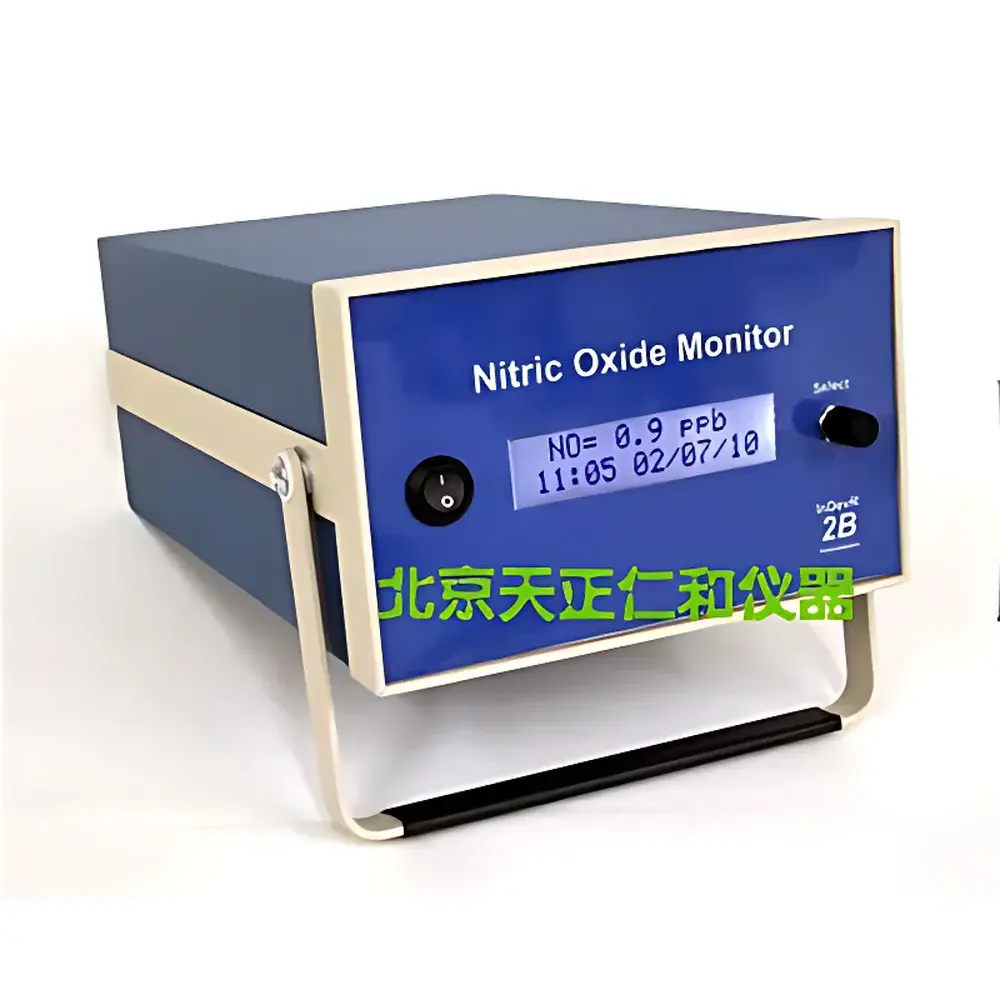
Thermo Scientific Model 410 Nitric Oxide Analyzer
| Origin | USA |
|---|---|
| Manufacturer Type | Authorized Distributor |
| Origin Category | Imported |
| Model | 410 |
| Pricing | Available Upon Request |
Overview
The Thermo Scientific Model 410 Nitric Oxide (NO) Analyzer is a compact, high-sensitivity ambient air quality monitor engineered for continuous, real-time quantification of nitric oxide at sub-ppb levels in outdoor and indoor atmospheric environments. It operates on the chemiluminescence-free principle of ozone depletion titration: NO in the sampled air stream reacts quantitatively with a precisely metered ozone (O₃) standard, generating nitrogen dioxide (NO₂) and consuming ozone in equimolar proportion. The resultant decrease in ozone concentration is measured via absolute ultraviolet absorption photometry at 254 nm—eliminating reliance on calibration gas standards for routine operation and significantly enhancing long-term measurement stability. This fundamental design distinguishes the Model 410 from conventional NO/NOx chemiluminescence analyzers, which require frequent span and zero calibrations using certified reference gases to maintain traceability per EPA Method 40 CFR Part 53 and ISO 7935.
Key Features
- Ultra-low power consumption: typical 11.4 W, max 22.3 W (with optional heated inlet)
- Compact footprint: 33.7 × 20.0 × 13.3 cm; lightweight design at 3.7 kg—optimized for mobile monitoring platforms, UAV-integrated payloads, and space-constrained urban sensor networks
- High-precision detection limit: ±1.5 ppb or ±2% of reading (whichever is greater), validated against NIST-traceable NO standards
- Fast response time: 10-second measurement cycle with configurable averaging intervals (10 s, 1 min, 5 min, 1 hr)
- Integrated dual-channel capability when paired with the Thermo Scientific Model 401 NO₂ Converter: enables simultaneous, co-located NO, NO₂, and NOx (NO + NO₂) measurement without hardware duplication or spatial mismatch
- Robust architecture with internal temperature stabilization and pressure-compensated flow control (1.0 L/min ±2%) to ensure metrological consistency across variable ambient conditions
Sample Compatibility & Compliance
The Model 410 is designed for direct analysis of ambient air without pre-concentration or chemical derivatization. Its sample inlet accommodates particulate filters (e.g., Teflon® 2.5 µm cutoff) and optional Nafion® dryers to mitigate humidity interference. The analyzer meets performance criteria specified in U.S. EPA Reference Method EQOA-0032 for NO monitoring and aligns with ISO 11085:2022 (ambient air—determination of nitrogen oxides—ultraviolet photometric method). All firmware and data handling protocols support audit-ready operation under GLP and ISO/IEC 17025 laboratory accreditation frameworks. Optional analog and digital outputs comply with industrial process control standards (4–20 mA, RS-232, 0–2.5 V) and are compatible with SCADA, EPA AirNow, and European EEA Air Quality e-Reporting systems.
Software & Data Management
Data acquisition and instrument control are managed via embedded firmware with non-volatile memory supporting up to 14,336 data records. Storage duration varies with averaging interval: ~1.4 days at 10-second resolution or ~1.4 months at 5-minute averaging. Internal timestamps are synchronized to UTC via optional GPS input. Raw and averaged values—including NO concentration, internal O₃ reference level, flow rate, temperature, and pressure—are logged with full metadata. Optional removable microSD card enables offline archival and field-deployable data offload. Remote configuration, diagnostics, and firmware updates are supported via serial command protocol, ensuring compatibility with centralized environmental data management platforms compliant with FDA 21 CFR Part 11 (electronic records and signatures) when deployed in regulated monitoring networks.
Applications
- Urban and roadside air quality monitoring networks (AQMS) for compliance with WHO and EU Directive 2008/50/EC NO2 limits
- Mobile emissions testing—mounted on research vehicles or drones for spatially resolved NO plume mapping near traffic corridors and industrial perimeters
- Indoor air quality assessment in laboratories, cleanrooms, and healthcare facilities where NO exposure must be monitored below occupational exposure limits (OSHA PEL = 25 ppm; ACGIH TLV = 25 ppm)
- Atmospheric chemistry field campaigns requiring low-power, high-reproducibility NO measurements alongside O₃, CO, and VOC analyzers
- Calibration transfer and intercomparison studies between reference-grade and low-cost sensor networks
FAQ
Does the Model 410 require periodic calibration with certified NO gas standards?
No—its ozone depletion photometric principle provides inherent traceability to primary UV absorbance standards. Routine zero checks (using scrubbed air) and ozone generator verification are recommended every 7–14 days; full multi-point calibration is required only annually or after major maintenance.
Can the Model 410 operate unattended for extended periods?
Yes—it supports continuous 24/7 operation with built-in watchdog timers, automatic fault logging, and power-fail recovery. With external battery backup and solar charging integration, field deployments exceeding 30 days are routinely achieved.
Is the Model 410 compatible with the Model 401 NO₂ Converter for NOx measurement?
Yes—the two instruments share identical mechanical mounting interfaces, power architecture, and communication protocols. When coupled, they deliver synchronized NO, NO₂, and NOx data streams with matched time stamps and uncertainty budgets.
What environmental conditions affect measurement accuracy?
Ambient temperature fluctuations beyond 15–35°C may require optional inlet heating/cooling modules. Relative humidity >90% RH may necessitate a Nafion® dryer to prevent condensation-induced optical path distortion in the UV cell.
How is data integrity ensured during transmission and storage?
All stored records include CRC-16 checksums, instrument ID, firmware version, and operator-defined site metadata. Optional encryption and digital signing modules satisfy GDPR and HIPAA-compliant data handling requirements for sensitive environmental health studies.
Related Products







