
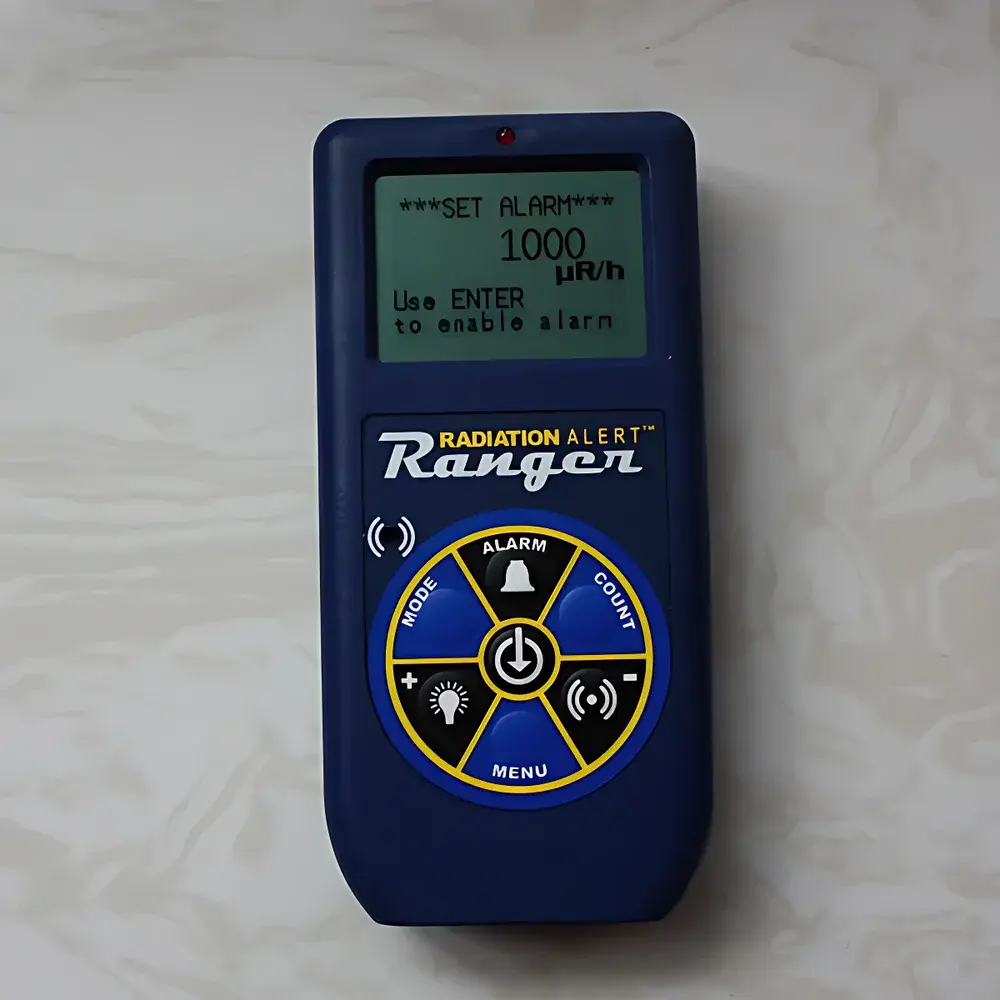
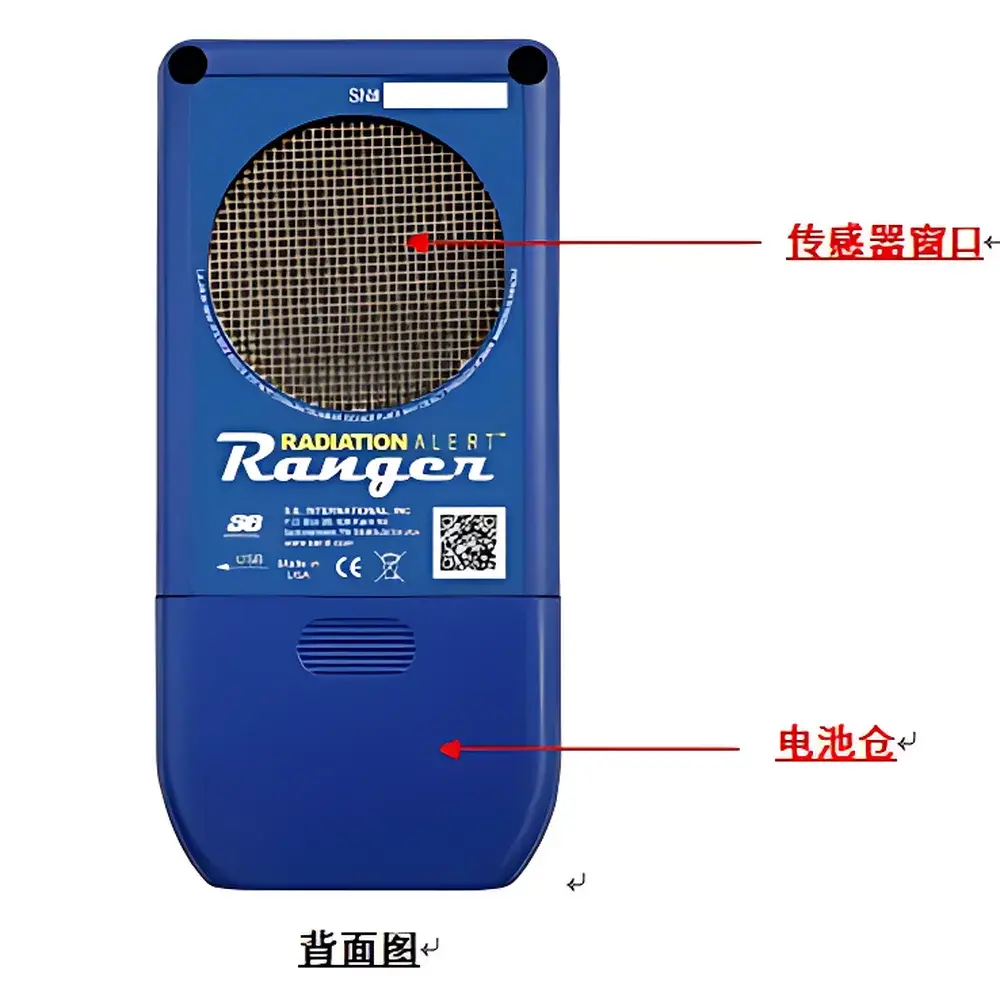
Ranger USB Digital Multifunction Radiation Detector
| Brand | PKSAIR |
|---|---|
| Origin | USA |
| Model | Ranger USB |
| Instrument Type | Portable Dose Rate Meter |
| Detector Type | Halogen-filled Geiger-Müller Tube (1.77" / 45 mm effective diameter |
| mica window density | 1.4–2.0 mg/cm²) |
| Measurement Range | 0.001–100.0 mR/hr |
| Sensitivity | 3340 CPM/mR/hr (referenced to Cs-137) |
| Sample Form | Solid |
| Compliance | CE certified |
Overview
The Ranger USB Digital Multifunction Radiation Detector is a portable, high-sensitivity radiation monitoring instrument engineered for precision dose rate measurement, surface contamination assessment, and real-time radiological safety surveillance. It operates on the principle of gas ionization detection via a halogen-quenched Geiger-Müller (GM) tube—specifically optimized for broad-energy response across alpha (≥2.0 MeV), beta (≥40 keV), gamma (≥10 keV), and X-ray spectra. Unlike scintillation or semiconductor-based detectors, the GM tube architecture delivers robust, cost-effective, and field-deployable performance with inherent pulse-counting capability, enabling simultaneous acquisition of count rate (CPS/CPM), accumulated counts, and dose-equivalent rate (mR/hr or µSv/hr). Designed for operational continuity in dynamic environments—from emergency response teams to hospital radiation safety officers—the Ranger USB integrates a dedicated Real-time Monitoring Engine (RME) that supports continuous background assessment and rapid anomaly detection without user intervention.
Key Features
- High-efficiency 45 mm (1.77″) halogen-filled GM detector with ultra-thin mica end-window (1.4–2.0 mg/cm²), optimized for alpha/beta sensitivity while maintaining gamma/X-ray response.
- Four-digit LCD display with mode indicators and auto-scaling averaging—updates every 3 seconds using a dynamically weighted 30-second moving average (shorter averaging intervals at elevated count rates).
- Multi-mode operation: dose rate (mR/hr, µSv/hr), surface contamination (CPM → Bq/cm² conversion per national regulatory conventions), total count accumulation, and pulse counting (CPS/CPM/DPM).
- User-configurable dual-threshold audible/visual alarm (0.001–50 mR/hr or 1–160,000 CPM); 70 dB @ 1 m; optional silent mode with LED-only alerting.
- Onboard data logger with non-volatile memory; USB 2.0 interface for direct PC connection and firmware/data transfer using proprietary Windows-compatible software.
- Auto-calibration support with customizable calibration factors for multiple reference sources (e.g., Cs-137, Co-60, Am-241); manual calibration routine included for traceable field verification.
- Ruggedized IP54-rated enclosure with shock-absorbing overmold; operational across –10°C to +50°C and 20–90% RH (non-condensing).
Sample Compatibility & Compliance
The Ranger USB is validated for solid-surface measurements—including swipe tests, building materials (granite, concrete), medical devices, scrap metal, and consumer goods (ceramics, glassware). Its thin mica window permits direct alpha/beta detection from unsealed sources, while its energy response profile meets IEC 60846-1:2014 requirements for portable ambient dose equivalent rate meters. CE marking confirms compliance with EU Electromagnetic Compatibility (2014/30/EU) and Low Voltage (2014/35/EU) directives. Although not FDA 510(k)-cleared or ISO 17025-accredited out-of-box, the device supports GLP/GMP-aligned workflows through audit-trail-capable software logging, timestamped records, and user-accessible calibration history—facilitating integration into radiation protection programs compliant with NRC Regulatory Guide 8.34, IAEA Safety Standards Series No. RS-G-1.9, and EPA Method M-112.
Software & Data Management
The bundled PC application enables real-time streaming, historical trend visualization, CSV export, and batch analysis of stored datasets. Each logged entry includes UTC timestamp, measurement mode, unit, detector voltage status, and battery level. The software enforces role-based access control for configuration changes and supports digital signature-enabled report generation for QA/QC documentation. USB communication adheres to CDC ACM class protocols—no driver installation required on modern Windows/macOS/Linux systems. Firmware updates are delivered via signed binary packages with SHA-256 checksum validation to ensure integrity and prevent unauthorized modification.
Applications
- Nuclear incident first-response screening (e.g., RDDs, lost sources)
- Hospital radiology department QA: X-ray room leakage surveys, PET/CT shield integrity checks
- Customs and border protection: cargo container scanning for orphan sources or illicit radioactive material
- Environmental site assessment: radon progeny in soil gas, Ra-226 in groundwater, NORM/TENORM in oilfield equipment
- Industrial radiography safety: source handling verification, collimator alignment checks
- Consumer product testing: ceramic glazes, antique luminous dials, granite countertops, recycled steel
- Academic and teaching labs: nuclear physics demonstrations, shielding effectiveness studies
FAQ
What radiation types can the Ranger USB detect?
It detects alpha particles (≥2.0 MeV), beta particles (≥40 keV), gamma rays (≥10 keV), and X-rays via its thin-window halogen GM tube.
Is the device suitable for quantitative surface contamination measurement?
Yes—when used with standardized smear techniques and calibrated against traceable standards, it provides Bq/cm² results aligned with GB/T 14583-1993 and ISO 7503-1:2019 methodologies.
Does the Ranger USB meet regulatory requirements for workplace monitoring?
It satisfies general-purpose survey meter performance criteria per ANSI N42.33-2022 and IEC 60846-1:2014; however, formal dosimetry accreditation requires site-specific validation and periodic intercomparison with reference instruments.
Can data be exported for regulatory reporting?
Yes—CSV and PDF reports include metadata (operator ID, location tag, instrument serial number, calibration date) and support 21 CFR Part 11-compliant electronic signatures when deployed with validated software configurations.
How often does the detector require recalibration?
Annual calibration is recommended; more frequent verification (e.g., quarterly) is advised in high-use or mission-critical applications, using a traceable Cs-137 check source.
Related Products







