
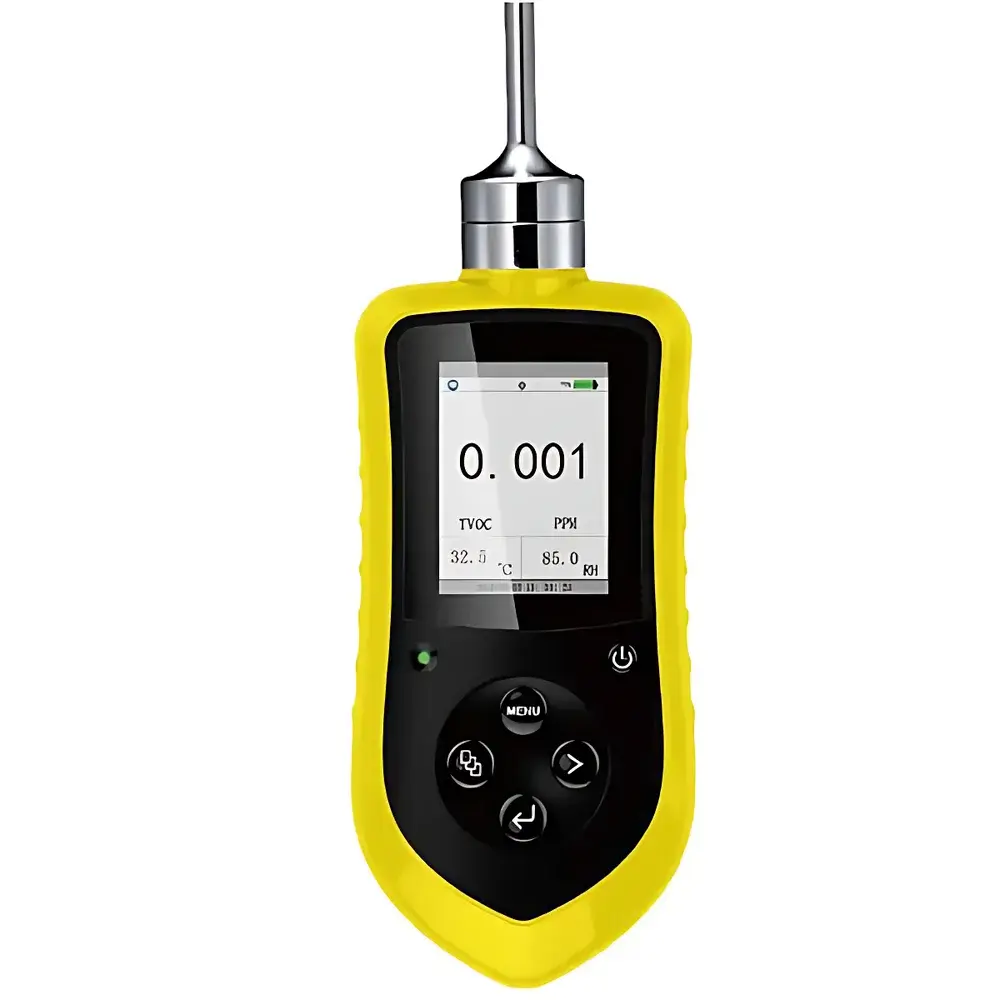
PKSAIR C4 Portable VOC Gas Detector
| Brand | PKSAIR |
|---|---|
| Model | C4 |
| Origin | Beijing, China |
| Instrument Type | Portable VOC Detector |
| Detection Principle | Electrochemical (for VOCs) |
| Detection Range | 0.01–20.00 ppm |
| Resolution | 0.01 ppm |
| Accuracy | ≤±3% FS |
| Response Time | ≤30 s (T90) |
| Repeatability | ≤±2% FS |
| Linearity Error | ≤±2% FS |
| Zero Drift | ≤±1% FS/year |
| Display | 2.4" color LCD (320×240) |
| Operating Temperature | −20 °C to +50 °C |
| Operating Humidity | ≤95% RH (non-condensing) |
| IP Rating | IP65 |
| Explosion Protection | Ex ib IIC T4 Gb |
| Battery | 2800 mAh Li-polymer, ~20 h continuous operation |
| Dimensions | 211.5 × 73 × 34.5 mm |
| Weight | 240 g |
| Sampling Method | Integrated Thomas vacuum pump (300–500 mL/min) |
| Data Storage | Up to 100,000 records (optional) |
| Compliance | GB 50493-2009, GB 12358-2006, GBZ 2.1-2007, GB 3836.1/4-2010 |
Overview
The PKSAIR C4 Portable VOC Gas Detector is an intrinsically safe, electrochemical-based field instrument engineered for reliable, real-time quantification of volatile organic compounds (VOCs) in occupational and environmental settings. Designed in accordance with international functional safety principles and aligned with Chinese national standards for hazardous area instrumentation (GB 3836.4-2010), the C4 employs a calibrated electrochemical sensing module—sourced from a Tier-1 global sensor manufacturer—to deliver trace-level detection across a linear range of 0.01–20.00 ppm. Its measurement architecture integrates active sampling via a certified Thomas miniature vacuum pump (Germany), ensuring consistent volumetric flow (300–500 mL/min) and minimizing diffusion-limited response delays. The device operates on a 32-bit nanoscale microcontroller paired with a 24-bit high-resolution ADC, enabling low-noise signal acquisition, full-scale temperature and humidity compensation, and robust baseline stability—even under transient ambient conditions. Unlike optical or PID-based alternatives, the electrochemical platform provides selective, low-power, maintenance-light detection suitable for routine industrial hygiene monitoring, confined-space entry verification, and long-duration personal exposure assessment.
Key Features
- Intrinsically safe design certified to Ex ib IIC T4 Gb for use in Zone 1/2 explosive atmospheres
- IP65-rated enclosure constructed from impact- and chemical-resistant ABS+PC polymer, compliant with UL 94 V-0 flame retardancy
- Integrated Thomas vacuum pump delivering stable, quiet, and durable active sampling (≥10,000 h MTBF)
- 2.4-inch high-definition color LCD (320×240) with dual-language (English/Chinese) UI and real-time graphical trend display
- Onboard 2800 mAh Li-polymer battery supporting ≥20 hours of continuous operation; Micro-USB charging compatible with standard 5 V DC sources
- Configurable dual-stage alarms (high/low threshold), audible buzzer (≥85 dB), bright LED indicators, and on-screen text alerts
- Comprehensive data integrity safeguards: anti-clogging pump protection, overvoltage/ESD/EMI hardening, automatic zero calibration, and dual recovery modes (soft reset + factory restore)
- Optional internal memory supporting up to 100,000 timestamped records—including concentration values, alarm events, fault logs, and power cycles
Sample Compatibility & Compliance
The PKSAIR C4 is validated for direct air sampling of common VOCs including benzene, toluene, xylene, formaldehyde, acetone, and ethanol—subject to sensor-specific cross-sensitivity profiles documented in the technical manual. It meets the performance requirements of GB 12358-2006 (General Technical Requirements for Gas Detection Alarm Instruments in Workplaces) and aligns with occupational exposure limits defined in GBZ 2.1-2007. For fixed-installation integration or regulatory reporting, raw data export (CSV/Excel) supports traceability in GLP-aligned workflows. While not FDA 21 CFR Part 11–certified out-of-box, audit-ready logging (with user ID, timestamps, and event flags) enables adaptation to ISO/IEC 17025–accredited laboratory quality systems when deployed with controlled procedures.
Software & Data Management
Data retrieval is performed via USB connection to Windows/macOS platforms using PKSAIR’s proprietary PC Utility v3.2. The software enables batch export of stored records into editable Excel spreadsheets, time-series charting, alarm summary generation, and customizable report templates. All logged entries include UTC timestamps, sensor status flags (e.g., “calibrating”, “low battery”, “pump fault”), and contextual metadata (e.g., operator ID, location tag). Firmware updates are delivered via signed binary packages with CRC-32 validation. No cloud connectivity or remote telemetry is embedded—ensuring air-gapped operation where required by site security policy.
Applications
- Occupational health monitoring: Personal exposure assessment during painting, coating, cleaning, or solvent-handling tasks
- Hazardous area surveillance: Leak detection in petrochemical plants, LNG terminals, and pharmaceutical cleanrooms
- Environmental compliance: Ambient air screening near landfills, wastewater treatment facilities, and industrial fencelines
- Indoor air quality (IAQ) audits: Post-renovation VOC off-gassing evaluation in offices, schools, and healthcare facilities
- Emergency response: Rapid reconnaissance during chemical spills, fire aftermath, or illicit lab investigations
- Academic research: Field-deployable reference instrumentation for atmospheric chemistry studies and sensor validation trials
FAQ
What VOC compounds does the C4 detect?
The C4 is calibrated for total VOC response using a broad-spectrum electrochemical sensor. Specific compound sensitivity varies; users should consult the sensor datasheet for relative response factors (RRFs) and interference profiles.
Is field calibration supported?
Yes—zero calibration and span adjustment are accessible via password-protected service menus using certified gas standards (e.g., 10 ppm isobutylene in air). Calibration intervals follow GB 12358-2006 recommendations (typically every 3–6 months, or after exposure to >100 ppm).
Can the device operate in sub-zero temperatures?
Rated for −20 °C to +50 °C ambient operation. Below 0 °C, battery discharge rate increases and sensor response time may extend slightly; pre-warming is advised for critical measurements.
Does the C4 meet ATEX or IECEx certification requirements?
No—it holds only China’s GB 3836.4-2010 intrinsic safety certification (Ex ib IIC T4 Gb). For ATEX/IECEx-marked equivalents, contact PKSAIR’s OEM partners for region-specific variants.
How is data integrity ensured during storage and transfer?
All records are written to non-volatile flash memory with write-cycle redundancy. Exported CSV files include SHA-256 checksums; no data modification occurs during PC transfer.
Related Products







