
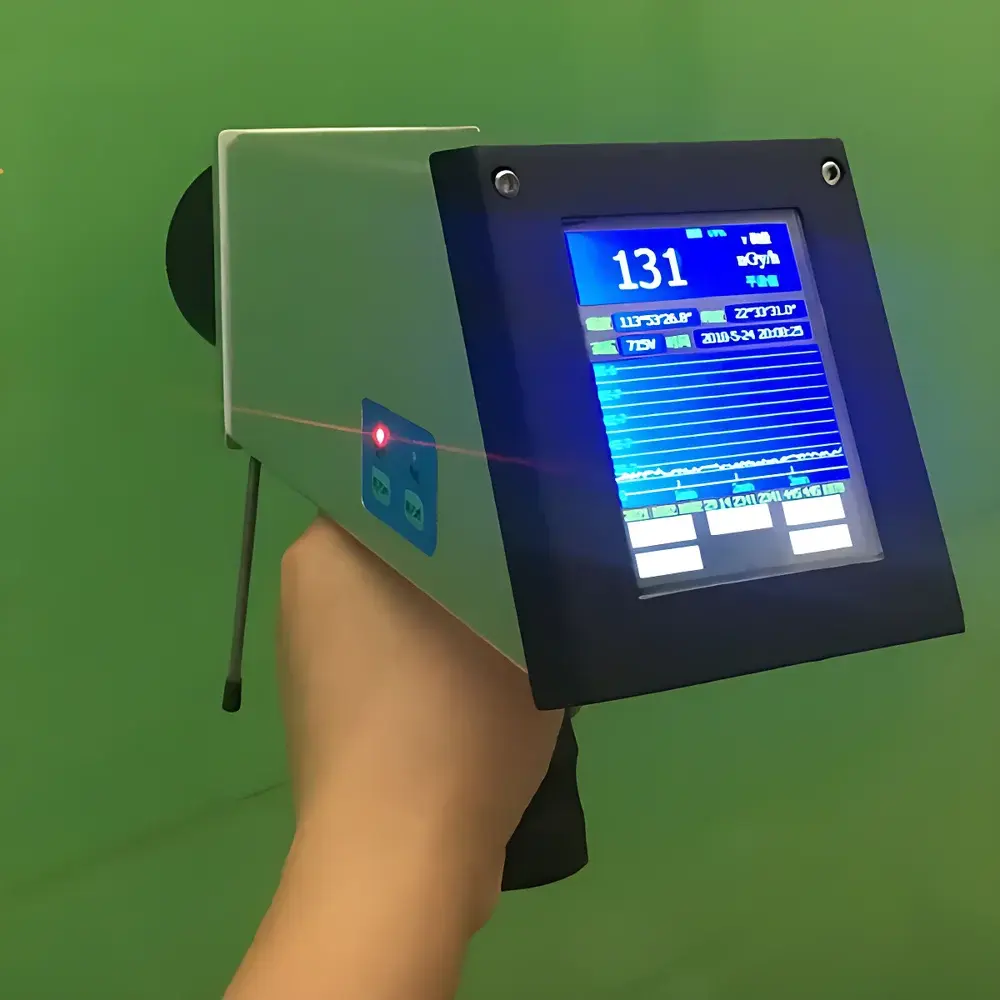
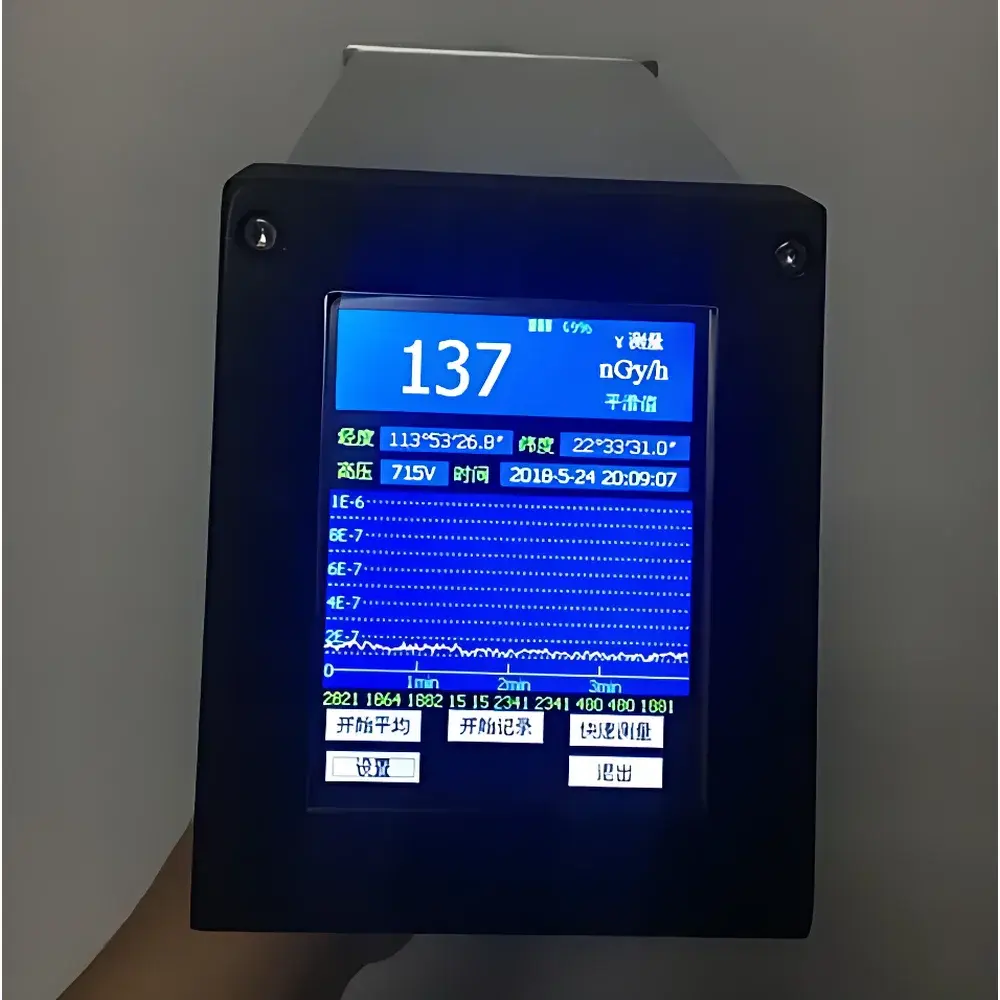
PKSAIR 113E Portable Environmental X- and γ-Ray Dose Rate Meter
| Brand | PKSAIR |
|---|---|
| Origin | Beijing, China |
| Manufacturer Type | Authorized Distributor |
| Country of Origin | China |
| Model | 113E |
| Instrument Category | Radiation Dosimeter / Dose Rate Meter |
| Form Factor | Portable |
| Measured Radiation | X-rays and γ-rays |
| Detector Type | 76.2 × 57.15 mm Plastic Scintillator |
| Dose Rate Range | 10 nGy/h – 2 mGy/h |
| Equivalent Dose Rate Range | 10 nSv/h – 2 mSv/h |
| Energy Response | 60 keV – 3.0 MeV (±30% deviation) |
| Response Time | 50 ms |
| Update Rate | 1 Hz (averaged), 20 Hz (instantaneous peak capture) |
| Display | 3.5-inch Industrial LCD Touchscreen |
| Power Supply | Rechargeable Li-ion Battery (≥8 h operation), Optional 12.6 VDC or Vehicle Cigarette Lighter Adapter |
| Operating Temperature | −10 °C to +45 °C |
| Relative Humidity | ≤95% RH (non-condensing) |
| Weight | ~2.0 kg |
| Data Storage Capacity | >10 million records |
| Positioning | Integrated GPS Module (typical horizontal accuracy <15 m) |
| Communication Interfaces | RS232, Optional Bluetooth/Wi-Fi |
Overview
The PKSAIR 113E Portable Environmental X- and γ-Ray Dose Rate Meter is a field-deployable radiation survey instrument engineered for high-fidelity environmental and operational dose rate monitoring. It operates on the principle of scintillation detection: incident X- and γ-ray photons interact with an air-equivalent plastic scintillator (76.2 × 57.15 mm), generating visible light pulses proportional to deposited energy. These pulses are converted into electrical signals by a photomultiplier tube (PMT), digitized, and processed in real time by an embedded microcontroller. The instrument delivers simultaneous measurement of ambient dose equivalent rate H’(10) and air kerma rate Ka, traceable to national standards per JJG 521–2006—China’s metrological verification regulation for environmental X/γ radiation dose rate meters. Its single-detector architecture eliminates mechanical switching between low- and high-range sensors, enabling seamless coverage from natural background levels (10 nSv/h) up to emergency response thresholds (2 mSv/h), while maintaining linearity and stability across temperature and humidity gradients.
Key Features
- Integrated 3.5-inch industrial-grade color touchscreen interface supporting real-time display of dose rate, accumulated dose, temporal trend curves, detector high voltage status, battery level, GPS coordinates (latitude/longitude), and timestamp.
- Air-equivalent plastic scintillator with optimized energy response from 60 keV to 3.0 MeV (±30% deviation), ensuring reliable measurements across common environmental and medical isotopic spectra (e.g., 137Cs, 60Co, 192Ir, 99mTc).
- High-speed pulse processing capability: 20 Hz instantaneous sampling enables accurate capture of transient radiation events—including diagnostic X-ray pulses—with reporting of peak dose rate, pulse width, and integrated dose per pulse.
- Full-sealed detector housing rated for IP65-level ingress protection, enabling continuous operation during mobile surveys (e.g., vehicle-mounted monitoring), in rain, dust, or high-humidity conditions.
- Onboard GPS module with sub-15-meter horizontal positioning accuracy; supports georeferenced logging of every dose reading for spatial dose mapping and route-based exposure assessment.
- Extended data storage (>10 million records) in non-volatile memory; exportable via RS232 or optional Bluetooth/Wi-Fi to CSV files compatible with regulatory reporting software and GIS platforms.
Sample Compatibility & Compliance
The PKSAIR 113E is validated for direct measurement of photon radiation fields in air without sample preparation. It complies with JJG 521–2006 for environmental dose rate meter performance, including requirements for lower limit of detection, energy dependence, angular response, and temperature stability. While not certified to IEC 60846-1:2014 or ANSI N42.22, its design principles align with international best practices for portable survey meters used in radiological protection. The instrument meets general functional expectations for use under ISO 2889:2015 (radiation protection instrumentation — portable contamination monitors) and supports GLP-aligned field documentation when paired with timestamped, GPS-tagged data logs. Its ±15% intrinsic calibration error and <±0.2%/°C thermal drift fall within acceptable tolerances for environmental screening and emergency triage applications as defined in IAEA Safety Standards Series No. RS-G-1.8.
Software & Data Management
The included PC application provides real-time telemetry visualization during field deployment, displaying live dose rate trends, geographic overlays, and battery telemetry. All acquired data—including dose rate (nSv/h), accumulated dose (µSv), GPS position (WGS84), UTC timestamp, and detector high voltage—are logged in comma-separated value (CSV) format. This structured output facilitates integration with laboratory information management systems (LIMS), regulatory submission templates (e.g., EPA Form 540), and third-party analysis tools such as Python Pandas, MATLAB, or QGIS. The software implements basic audit trail functionality—recording user login, session start/end timestamps, and configuration changes—to support internal quality assurance protocols. While not compliant with FDA 21 CFR Part 11 electronic signature requirements, the raw CSV log files are immutable and suitable for archival per ISO/IEC 17025:2017 clause 7.5.2.
Applications
- Environmental radiation surveillance: baseline mapping near nuclear facilities, post-incident plume tracking, and long-term monitoring of contaminated sites.
- Emergency response: rapid deployment during radiological dispersal device (RDD) incidents, lost source recovery, or transportation accidents involving radioactive materials.
- Regulatory compliance: routine surveys for licensees under national nuclear regulatory frameworks (e.g., NNSA oversight in China, NRC or CNSC equivalents abroad).
- Occupational health & safety: mobile dose rate assessment in decommissioning zones, waste handling areas, and border control checkpoints.
- Public health infrastructure: screening at airports, seaports, and land border crossings in accordance with IAEA Code of Conduct on the Safety and Security of Radioactive Sources.
- Academic and geological research: terrestrial gamma dose rate profiling for radon progeny studies, uranium/thorium mapping, and cosmic ray modulation analysis.
FAQ
What radiation types does the PKSAIR 113E detect?
It measures X-ray and gamma-ray photon fields exclusively. It is not sensitive to alpha, beta, or neutron radiation.
Is the instrument suitable for personal dosimetry?
No—it is a survey meter intended for area monitoring, not individual dose assessment. Personal dosimeters (e.g., TLD or OSL badges) remain required for legal dose-of-record purposes.
Can the detector be calibrated traceably to national standards?
Yes—calibration services are available through PKSAIR-authorized metrology laboratories accredited to ISO/IEC 17025, with certificates referencing primary standards maintained by BIPM or CNIM.
Does the device meet international radiation protection standards?
It satisfies JJG 521–2006 and exhibits performance characteristics consistent with IEC 60846-1:2014 Class II requirements for environmental dose rate meters, though formal certification is not held.
How is data integrity ensured during extended field deployments?
All measurements are timestamped, geotagged, and stored in non-volatile memory with cyclic overwrite protection. Battery-backed real-time clock maintains synchronization even during power interruption.







