
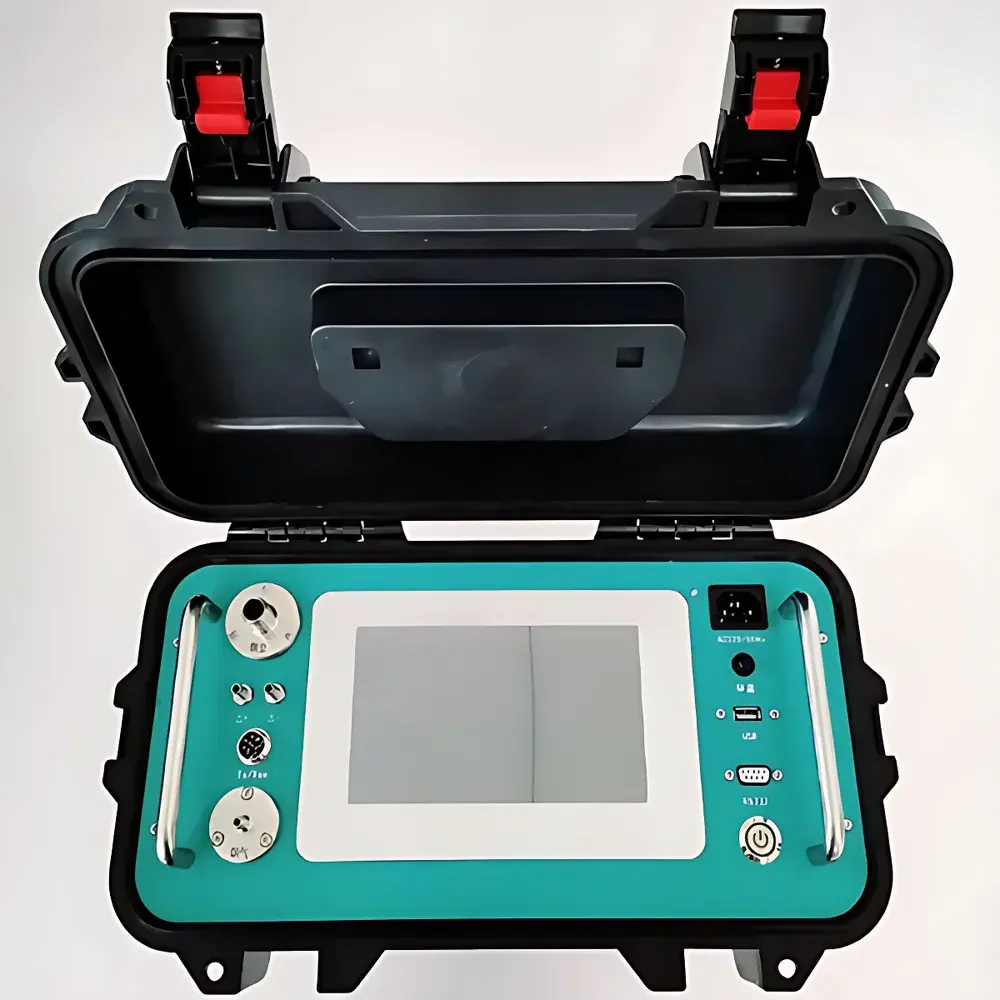
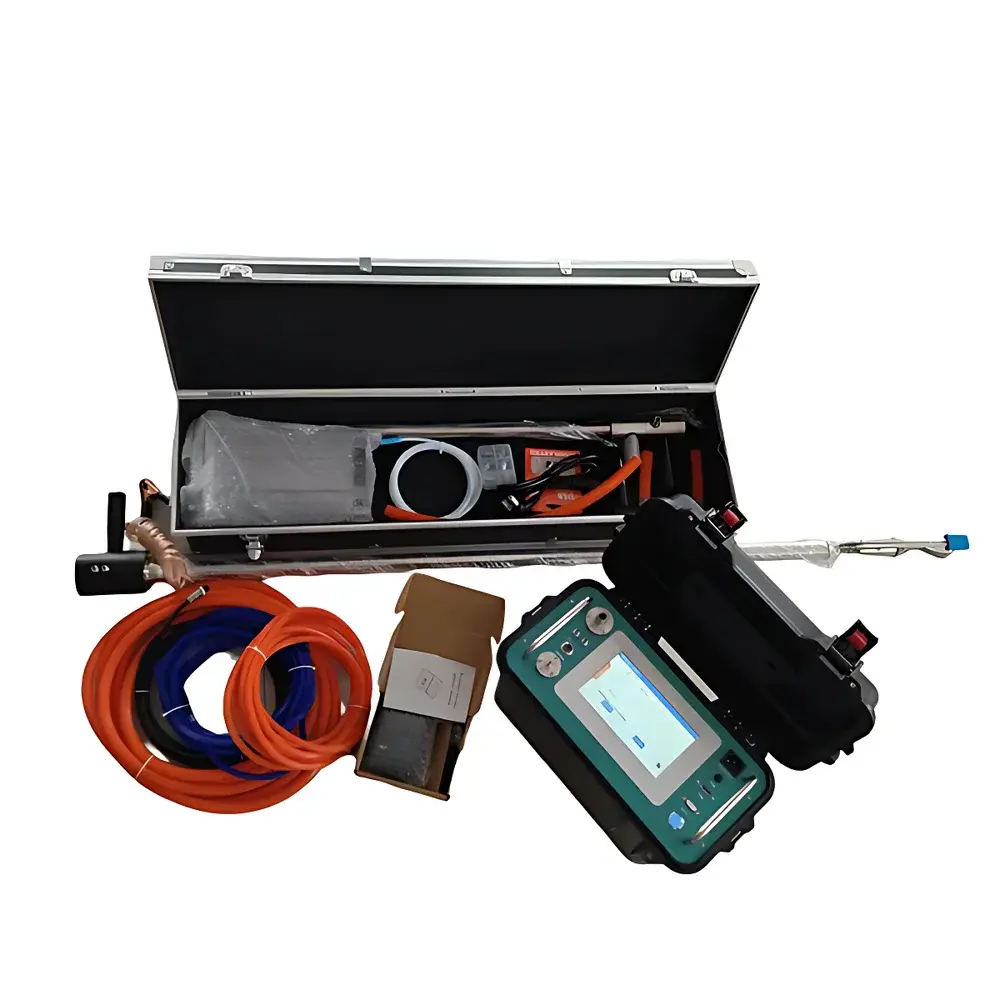
PKSAIR KS-51C Portable Flue Gas & Particulate Emission Analyzer
| Brand | PKSAIR |
|---|---|
| Origin | Beijing, China |
| Model | KS-51C |
| Instrument Type | Portable Flue Gas & Particulate Analyzer |
| Accuracy (Gas Sensors) | ±5% FS |
| Repeatability | ≤2.0% |
| Response Time | ≤90 s |
| Drift Stability | ≤5.0% over 1 h |
| Measured Gases | O₂, SO₂, NO, NO₂, CO, CO₂, H₂S |
| Dust Sampling Flow Rate | 10–100 L/min |
| Flue Gas Temperature Range | 0–200 °C |
| Pressure Ranges | Dynamic (0–2500 Pa), Static (−20 to +20 kPa) |
| Data Storage Capacity | ≥30,000 records |
| Power Supply | AC 220 V ±10% / 50 Hz or Rechargeable Li-ion Battery |
| Weight | ~5 kg (incl. battery) |
Overview
The PKSAIR KS-51C Portable Flue Gas & Particulate Emission Analyzer is an integrated, field-deployable instrument engineered for simultaneous measurement of stack particulate mass concentration and flue gas composition in compliance with Chinese national metrological verification regulations JJG 680–2007 (Particulate Samplers) and JJG 968–2002 (Flue Gas Analyzers). It implements gravimetric particulate sampling combined with electrochemical and NDIR gas sensing technologies to deliver concurrent, co-located determination of dust loading and gaseous pollutants—including O₂, SO₂, NO, NO₂, CO, CO₂, and H₂S—within a single operational sequence. Designed for regulatory monitoring at stationary emission sources, the KS-51C supports calculation of normalized concentrations (e.g., 6% O₂ reference), emission rates (mg/m³·h), and desulfurization/de-NOₓ efficiency metrics. Its architecture conforms to technical requirements specified in HJ/T 48–1999 (Technical Specification for Particulate Samplers) and HJ/T 76–2017 (Standard Specification for Continuous Emission Monitoring Systems), enabling direct use in environmental inspection, third-party verification, and routine compliance auditing.
Key Features
- Integrated dual-path sampling system enabling synchronized isokinetic particulate collection and real-time flue gas analysis—eliminating sequential measurement delays and minimizing field time.
- High-stability differential pressure sensor (imported) for accurate flue gas velocity measurement across dynamic pressure ranges up to 2500 Pa, supporting automatic isokinetic tracking with ≤4 s response.
- 7-inch industrial-grade capacitive touch LCD display with anti-glare coating—operable under direct sunlight and compatible with gloved handling.
- Corrosion-resistant 316 stainless steel probe and sampling line assembly, rated for continuous exposure to acidic condensates and high-humidity flue streams (up to 60% RH).
- Heated sensor modules (maintained at >60 °C) prevent water condensation on electrochemical cell surfaces, ensuring stable baseline and extended sensor life in saturated exhaust environments.
- Built-in Bluetooth thermal printer (optional driver support) for immediate hard-copy reporting of field measurements without external peripherals.
- Dual data export interfaces: USB 2.0 mass storage mode for CSV log retrieval and RS-232 port for firmware updates and remote configuration via PC-based utility software.
- Rechargeable lithium-ion battery pack delivering ≥4 h continuous operation at 1 L/min gas flow and 50 L/min particulate sampling—certified per UN 38.3 transport safety standards.
- Expandable internal memory storing ≥30,000 timestamped records with full metadata (date/time, location tag, operator ID, calibration status, ambient conditions).
Sample Compatibility & Compliance
The KS-51C is validated for use across coal-fired boilers, biomass furnaces, cement kilns, waste incinerators, and metallurgical process stacks operating under temperatures up to 200 °C and negative/positive static pressures from −20 to +20 kPa. It accommodates duct diameters ≥0.3 m and flue velocities between 5–45 m/s while maintaining isokinetic sampling integrity. All gas sensors are factory-calibrated against NIST-traceable standard gases and comply with GB/T 16157–1996 (Determination of Particulates in Exhaust Gases from Stationary Sources) and GB 13223–2011 (Emission Standards of Air Pollutants for Thermal Power Plants). The instrument’s measurement uncertainty budget satisfies ISO 5725-2:2019 (accuracy and precision) and meets functional equivalency requirements for audit-ready data under China’s MEP Order No. 39 (Environmental Monitoring Management Measures).
Software & Data Management
Data acquisition and post-processing are managed through PKSAIR’s proprietary PC software (v3.2+), supporting automated report generation in bilingual (CN/EN) PDF format compliant with local EPB submission templates. The software enforces audit trails including user login timestamps, parameter change logs, calibration event records, and digital signatures—aligned with GLP principles. Raw data exports include full sensor diagnostics (zero/span drift flags, temperature compensation coefficients, pump vacuum alerts). Optional GPRS module enables secure TLS-encrypted transmission of summary datasets to centralized environmental information platforms (e.g., provincial MEP cloud systems), with configurable upload intervals and failover retry logic. Firmware updates preserve historical calibration coefficients and user-defined site profiles.
Applications
- Regulatory stack testing for compliance with GB 13271–2014 (Boiler Atmospheric Pollutants Emission Standard) and GB 16297–1996 (Comprehensive Emission Standard of Air Pollutants).
- Performance evaluation of flue gas desulfurization (FGD), selective catalytic reduction (SCR), and electrostatic precipitator (ESP) systems.
- Source apportionment studies requiring co-located particulate and speciated gas data to identify combustion inefficiencies or reagent dosing anomalies.
- Pre-commissioning verification and periodic maintenance checks for CEMS backup validation per HJ 75–2017.
- Mobile monitoring campaigns conducted by provincial environmental supervision teams during seasonal air quality enforcement periods.
FAQ
Does the KS-51C support automatic isokinetic sampling correction during variable flow conditions?
Yes—the instrument continuously monitors dynamic pressure and adjusts sampling pump speed in real time to maintain isokinetic ratio within ±4.0% tolerance, as verified per HJ/T 48–1999 Annex B.
Are sensor cross-sensitivities compensated in firmware?
Electrochemical sensors for NO and NO₂ incorporate embedded temperature/humidity compensation algorithms; SO₂ and H₂S modules include optical filter layers to minimize interference from CO and hydrocarbons.
Can raw sensor voltage outputs be accessed for custom calibration protocols?
Yes—RS-232 interface provides access to unprocessed ADC values and internal thermistor readings for metrology-grade recalibration using accredited reference standards.
Is the device certified for intrinsically safe operation in explosive atmospheres?
No—the KS-51C is not ATEX or IECEx certified; it is intended for use in non-hazardous classified zones only.
What is the recommended calibration frequency under daily field use?
Zero and span calibration is required before each measurement shift using certified span gases; full multi-point verification is advised every 90 days or after 200 hours of cumulative operation.
Related Products







