Taiwan-Made Model 302 Far-Infrared Emissivity Tester (Technology Licensed from National Chung-Shan Institute of Science and Technology)
| Origin | Taiwan |
|---|---|
| Manufacturer Type | Authorized Distributor |
| Domestic Origin | Yes |
| Model | 302 |
| Pricing | Available Upon Request |
| Emissivity Range | 0.01–1.00 |
| Spectral Band | 5–14 µm |
| Temperature Accuracy | ±0.015 °C |
| Response Time | 500 ms |
| Emissivity Readout Interval | 3 s |
| Operating Ambient Temperature | 24–28 °C (Optimal at 26 °C) |
| Operating Humidity | 10–95% RH (Non-condensing) |
| Sample Test Temperature | 34.0 °C |
| Calibration Blackbody Diameter | φ60 ±1 mm |
| Blackbody Setpoint | 34.0 °C |
| Dimensions (H×W×D) | 18.7 × 18.4 × 15.0 cm |
| Weight | 3.2 kg |
| Power Supply | AC 110 V / 220 V |
| Standard Accessory | Certified 0.95 Emissivity Blackbody Reference (at 26 °C) |
| Optional Accessory | PC Control Software & USB/RS-232 Interface Module |
Overview
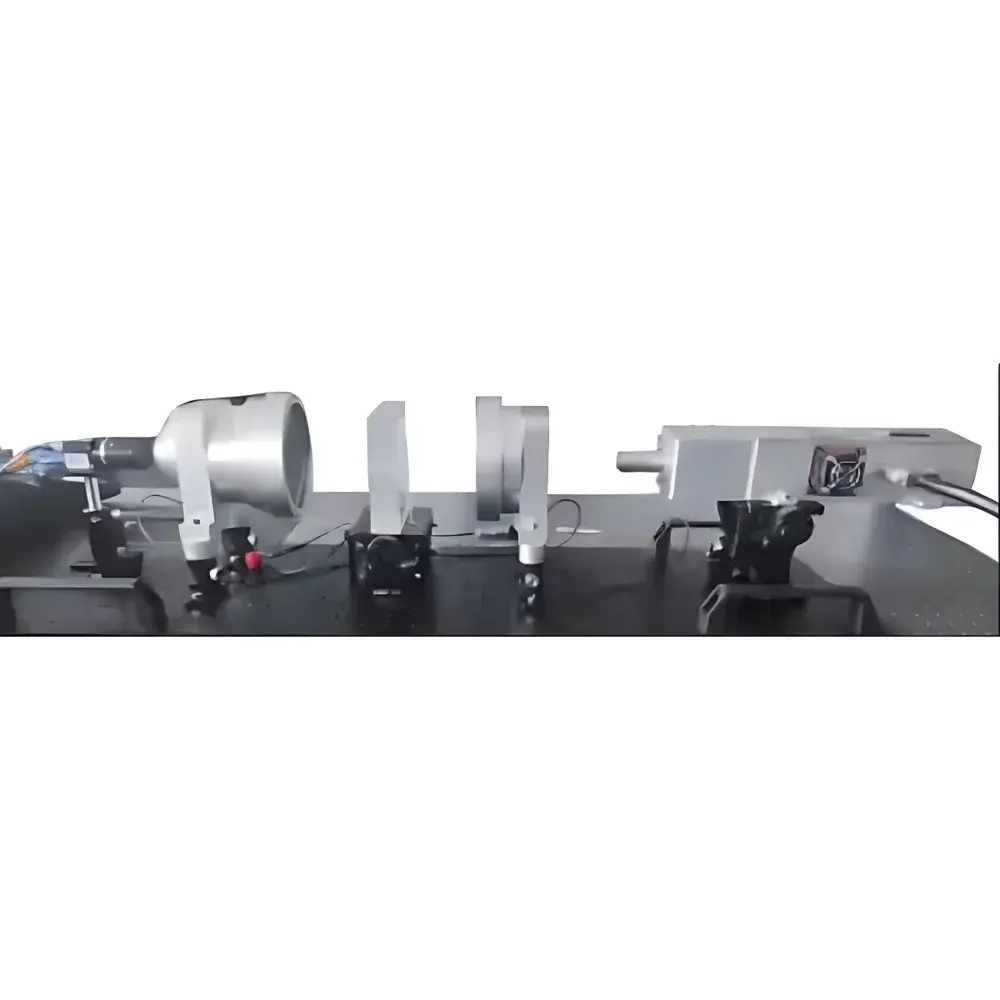
The Model 302 Far-Infrared Emissivity Tester is an engineered metrological instrument designed for non-contact, high-fidelity measurement of spectral emissivity in the far-infrared band (5–14 µm). Developed under technology transfer from the National Chung-Shan Institute of Science and Technology (NCSIST), Taiwan, it implements a calibrated blackbody reference-based differential radiometric method—eliminating dependence on sample geometry, phase state, or consumables. Unlike conventional emissometers requiring vacuum chambers, cryogenic cooling, or spectral scanning mechanisms, the Model 302 operates at ambient laboratory conditions with a fixed-temperature blackbody cavity (34.0 °C, φ60 ±1 mm) serving as the primary radiance reference. Its core architecture enables stable, repeatable emissivity quantification across heterogeneous material classes—including irregular solids, textiles, powders, granular media, and liquids—without surface preparation or coating. The device complies with fundamental principles outlined in ASTM E1933-19 (Standard Test Methods for Measuring and Compensating for Emissivity Using Infrared Imaging Systems) and supports traceable calibration protocols aligned with ISO/IEC 17025 requirements for testing laboratories.
Key Features
- Patented blackbody-referenced radiometric design enabling emissivity measurement without sample contact, heating, or geometric constraints
- Stable thermal reference source maintained at precisely 34.0 °C (±0.015 °C accuracy) via integrated Peltier-controlled cavity
- Real-time emissivity output with 3-second readout interval and sub-millisecond detector response (500 ms)
- Wide dynamic range: emissivity values quantified from 0.01 to 1.00 with linear digital resolution
- Compact benchtop form factor (18.7 × 18.4 × 15.0 cm; 3.2 kg) suitable for QC labs, R&D facilities, and regulatory-compliant environments
- Dual-voltage power compatibility (AC 110 V / 220 V) and operational resilience across 10–95% RH (non-condensing)
- Included NIST-traceable 0.95-emissivity blackbody reference disc calibrated at 26 °C for daily verification
Sample Compatibility & Compliance
The Model 302 accommodates diverse physical states and morphologies without modification: rigid or flexible solids (e.g., ceramics, composites, polymer films), irregularly shaped components (e.g., heat sinks, medical devices), textile substrates (woven, knitted, nonwovens), bulk powders and granules (pharmaceutical excipients, catalysts), and static liquid surfaces (coolants, biofluid simulants). It does not require vacuum, inert atmosphere, or temperature ramping—making it suitable for routine quality control under GLP or ISO 9001 frameworks. While not FDA-cleared as a medical device, its thermal stability and repeatability support validation activities referenced in USP (Containers—Glass) and ASTM C1371-22 (Standard Test Method for Determination of Emissivity of Materials Near Room Temperature Using a Portable Infrared Emissometer).
Software & Data Management
An optional PC-based software suite provides full instrument control, time-stamped data logging, emissivity trend analysis, and CSV export for statistical process control (SPC). The interface supports audit trail functionality compliant with FDA 21 CFR Part 11 when deployed with user authentication and electronic signature modules. Raw radiance values, ambient condition metadata (temperature/humidity), and operator ID are embedded in each dataset. Software-generated reports include calibration history, measurement uncertainty estimates per GUM (Guide to the Expression of Uncertainty in Measurement), and conformance flags against user-defined specification limits.
Applications
- Thermal management validation of electronics packaging and heat-dissipating materials
- Emissivity mapping of aerospace thermal control coatings (e.g., ZnO, SiO₂-based paints)
- Quality assurance of far-infrared emitting textiles (e.g., wellness garments, therapeutic fabrics)
- Material screening for passive radiative cooling applications (e.g., building envelope materials)
- Reference characterization of standard reference materials (SRMs) for infrared thermography labs
- Supporting ISO 10211-compliant thermal bridge analysis in building physics research
FAQ
Does the Model 302 require periodic recalibration by an accredited lab?
Yes. Annual recalibration against primary blackbody standards is recommended. Certificate of Calibration includes uncertainty budget per ISO/IEC 17025.
Can emissivity be measured on curved or highly reflective surfaces?
Yes—provided the measurement spot (defined by optical field-of-view) is fully covered and ambient reflections are minimized using standardized shrouding techniques per ASTM E1933-19 Annex A2.
Is the 0.95 blackbody reference disc certified for traceability?
Yes. Supplied with a calibration certificate referencing NPL or NIST-traceable standards, valid for 12 months from date of issue.
What environmental conditions must be controlled during operation?
Ambient temperature must remain within 24–28 °C (26 °C optimal); humidity below 95% RH with no condensation. Air drafts near the aperture must be avoided to prevent thermal boundary layer disturbance.
How is measurement uncertainty estimated for a given sample?
Combined standard uncertainty incorporates contributions from blackbody temperature stability (±0.015 °C), detector nonlinearity (<0.2% FS), ambient drift compensation algorithm, and reference emissivity tolerance (±0.005), yielding typical expanded uncertainty (k=2) of ±0.012 in emissivity units.