
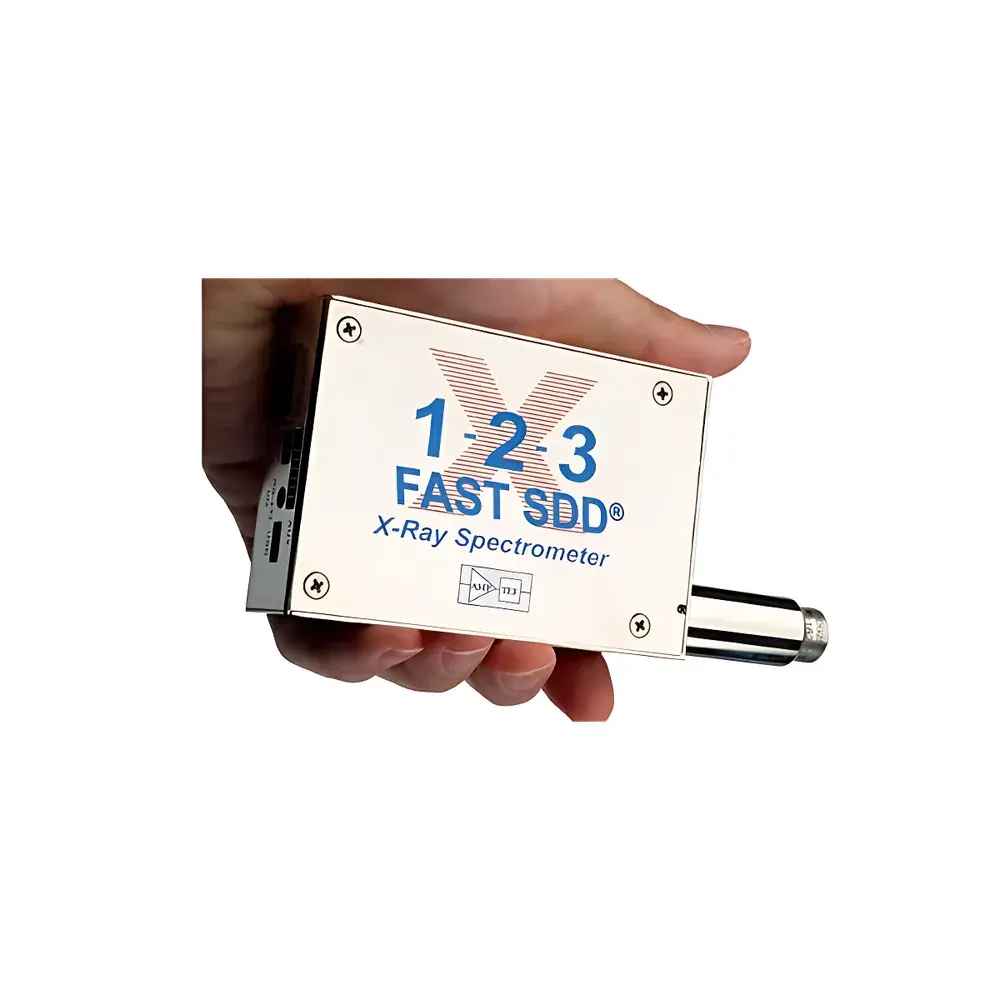
Amptek FASTSDD 70 mm² Active Area, 1000 µm Thick Silicon Drift Detector
| Brand | Amptek |
|---|---|
| Origin | USA |
| Model | FASTSDD-70-1000 |
| Detector Type | Silicon Drift Detector (SDD) |
| Active Area | 70 mm² |
| Thickness | 1000 µm |
| Elemental Range | Be (Z=4) to U (Z=92) |
| Detection Limit | 1 ppm |
| Energy Resolution | <140 eV at Mn Kα (5.9 keV) |
| Count Rate Capability | High-throughput fast pulse processing |
| Reproducibility | ≤0.1% RSD |
| Package | TO-8 metal can, pin-compatible with legacy 0.5 mm thick SDDs |
| Operating Voltage | Standard ±5 V analog output |
| Transmission Efficiency | Enhanced above 15 keV vs. thinner SDDs |
| Mounting Form Factor | Benchtop and floor-standing EDXRF systems |
Overview
The Amptek FASTSDD-70-1000 is a high-performance silicon drift detector (SDD) engineered for energy-dispersive X-ray fluorescence (EDXRF) spectrometry. Designed with a 70 mm² active area and 1000 µm silicon thickness, this detector delivers optimized sensitivity across the full elemental range—from beryllium (Z = 4) to uranium (Z = 92)—while maintaining sub-140 eV energy resolution at Mn Kα (5.9 keV). Its increased depletion depth significantly improves quantum efficiency for higher-energy X-rays (>15 keV), enabling robust detection of K-lines from heavy elements (e.g., Ba, Pb, U) and L- and M-lines from transition metals and actinides without sacrificing low-energy performance. The detector employs Amptek’s proprietary fast pulse processing architecture, supporting high count rates (>500 kcps) with minimal dead time and pulse pile-up distortion—critical for quantitative analysis in industrial QA/QC, geological surveying, and regulatory compliance testing.
Key Features
- 70 mm² large-area SDD with 1000 µm thick active silicon layer—enhanced stopping power for high-energy X-rays
- TO-8 hermetic metal-can packaging—mechanically robust, vacuum-compatible, and thermally stable
- PIN-pin-compatible drop-in replacement for legacy 0.5 mm thick SDDs—no rework of preamplifier, cabling, or mechanical interface required
- Standard ±5 V analog output with integrated FET and feedback resistor—direct integration with Amptek A250/A225 preamplifiers and DP5 digital pulse processors
- Optimized for Peltier-cooled operation (−20 °C typical), eliminating need for liquid nitrogen while sustaining resolution and noise performance
- High count-rate capability enabled by fast shaping time (0.25–1 µs) and real-time baseline restoration
Sample Compatibility & Compliance
The FASTSDD-70-1000 is designed for integration into benchtop and floor-standing EDXRF platforms used in regulated environments—including ISO/IEC 17025-accredited laboratories, EPA Method 6200-compliant soil screening, RoHS/WEEE-conformant electronics testing, and ASTM E1621-22 certified alloy analysis. Its linear response over 1 ppm–99.99% concentration range supports both bulk and thin-film quantification under fundamental parameter (FP) and empirical calibration models. The detector meets electromagnetic compatibility (EMC) requirements per IEC 61326-1 and operates within safety limits defined by IEC 61010-1 for measurement control equipment. Its stable gain and energy scale facilitate long-term drift correction essential for GLP/GMP audit trails.
Software & Data Management
When paired with Amptek’s DP5 digital processor and associated firmware (v3.2+), the FASTSDD-70-1000 enables full spectral acquisition, real-time peak deconvolution, and on-board dead-time correction. Compatible with industry-standard spectroscopy software—including PyMCA, AXIL, and commercial packages such as Thermo Fisher’s Omnian and Bruker’s ESPRIT—the detector supports export of calibrated spectra in standard formats (e.g., .csv, .rtd, .eds). All spectral metadata—including live time, real time, detector temperature, and HV bias—is embedded in spectrum headers to satisfy FDA 21 CFR Part 11 requirements for electronic records and signatures when deployed in pharmaceutical or medical device manufacturing QC workflows.
Applications
- Multi-element quantification in mining and exploration geochemistry (e.g., Ni, Cu, Zn, As, Pb in drill core powders)
- Non-destructive coating thickness and composition analysis (e.g., Sn/Pb plating on PCBs, Cr on stainless steel)
- Environmental monitoring of heavy metals in soils, sediments, and air particulates (PM2.5 filters)
- Forensic glass and paint chip analysis using trace element fingerprinting
- Quality assurance of catalysts, battery cathode materials (Ni-Co-Mn-Al oxides), and rare-earth magnets
FAQ
Is the FASTSDD-70-1000 compatible with existing EDXRF systems using older Amptek SDDs?
Yes—it uses identical TO-8 packaging, pinout configuration, and bias voltage requirements, allowing seamless hardware substitution without firmware or mechanical modification.
Does the 1000 µm thickness compromise low-energy resolution?
No—advanced guard ring design and optimized field shaping preserve charge collection uniformity and minimize capacitance, ensuring <140 eV resolution at 5.9 keV while extending effective detection to 40 keV.
What cooling method is required?
A single-stage Peltier cooler operating at −20 °C is sufficient; no liquid nitrogen or cryocooler is needed.
Can this detector be used in vacuum or helium-purged environments?
Yes—the TO-8 package is rated for operation under vacuum (<10⁻³ mbar) and inert gas purging, supporting light-element analysis down to Be.
How is energy calibration maintained over time?
Built-in reference sources (e.g., ⁵⁵Fe) or periodic external calibration with Fe/Mn/Cu standards enable automated gain stabilization via software-controlled offset adjustment.






