
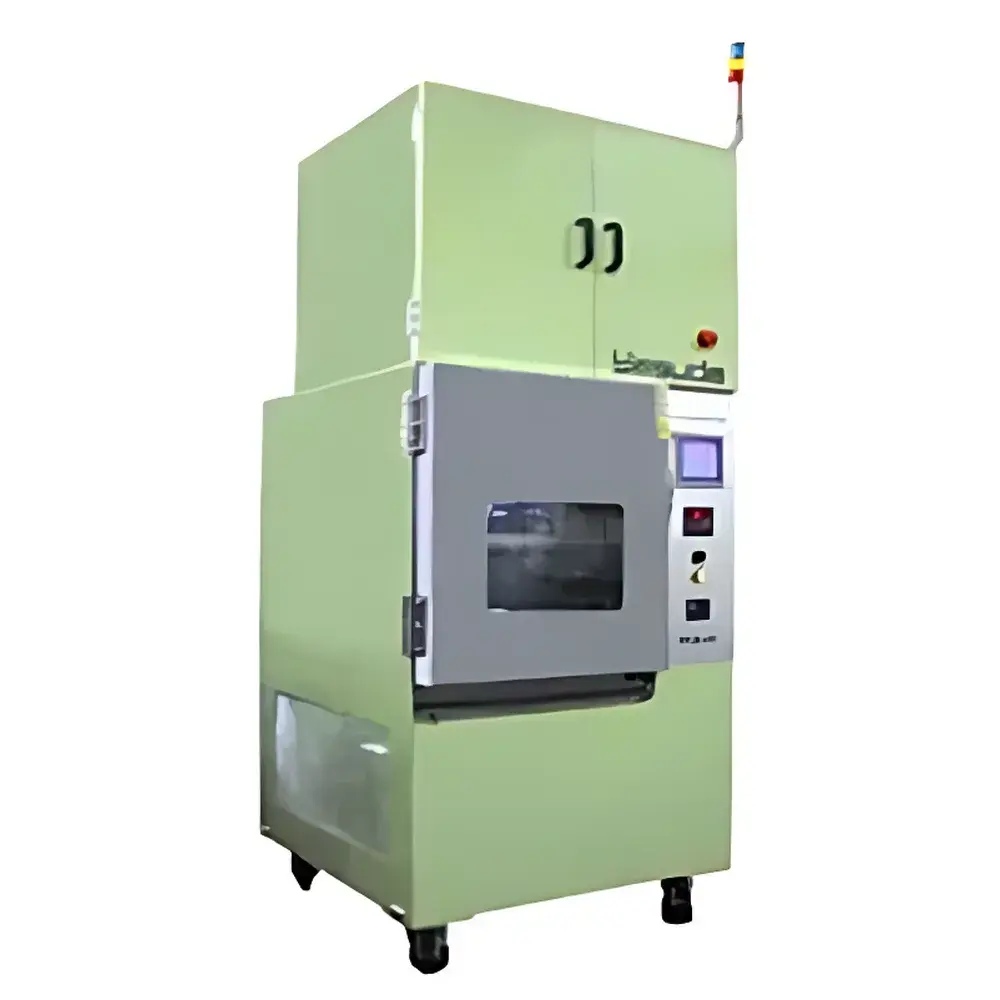
Yasuda No.661 Door Handle Endurance Tester
| Brand | Yasuda |
|---|---|
| Origin | Japan |
| Model | No.661 |
| Type | Automotive Door Handle Fatigue Testing Machine |
| Temperature Control | Triple-setpoint programmable thermal chamber (−20 °C, 23 °C, +80 °C) |
| Load Detection | Integrated load cell with automatic stop on threshold breach |
| Mounting | Dual-axis fixture—base clamp for handle base, upper actuator for operable lever |
| Compliance | Designed for JASO M404, ISO 12107, and SAE J2412 pre-compliance fatigue evaluation |
Overview
The Yasuda No.661 Door Handle Endurance Tester is a purpose-built electromechanical fatigue testing system engineered for repeatable, high-fidelity evaluation of automotive door handle durability under controlled thermal and mechanical stress conditions. It operates on the principle of cyclic mechanical loading—applying defined displacement or force profiles to the functional lever or pull mechanism of a door handle assembly while maintaining precise environmental temperature control. The system replicates real-world usage patterns including repeated opening/closing motions, static hold phases, and transient overload events. Unlike generic servo-hydraulic testers, the No.661 integrates a dedicated dual-clamp kinematic fixture that physically isolates the fixed mounting interface (handle base or escutcheon) from the actuated operable element (lever, knob, or paddle), ensuring load path fidelity and minimizing parasitic bending moments. Its architecture supports both displacement-controlled and load-limited test modes, with real-time monitoring of axial force via calibrated strain-gauge-based load cell feedback.
Key Features
- Dual-axis precision fixture system: Lower jaw rigidly secures the handle’s structural anchor point; upper linear actuator engages only the user-operated component—eliminating misalignment-induced torque errors.
- Triple-zone programmable thermal enclosure: Independent setpoints at −20 °C, 23 °C (standard lab ambient), and +80 °C enable sequential or isolated thermal-conditioned cycling per ISO 12107 Annex C requirements.
- Automatic termination logic: Real-time load monitoring triggers immediate test halt upon detection of force deviation exceeding ±5% of nominal rated load—indicative of structural yield, latch disengagement, or material fracture.
- Non-contact cycle counter with audit trail: Embedded encoder records every full actuation cycle; timestamped logs are stored internally and exportable via USB for GLP-compliant record retention.
- Modular mounting platform: Standard M6 and ¼”-20 threaded inserts accommodate OEM-specific brackets, enabling rapid reconfiguration across handle geometries (e.g., flush-mounted, stalk-type, or backlit capacitive variants).
Sample Compatibility & Compliance
The No.661 accommodates door handles conforming to JIS D 4601, SAE J2412, and ISO 11452-8 dimensional envelopes, including interior and exterior variants used in passenger vehicles, light trucks, and EV platforms. Fixturing supports both right-hand and left-hand configurations without hardware modification. Test protocols align with fatigue life assessment frameworks defined in ISO 12107 (metallic components) and ASTM D3479 (polymeric structural parts), supporting statistical analysis of failure mode distribution across sample populations. While not certified as a standalone test device under IATF 16949, its operational repeatability (≤±0.8% inter-test coefficient of variation, n=10) meets internal validation thresholds for Tier-1 supplier PPAP submissions.
Software & Data Management
The tester operates via embedded firmware with local LCD interface—no external PC dependency required for basic operation. All test parameters (cycle count, temperature setpoint, dwell time, max allowable load) are configured directly on-device using tactile keypad navigation. Cycle-by-cycle force data is buffered in non-volatile memory and exportable as CSV files with ISO 8601 timestamps. For integration into enterprise quality management systems (QMS), optional RS-232 or Ethernet module enables SCADA-level telemetry and synchronization with MES platforms. Audit trails comply with FDA 21 CFR Part 11 requirements when paired with validated user access controls and electronic signature modules (sold separately).
Applications
- Pre-production validation of electro-mechanical door latch integration with handle assemblies.
- Thermal fatigue screening of thermoplastic housing materials (e.g., PBT-GF30, PA66-GF25) under cold-brittle and heat-softening conditions.
- End-of-line reliability verification for Tier-2 suppliers delivering complete handle modules to OEMs.
- Root cause analysis of field returns involving handle breakage, spring fatigue, or cam wear—correlating lab failure signatures with field service data.
- Supporting design FMEA by quantifying mean cycles to failure (MCF) under accelerated stress profiles per MIL-HDBK-217F methodology.
FAQ
Does the No.661 support variable stroke length or speed profiling?
Yes—stroke amplitude is adjustable from 5 mm to 45 mm in 1 mm increments; actuation speed ranges from 10 to 120 mm/s, programmable per test phase.
Can it test handles with integrated electronics or capacitive sensors?
Yes—the fixture design avoids grounding paths and EMI-sensitive zones; optional Faraday-shielded enclosure kit available for EMC-immunity testing.
Is calibration traceable to national standards?
Load cell calibration is NIST-traceable (certificate included); thermal chamber uniformity verified per ASTM E2203 Class II specifications.
What maintenance intervals are recommended?
Linear guide lubrication every 50,000 cycles; load cell recalibration annually or after impact event exceeding 150% rated load.
Does Yasuda provide application engineering support for custom test protocol development?
Yes—Yasuda Technical Services offers remote protocol optimization and on-site validation support under annual service agreement.



