
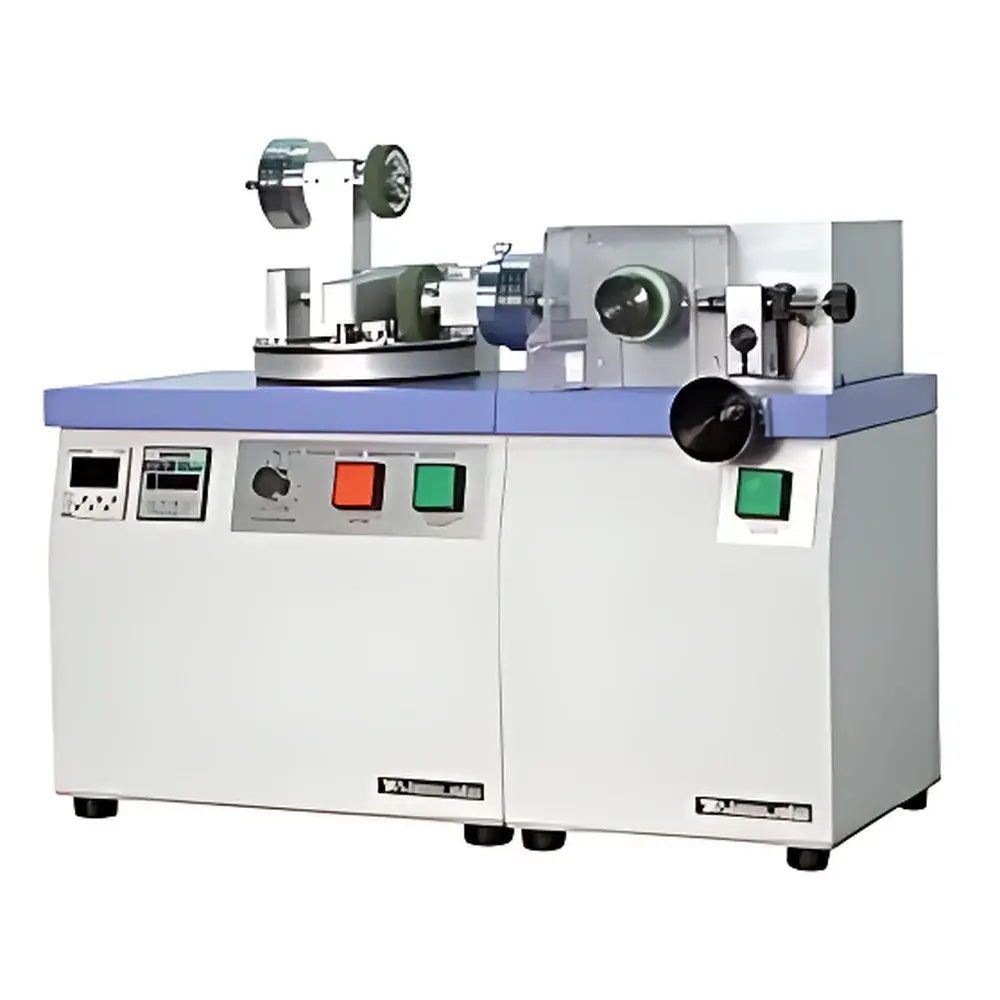
Yasuda No.101 TABER Abrasion Tester
| Brand | Yasuda |
|---|---|
| Origin | Japan |
| Model | No.101 |
| Compliance Standards | JIS A1453, JIS K5400, JIS K5600-5-8/9, JIS K5665, JIS K6264-2, JIS K6404-22, JIS K6902, JIS K7204, JIS L1018, JIS L1085, JIS L1096, ASTM D1044, ASTM D1175, TAPPI T476, JAS, JASO M403, ISO 4649, ISO 5470-1, ISO 7784-1/2, ISO 9352 |
| Configuration Options | Standard (No.101), HS variant with integrated suction airflow metering, K variant for TABER abrasive wheels |
| Application Scope | Flat-sheet polymeric, elastomeric, coated, and composite materials |
Overview
The Yasuda No.101 TABER Abrasion Tester is a precision-engineered rotational wear testing instrument designed to quantify surface resistance to abrasive degradation under controlled mechanical loading. Based on the standardized TABER oscillating abrasion principle—where two counter-rotating abrasive wheels traverse concentric circular paths across a horizontally mounted, rotating test specimen—the system delivers repeatable, traceable wear metrics including mass loss (mg), volumetric wear (mm³), thickness reduction (µm), and optical property changes (e.g., haze or gloss retention per ASTM D1044 or ISO 7784-2). Its mechanical architecture conforms to the kinematic constraints defined in ISO 4649 and JIS K6264-2, ensuring alignment with international tribological test protocols for flat, rigid, or semi-rigid planar substrates up to 105 mm in diameter and 12 mm in thickness.
Key Features
- Modular platform supporting three operational configurations: base No.101 (standard compliance testing), No.101-HS (integrated volumetric suction airflow metering for airborne particulate capture and flow-rate correlation), and No.101-K (optimized mounting interface and torque calibration for TABER-brand CS-10, CS-17, or S-32 abrasive wheels)
- Motor-driven specimen rotation at fixed speeds of 60 or 72 rpm, synchronized with dual-wheel oscillation (72 cycles/min) to maintain consistent relative velocity and contact geometry per ISO 5470-1
- Adjustable vertical load application (typically 250 g, 500 g, or 1000 g per wheel) via calibrated dead-weight loading system; load accuracy ±0.5% of full scale
- Stainless-steel test chamber with removable front panel and standardized dust port (ISO 9352-compliant 25 mm diameter outlet) for integration with laboratory fume extraction systems
- Mechanically robust cast-aluminum frame with vibration-damped base plate, engineered for long-term stability during extended test sequences (e.g., 1000+ cycles)
Sample Compatibility & Compliance
The No.101 accommodates flat, non-curved specimens with nominal dimensions of Ø100–105 mm × ≤12 mm thickness, including thermoplastics (e.g., ABS, PC, PP), vulcanized rubbers, fiber-reinforced composites, decorative laminates, coated metals, anodized aluminum sheets, and paper-based substrates. All test procedures adhere to method-specific sample conditioning requirements outlined in ASTM D618 and ISO 291. The instrument satisfies metrological traceability requirements for GLP and GMP environments when operated with documented calibration records for load cells, rotational encoders, and (in HS configuration) thermal-mass airflow sensors. Full compliance documentation—including certificate of conformance to JIS, ASTM, ISO, and TAPPI standards—is supplied with each unit.
Software & Data Management
While the base No.101 operates as a manually monitored mechanical tester, optional digital interfaces support integration with third-party data acquisition systems via 0–10 V analog output (rotation count, cycle completion signal) and RS-232 serial port (firmware version, error status). For regulated laboratories, the HS variant’s airflow metering module provides time-stamped volumetric flow data (L/min) synchronized with cycle count, enabling correlation analysis between particulate generation rate and cumulative wear. All raw outputs are compatible with 21 CFR Part 11-compliant LIMS platforms when paired with validated acquisition software; audit trails, electronic signatures, and data integrity controls must be implemented at the host system level.
Applications
This tester is routinely deployed in R&D labs and QC departments for material qualification against end-use durability specifications: automotive interior trim (JASO M403 abrasion resistance), architectural cladding (JIS A1453 scratch-and-wear classification), flooring products (ISO 9352 heavy-duty wear rating), printed electronics substrates (ASTM D1175 coating adhesion screening), and medical device packaging films (ISO 7784-2 coefficient-of-friction–linked wear assessment). It also supports failure mode analysis in accelerated aging studies where surface erosion precedes bulk property degradation.
FAQ
What abrasive wheels are compatible with the No.101-K configuration?
The No.101-K is mechanically adapted for standard TABER abrasive wheels (CS-10, CS-17, S-32, LC-10, or H-18) using ISO 4649-specified mounting hardware and dynamic balancing protocols.
Is calibration certification included with shipment?
Yes—each unit ships with a factory-issued calibration report covering rotational speed verification (±0.2 rpm), load application accuracy (±0.5 g at 500 g setpoint), and (for HS models) airflow sensor linearity (±2% FS over 5–30 L/min range).
Can the No.101 be used for wet-abrasion testing?
No—the standard configuration is dry-abrasion only. Optional splash-guard kits and solvent-resistant bearing seals are available under engineering consultation but require validation per ISO 20072 Annex B for liquid-assisted protocols.
How is test endpoint determined?
Endpoint is user-defined: either by pre-set cycle count (e.g., 1000 cycles per ASTM D1044), mass loss threshold (e.g., 50 mg per JIS K6902), or real-time optical monitoring via external spectrophotometer interfacing.
Does Yasuda provide application support for method development?
Yes—Yasuda’s technical applications team offers protocol optimization services, including wheel selection guidance, load/speed matrix design, and statistical repeatability assessment per ISO 5725-2, available under annual support contract.



