
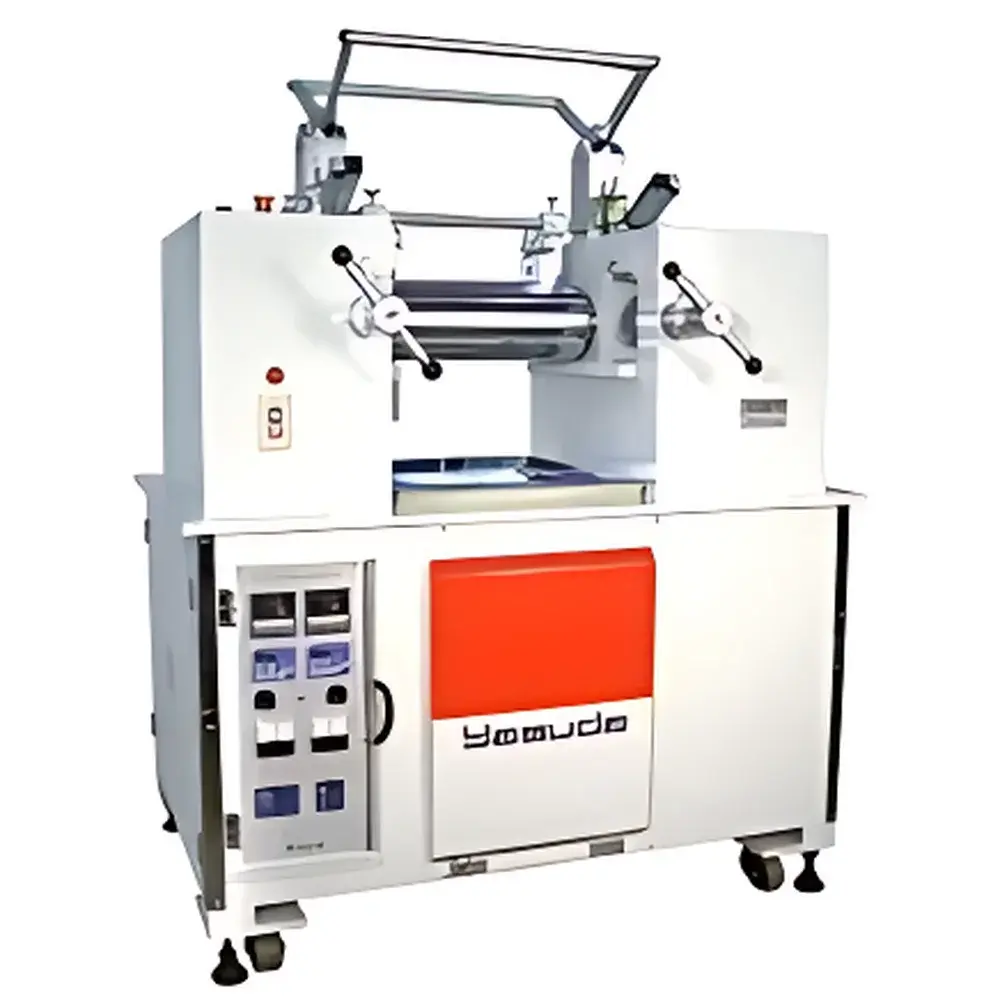
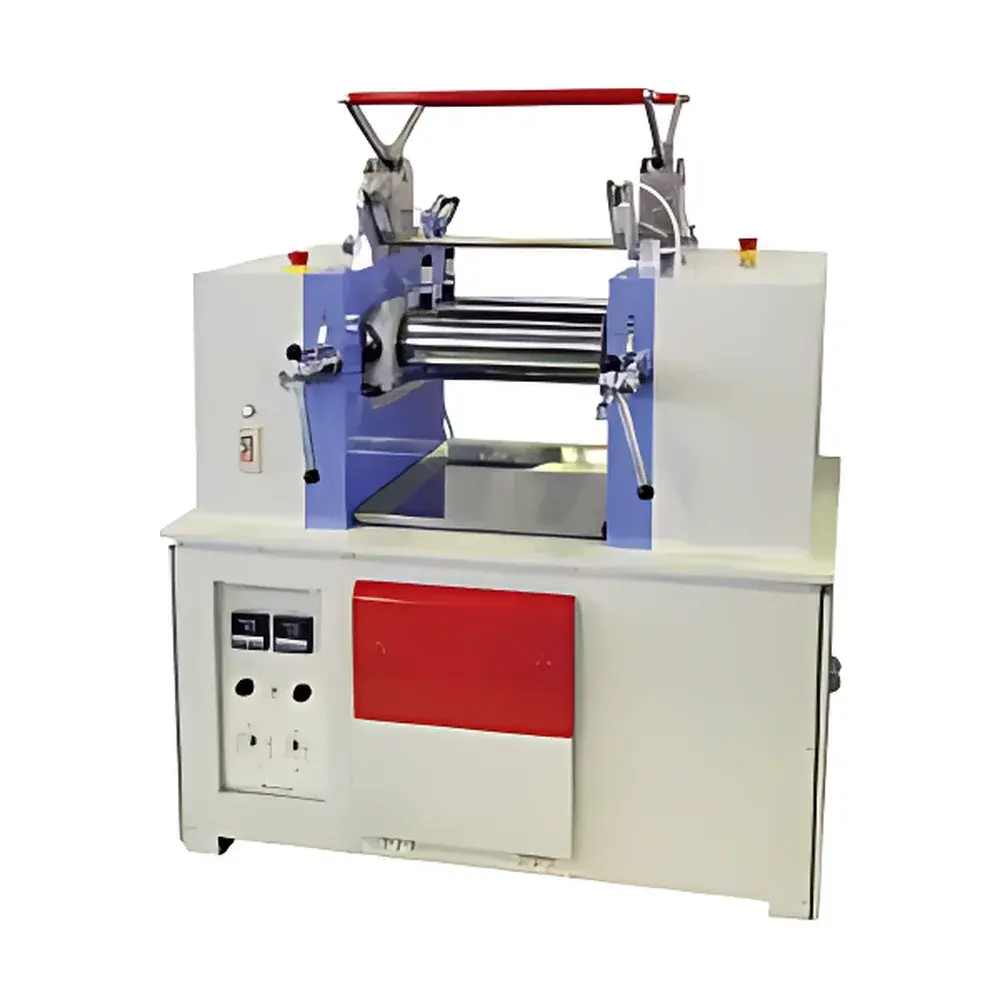
Yasuda No.191-TM Electrically Heated Open Two-Roll Mill
| Brand | Yasuda |
|---|---|
| Origin | Japan |
| Model | No.191-TM |
| Roll Diameter Options | 3″, 4″, 5″, 6″, or 8″ |
| Roll Length Options | 8″, 8″, 12″, 15″, or 20″ |
| Max. Roll Surface Temperature | 200 °C (optional: 300 °C) |
| Roll Speed (Front) | 12.5–31.25 rpm |
| Roll Speed (Rear) | 10–25 rpm |
| Speed Ratio | ~1:1.25 |
| Heating Method | Cartridge-type electric heaters |
| Safety Systems | Dual knee-actuated stop plates, mushroom-type emergency stop button, overload metal circuit breaker (standard on ≥5″ rolls), optional Y-bar emergency tilt bar, photoelectric safety curtains, reverse-rotation interlock |
| Lubrication | Adjustable needle-valve drip feed |
| Standard Accessories | One set of PTFE collection board, calendering discs, high-temp bearing oil |
| Optional Upgrades | Variable-speed drive, independent roll motorization, digital PID temperature controller, recirculating oil lubrication system, automatic knife blade assembly |
| Power Supply | AC 200 V, 3-phase, 20–50 A, 50/60 Hz |
Overview
The Yasuda No.191-TM Electrically Heated Open Two-Roll Mill is a precision-engineered laboratory-scale mixing and compounding device designed for controlled rheological evaluation and small-batch processing of elastomers, thermoplastics, thermoplastic elastomers (TPEs), and filled polymer systems. Operating on the fundamental principle of shear deformation between counter-rotating cylindrical rolls with a defined speed differential, the mill subjects materials to reproducible mechanical work input—enabling assessment of dispersion quality, scorch behavior, viscosity evolution, filler wetting efficiency, and batch-to-batch consistency. Its compact footprint and modular configuration make it particularly suited for R&D laboratories, quality control environments, and pilot-scale formulation development where regulatory traceability, operational repeatability, and operator safety are non-negotiable requirements.
Key Features
- Electric cartridge heating system integrated directly into roll cores ensures rapid thermal response, uniform axial temperature distribution, and precise surface temperature control up to 200 °C (optionally extended to 300 °C for high-temperature elastomer processing)
- Five standard roll geometry configurations (φ3″×8″, φ4″×8″, φ5″×12″, φ6″×15″, φ8″×20″) accommodate diverse sample volumes—from 50 g to 1.5 kg—while maintaining consistent shear rate profiles across scales
- Adjustable front/rear roll speed range (front: 12.5–31.25 rpm; rear: 10–25 rpm) enables fine-tuning of shear rate (γ̇ ≈ 10–120 s⁻¹ typical) and residence time, critical for simulating downstream extrusion or calendering conditions
- Dual knee-actuated stop plates mounted at front and rear positions provide immediate mechanical cutoff upon inadvertent contact—complying with ISO 13857 and IEC 61496-1 safety distance requirements for Category 3 PLd architectures
- Mushroom-type emergency stop button with positive-opening contacts meets EN 60204-1 requirements for Category 0 emergency shutdown
- Overload protection via thermal-magnetic circuit breaker (standard on all models with ≥5″ roll diameter) prevents motor damage during high-viscosity compound jamming
- Needle-valve-controlled oil drip lubrication system ensures consistent bearing film formation without over-lubrication or oil migration onto roll surfaces
Sample Compatibility & Compliance
The No.191-TM accommodates raw natural rubber (NR), synthetic rubbers (SBR, BR, EPDM, NBR, CR), thermoplastics (PP, PE, PVC, ABS), conductive composites, flame-retardant formulations, and masterbatches containing carbon black, silica, calcium carbonate, or nanofillers. All roll surfaces are precision-ground and hardened (≥58 HRC), minimizing wear-induced surface roughness that could compromise dispersion fidelity. The unit conforms to JIS K 6251 (rubber testing standards), ASTM D3182 (standard practice for rubber compounding), and supports GLP-compliant workflows when paired with optional digital temperature controllers featuring audit-trail logging per FDA 21 CFR Part 11 requirements.
Software & Data Management
While the base No.191-TM operates as a manually supervised mechanical platform, optional digital upgrades—including programmable PID temperature controllers with RS-485 Modbus RTU output—enable integration into centralized lab data acquisition networks. These controllers record real-time roll surface temperature, elapsed mixing time, and motor current draw (proxy for torque load), exporting timestamped CSV files compatible with LIMS platforms. Optional independent motor drives support synchronized speed ramping protocols for standardized Mooney-like preheating sequences, enhancing inter-laboratory method transferability.
Applications
- Small-scale formulation screening of vulcanization systems (accelerators, curatives, activators)
- Evaluation of filler dispersion homogeneity using optical microscopy or SEM cross-section analysis post-mixing
- Scorch time determination via timed sheet extraction and subsequent rheometer testing (e.g., MDR or ODR)
- Preparation of homogeneous test slabs for tensile, hardness, and tear testing per ASTM D412, D2240, D624
- Processing window assessment for thermoplastic compounds prior to injection molding trials
- Batch qualification for GMP-regulated medical-grade elastomer production lines
FAQ
What roll geometries are available for the No.191-TM, and how do they affect mixing capacity?
The No.191-TM offers five standardized roll configurations: φ3″×8″, φ4″×8″, φ5″×12″, φ6″×15″, and φ8″×20″. Smaller rolls (3″–4″) support 50–200 g batches ideal for rapid formulation iteration; larger rolls (6″–8″) handle 800 g–1.5 kg batches required for representative property testing.
Is the machine compliant with international electrical safety standards?
Yes—the unit complies with IEC 61000-6-2 (immunity) and IEC 61000-6-4 (emission) standards, carries PSE certification for Japanese market deployment, and meets CE marking requirements under the Machinery Directive 2006/42/EC when equipped with specified safety options.
Can temperature profiles be logged and exported for audit purposes?
When configured with the optional digital PID temperature controller, continuous roll surface temperature data—with timestamps and operator ID fields—is stored locally and exportable in CSV format, satisfying GLP documentation requirements and facilitating FDA 21 CFR Part 11 compliance when deployed with validated software.
What maintenance intervals are recommended for the lubrication system?
The needle-valve drip feed system requires weekly visual inspection of oil level and flow rate calibration; bearing oil (high-temperature mineral type) should be replaced every 500 operating hours or annually, whichever occurs first, to maintain optimal hydrodynamic film thickness and prevent micropitting.
Are custom roll surface finishes available?
Standard rolls feature ground-and-polished steel (Ra ≤ 0.4 µm); optional chrome-plated or tungsten-carbide-coated surfaces are available for abrasive compound applications requiring extended service life and reduced material adhesion.






