
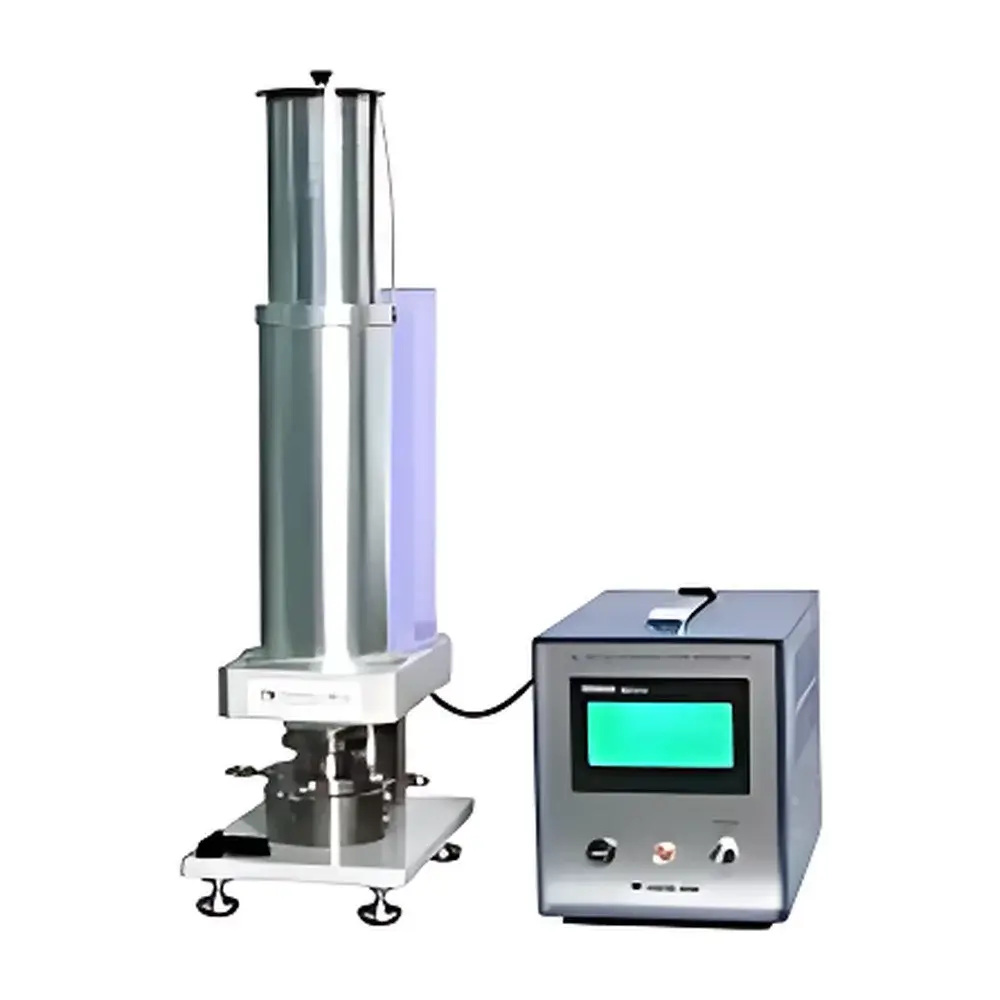
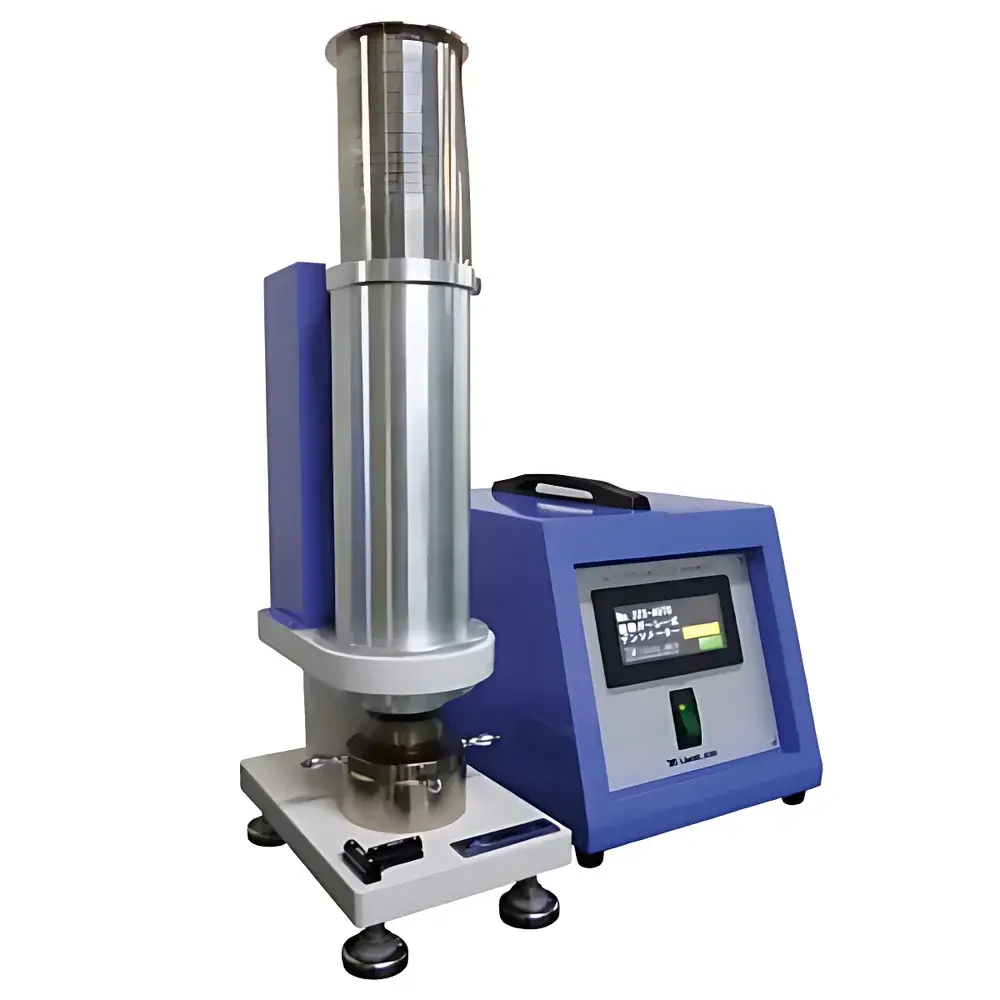
Yasuda No.323-AUTO Automatic Gurley-Type Air Permeability Tester
| Brand | Yasuda |
|---|---|
| Origin | Japan |
| Model | No.323-AUTO |
| Test Standards | JIS L1096, ASTM D726, TAPPI T460, ISO 5636-5, P8117 |
| Sample Size | 50 × 50 mm |
| Clamp Orifice Diameter | φ28.6 ± 0.1 mm (Effective Area: 642 mm²) |
| Outer Cylinder ID | φ82.6 mm |
| Inner Cylinder OD/ID | φ76.2 / φ74 mm |
| Inner Cylinder Height | 254 mm |
| Inner Cylinder Mass | 567 ± 0.5 g |
| Air Volume Range | 0–100 mL (25 mL graduations), 100–350 mL (50 mL graduations) |
| Timing Resolution | 0.1 sec (Digital Timer, Max 99999.9 sec) |
| Detection Method | Photoelectric Sensor |
| Power Supply | AC 100 V, 1-phase, 3 A, 50/60 Hz |
| Main Unit Dimensions/Weight | ≈ W150 × D230 × H420 mm / ≈ 20 kg |
| Control Panel Dimensions/Weight | ≈ W250 × D450 × H280 mm / ≈ 8 kg |
| Optional Accessories | Silicone Oil, Porous Plug Adapter (φ10 mm) |
Overview
The Yasuda No.323-AUTO Automatic Gurley-Type Air Permeability Tester is a precision-engineered instrument designed for quantitative evaluation of air permeance in low-to-medium permeability sheet materials—primarily paper, paperboard, filter media, nonwovens, and woven fabrics such as wool textiles. It operates on the fundamental principle of Gurley air resistance measurement, defined by controlled gravitational displacement of a weighted inner cylinder within a sealed outer chamber. As the inner cylinder descends under its calibrated mass (567 ± 0.5 g), it compresses ambient air, forcing a fixed volume of air through a standardized test specimen clamped between parallel plates. The time required for a specified air volume (e.g., 100 mL) to pass through the sample is recorded—directly correlating to its air permeability (typically reported in Gurley seconds per 100 mL). This method provides high reproducibility for comparative quality control and material specification verification across production batches and supplier evaluations.
Key Features
- Automated digital timing system with photoelectric sensor detection ensures precise, operator-independent measurement resolution down to 0.1 second (maximum count: 99999.9 sec), eliminating human reaction error inherent in manual stopwatch operation.
- Standardized test geometry: fixed clamp orifice diameter of φ28.6 ± 0.1 mm (effective area = 642 mm²) and strict dimensional tolerances for both inner and outer cylinders, ensuring compliance with JIS L1096, ASTM D726, TAPPI T460, and ISO 5636-5 physical test protocols.
- Dual-range graduated air volume scale (0–100 mL at 25 mL intervals; 100–350 mL at 50 mL intervals) enables accurate volumetric calibration across typical permeability ranges encountered in packaging papers, cigarette wrapping, filtration substrates, and technical textiles.
- Robust mechanical architecture featuring machined aluminum alloy components and precision-ground cylinder surfaces minimizes frictional variance and thermal drift during extended testing cycles.
- Modular design separates main testing unit (≈20 kg) from dedicated control panel (≈8 kg), facilitating ergonomic placement, service access, and integration into QC laboratory workflows.
- Optional accessories—including silicone oil for enhanced seal integrity and a φ10 mm porous plug adapter—support method flexibility for specialized applications requiring modified flow paths or environmental stabilization.
Sample Compatibility & Compliance
The No.323-AUTO accommodates rigid and semi-flexible sheet specimens measuring exactly 50 × 50 mm, secured under uniform clamping pressure via spring-loaded parallel plates. Its standardized orifice and cylinder geometry ensure compatibility with internationally recognized test standards governing air permeability in industrial materials. The instrument meets metrological requirements for Type A Gurley densometers as specified in ASTM D726 Annex A1 and ISO 5636-5 Annex B. Calibration traceability aligns with national standards bodies (e.g., JCSS in Japan), supporting GLP-compliant documentation when integrated with validated SOPs. Routine verification using certified reference foils or NIST-traceable permeability standards is recommended prior to critical batch release testing.
Software & Data Management
While the No.323-AUTO operates as a standalone electromechanical instrument without embedded software, its digital timer output supports external data capture via RS-232 or analog voltage signal interfaces (optional configuration). When integrated into networked QC environments, timestamped measurements can be logged into LIMS or MES platforms using third-party acquisition modules compliant with FDA 21 CFR Part 11 requirements—including electronic signatures, audit trails, and user-access controls. Raw timing data remains fully exportable for statistical process control (SPC) analysis, capability studies (Cp/Cpk), and trending reports aligned with ISO 9001 and IATF 16949 quality management frameworks.
Applications
- Quality assurance of packaging papers (e.g., greaseproof, parchment, and barrier-coated grades) where controlled breathability affects shelf life and moisture management.
- Characterization of cigarette paper porosity to regulate burn rate and tar delivery in tobacco product development and regulatory submission dossiers.
- Validation of filtration media performance—including HEPA pre-filters, HVAC pleated panels, and medical mask substrates—against air resistance specifications.
- Comparative assessment of textile air permeability in apparel R&D, particularly for sportswear membranes and protective workwear meeting EN 343 or ASTM F1868 standards.
- Supplier qualification testing for corrugated board liners, kraft paper, and specialty laminates used in food and pharmaceutical secondary packaging.
FAQ
What test standards does the No.323-AUTO support?
It complies with JIS L1096 Method D, ASTM D726, TAPPI T460, ISO 5636-5, and Japanese Industrial Standard P8117.
Is calibration certification included with shipment?
Factory calibration verification is provided; users must perform periodic recalibration using certified reference materials per internal QA procedures or ISO/IEC 17025-accredited labs.
Can the instrument measure very low-permeability films?
The Gurley method is optimized for materials with permeability between ~10–10,000 Gurley seconds/100 mL; ultra-low permeability (<1 sec/100 mL) requires alternative techniques such as ASTM F1927 (moisture vapor) or ASTM D3846 (oxygen transmission).
What maintenance is required for long-term accuracy?
Routine cleaning of cylinder surfaces and orifice edges with lint-free cloth and isopropyl alcohol; annual inspection of photoelectric sensor alignment and inner cylinder mass verification are recommended.
Does the system support GLP-compliant audit trails?
When interfaced with validated external data acquisition software meeting 21 CFR Part 11 criteria, full electronic record retention—including operator ID, timestamp, and raw timing values—is achievable.






