
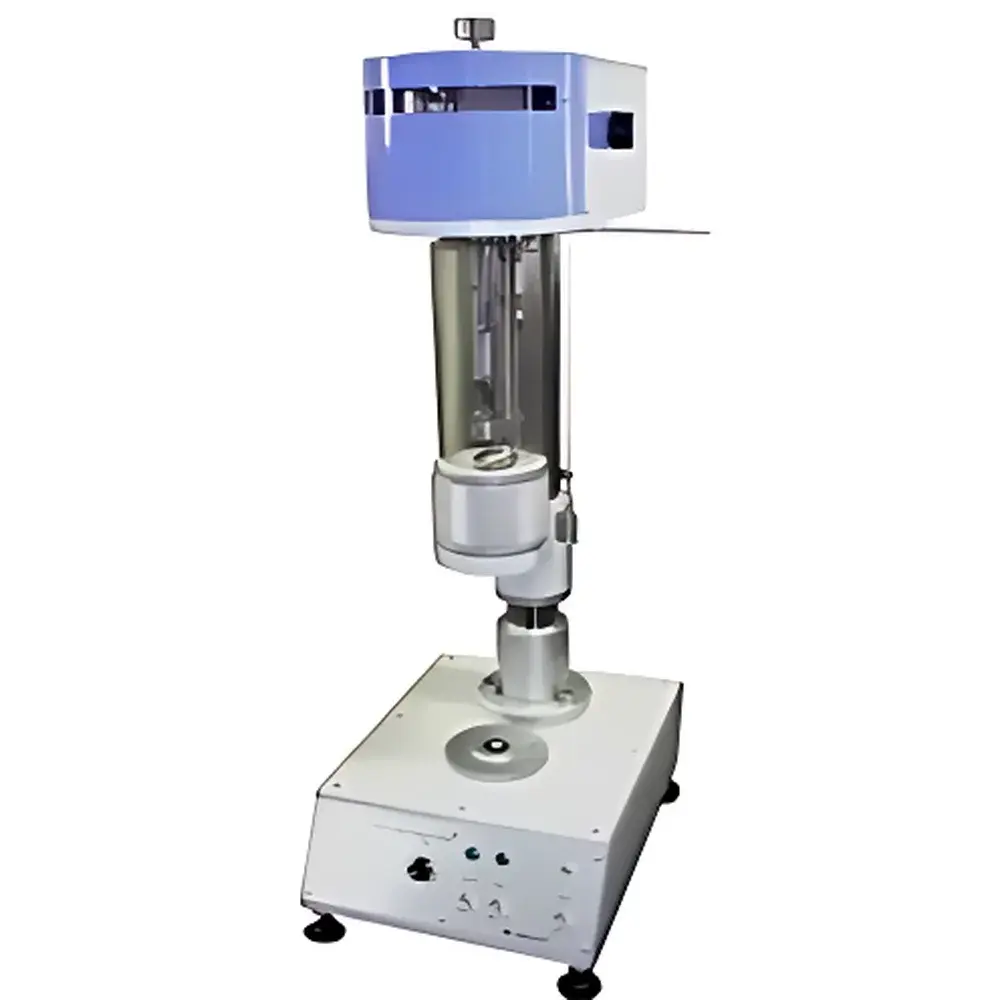
Yasuda No.170 Clash-Berg Torsion Flexibility Tester
| Brand | Yasuda |
|---|---|
| Origin | Japan |
| Model | No.170 |
| Test Standards | JIS K6734, K6745, K6773, K6924-2, ASTM D1043, ISO 458 |
| Sample Dimensions | 6.35 ± 0.03 mm (W) × 64 mm (L) × 0.8–1.5 mm (T) |
| Gauge Length | 40 mm |
| Angular Scale | 0–360° (1° graduation) |
| Temperature Range | −60 to +100 °C (dry ice cooling enabled) |
| Heating Rate | 2 °C/min |
| Torque Application | Pulley-and-weight system with 5 g, 10 g, 20 g, and 50 g calibrated masses |
| Accessories | Vacuum desiccator bottle, two calibrated thermometers, specimen cutting knife, hole punch, specimen alignment gauge |
| Power Supply | 220 V, single-phase, 10 A, 50/60 Hz |
| Dimensions & Weight | Approx. 300 × 400 × 780 mm (W×D×H), ~40 kg |
Overview
The Yasuda No.170 Clash-Berg Torsion Flexibility Tester is a precision-engineered instrument designed for the standardized determination of torsional rigidity and temperature-dependent flexibility in rigid polyvinyl chloride (PVC-U) and other thermoplastic sheet materials. Based on the classical Clash-Berg method, this apparatus implements a controlled thermal–mechanical protocol wherein specimens are subjected to incremental temperature elevation while immersed in a thermostatically regulated water bath. At discrete 5 °C intervals—each held for 3 minutes—the specimen is subjected to a defined static torque for 5 seconds via a calibrated pulley–weight system. The resulting angular deflection is measured with a high-resolution 1°-graduated scale, enabling calculation of torsional rigidity (N·m/rad) as a function of temperature. The inflection point or transition temperature derived from the rigidity–temperature curve serves as the quantitative indicator of material flexibility—a critical parameter for quality control in pipe, profile, and sheet extrusion manufacturing.
Key Features
- Temperature-controlled immersion bath with extended range (−60 °C to +100 °C), compatible with dry ice–ethanol or liquid nitrogen auxiliary cooling for low-temperature characterization.
- Mechanically stable dual-clamp fixture ensuring consistent gauge length (40 mm) and minimizing axial slippage during torsion.
- Direct-reading angular scale (0–360°, 1° resolution) mounted coaxially with the upper clamp for unambiguous torsion angle measurement.
- Modular torque application system using certified stainless-steel weights (5 g, 10 g, 20 g, 50 g) and low-friction pulleys, eliminating electronic transducer drift and ensuring long-term metrological stability.
- Dedicated specimen preparation toolkit—including precision cutting knife, center-punch tool, alignment gauge, and vacuum desiccator bottle—to ensure strict compliance with JIS and ASTM dimensional tolerances (e.g., 6.35 ± 0.03 mm width).
- Robust cast-aluminum frame with vibration-damped base, optimized for laboratory benchtop operation without external anchoring.
Sample Compatibility & Compliance
The No.170 is validated for use with flat, isotropic thermoplastic specimens meeting JIS K6734 and ASTM D1043 dimensional specifications: width 6.35 ± 0.03 mm, length 64 mm, thickness 0.8–1.5 mm. It supports routine testing under ISO 458 (plastics — determination of torsional stiffness at elevated temperatures) and JIS K6924-2 (flexibility testing of PVC pipes). All mechanical and thermal subsystems are traceable to JIS Z 8000 series standards for testing equipment calibration. The apparatus is routinely deployed in GLP-compliant QC laboratories supporting ISO 9001:2015 and IATF 16949-certified production lines for rigid PVC compounds.
Software & Data Management
The No.170 operates as a manual, operator-guided instrument with no embedded microprocessor or digital interface—ensuring immunity to firmware obsolescence and simplifying 21 CFR Part 11 compliance in regulated environments. Test data (temperature, torque mass, angular deflection) are recorded manually into standardized lab notebooks or LIMS-integrated spreadsheets. Optional third-party digital calipers and PT100 thermistor loggers (NIST-traceable) may be integrated for automated data capture; all such add-ons must satisfy ASTM E29–23 rounding rules and maintain audit trails per FDA guidance on electronic records.
Applications
- Quality assurance of rigid PVC formulations used in pressure pipe, window profiles, and cable conduits.
- Comparative evaluation of plasticizer efficiency and thermal aging effects on torsional modulus retention.
- Validation of batch-to-batch consistency in compound extrusion processes.
- Supporting technical documentation for CE marking submissions under EN 1452-1 (PVC-U pipes) and UL 651 (nonmetallic conduit).
- Academic research on structure–property relationships in semi-crystalline thermoplastics undergoing glass transition.
FAQ
What standards does the No.170 tester support?
JIS K6734, K6745, K6773, K6924-2, ASTM D1043, and ISO 458.
Is dry ice required for sub-zero testing?
Yes—the −60 °C lower limit requires dry ice–ethanol slurry or liquid nitrogen cooling in the bath reservoir; the unit includes insulation and mounting provisions for cryogenic accessories.
Can the tester accommodate non-PVC materials?
It is calibrated and validated for rigid PVC per standard methods; use with other polymers requires method validation per ISO/IEC 17025 clause 7.2.2.
What maintenance is recommended?
Biannual inspection of pulley bearings, weight calibration verification, thermometer recalibration against a reference RTD, and bath fluid replacement every 12 months.
Is electrical safety certification provided?
The unit complies with IEC 61010-1:2010 for laboratory electrical equipment and carries PSE marking for Japanese market deployment.



