
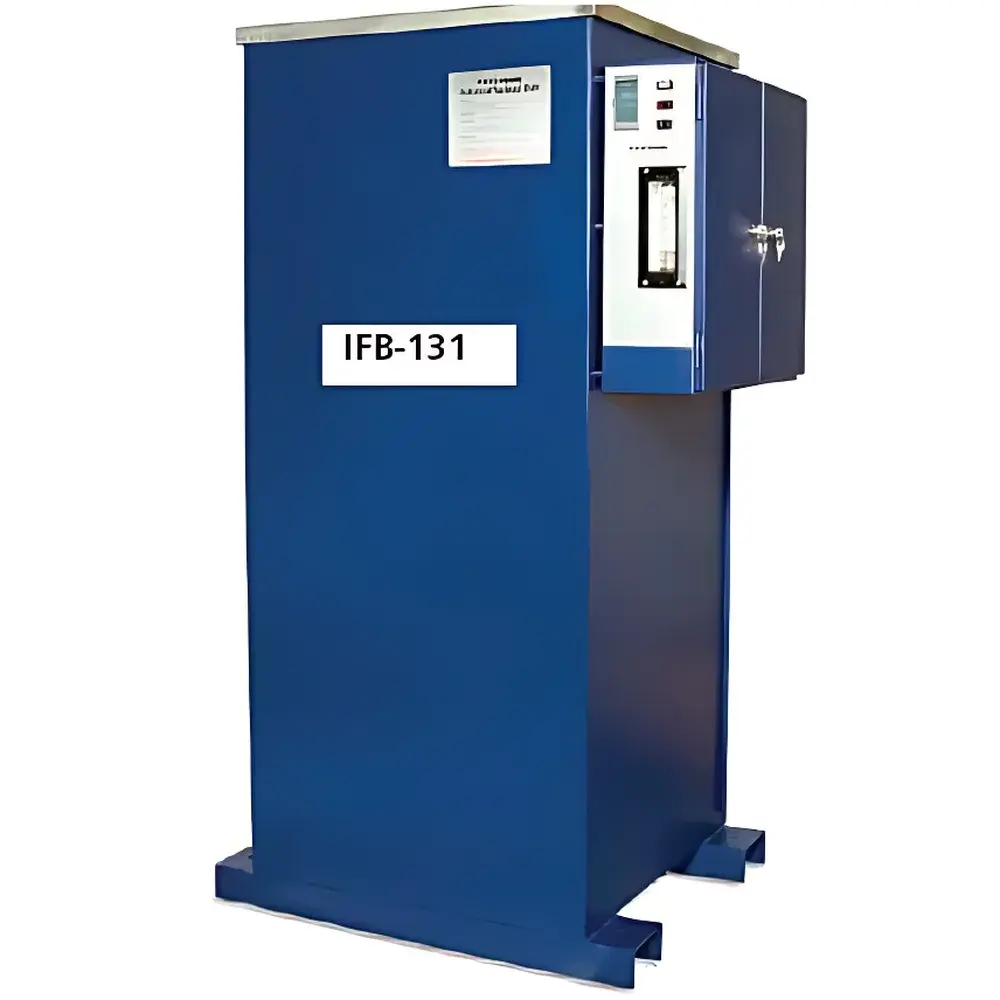
Techne IFB-121 and IFB-131 Fluidized Bed Sand Baths
| Brand | Techne |
|---|---|
| Origin | USA |
| Model | IFB-121 |
| Temperature Range | 50–600 °C |
| Temperature Accuracy | ±5.0 °C |
| Temperature Sensor | Type K Thermocouple |
| Internal Dimensions (Dia × Depth, cm) | 45 × 70 (IFB-121), 45 × 120 (IFB-131) |
| Air Flow Rate (at 0.2 MPa) | 300 L/min |
| Time to 450 °C | 195 min (IFB-121), 165 min (IFB-131) |
| Time to 600 °C | 330 min (IFB-121), 195 min (IFB-131) |
| External Dimensions (L × W × H, cm) | 134 × 85 × 113 (IFB-121), 184 × 85 × 113 (IFB-131) |
| Voltage | 480 V, 3-phase |
| Power Rating | 12 kW (IFB-121), 18 kW (IFB-131) |
| Empty Weight | 226 kg (IFB-121), 330 kg (IFB-131) |
| Weight with Al₂O₃ Media | 500 kg (IFB-121), 700 kg (IFB-131) |
Overview
The Techne IFB-121 and IFB-131 Fluidized Bed Sand Baths are precision-engineered thermal processing systems designed for controlled, uniform, and rapid heating of metallic components and tooling in industrial and laboratory environments. Unlike conventional oven or molten salt baths, these units employ a fluidized bed of high-purity aluminum oxide (Al₂O₃) particles, suspended and heated by precisely regulated forced air flow. This configuration establishes a highly efficient convective heat transfer medium—functionally equivalent to a dynamic, particle-based thermal bath—with exceptional temperature homogeneity (±5.0 °C across the working zone) and minimal thermal lag. The system operates within a wide temperature range of 50 °C to 600 °C, enabling applications from low-temperature stress relief to high-temperature pyrolytic cleaning and thermal treatment. Its core principle relies on rapid, volumetric heating of immersed parts—eliminating thermal gradients and reducing thermal shock-induced fatigue in molds, dies, extrusion screws, nozzles, and other high-value tooling.
Key Features
- Fluidized bed architecture using inert, high-temperature aluminum oxide media (Al₂O₃), rated for continuous operation up to 600 °C
- Dual-model platform: IFB-121 (70 cm depth, 12 kW) and IFB-131 (120 cm depth, 18 kW), optimized for varying batch sizes and thermal mass loads
- Integrated digital temperature controller with Type K thermocouple feedback and PID regulation for stable setpoint maintenance
- Forced-air delivery system delivering 300 L/min at 0.2 MPa, ensuring consistent fluidization and thermal uniformity throughout the bed volume
- Robust stainless-steel construction with insulated chamber walls and heavy-duty access lid with integrated cyclonic exhaust port
- Standard equipment includes exhaust hood, Al₂O₃ media, automatic airflow controller (F6425), mesh basket (F6426/F6427), and external exhaust fan (F5148)
- Optional emission control accessories certified for compliance with occupational hygiene and environmental safety standards—including acid gas scrubbers (SR-100), afterburners (AB-100), and Al₂O₃ recovery cyclones (CN-500)
Sample Compatibility & Compliance
The IFB series is specifically engineered for the thermal processing of ferrous and non-ferrous metal components—including injection molds, die-casting tools, extrusion dies, threaded barrels, and precision fixtures. It is not intended for direct processing of polymers, elastomers, or organic coatings; however, it is widely used for post-production pyrolytic removal of carbonaceous residues (e.g., cured resins, lubricants, greases, and hydrocarbon-based contaminants) from metal surfaces. During such cleaning cycles, organic material undergoes rapid oxidative decomposition at elevated temperatures, yielding CO₂, H₂O vapor, and trace ash—minimizing residue carryover and preserving substrate integrity. The system supports adherence to ASTM D3174 (ash content determination), ISO 9001 thermal process validation protocols, and internal quality management requirements for tool maintenance. When equipped with SR-100 scrubber and AB-100 afterburner, emissions comply with OSHA PELs for HCl and particulate matter, and meet EPA Method 26A criteria for halogenated acid gas abatement.
Software & Data Management
While the base IFB-121/131 models feature analog/digital front-panel controllers with manual setpoint adjustment and real-time temperature display, optional data logging modules (Techne FDL-200 series) enable time-stamped recording of temperature profiles, airflow pressure, and cycle duration. Logged data is exportable via USB or RS-232 to CSV format for integration into laboratory information management systems (LIMS) or electronic batch records. For GxP-regulated environments, validated firmware versions support 21 CFR Part 11-compliant audit trails—including user login tracking, parameter change history, and electronic signature capability—when deployed with compatible supervisory software (e.g., Techne ControlSuite v3.2+). All configurations maintain full traceability of thermal exposure parameters required for ISO/IEC 17025 accreditation of calibration and testing laboratories.
Applications
- Pyrolytic cleaning of tooling contaminated with thermoset resins, epoxies, rubber compounds, and silicone-based release agents
- Stress-relief annealing and tempering of hardened steel components prior to precision machining or metrology
- Controlled preheating of molds and dies to minimize thermal cycling fatigue during production runs
- Thermal calibration of thermocouples, RTDs, and infrared sensors across extended temperature ranges
- Accelerated aging studies of metallic alloys under sustained high-temperature exposure
- Supporting ASTM E2891 (standard guide for thermal analysis of polymer composites) through controlled matrix degradation protocols
- Research-grade simulation of industrial furnace conditions for metallurgical phase transformation studies
FAQ
What types of materials can be safely processed in the IFB fluidized bed?
Metallic components—including tool steels, aluminum alloys, and nickel-based superalloys—are fully compatible. Non-metallic substrates (e.g., ceramics, graphite) may be used with engineering review. Polymers, PVC, or halogenated materials must never be introduced without mandatory SR-100/AB-100 emission controls.
Is aluminum oxide media included with the unit?
Yes—both IFB-121 and IFB-131 ship with a full charge of high-purity Al₂O₃ (25 kg or 50 kg options available as F0885/F0885A). CN-500 cyclone systems allow >95% media recovery and reuse.
How is temperature uniformity verified across the fluidized bed?
Uniformity is validated per ASTM E220 using multiple calibrated thermocouples inserted at defined radial and axial positions. Typical deviation remains within ±3 °C at steady-state 450 °C, well within the stated ±5.0 °C system accuracy specification.
Can the IFB be integrated into an automated production line?
Yes—digital I/O ports support PLC interfacing for start/stop commands, temperature interlocks, and alarm relay outputs. Optional Ethernet/IP or Modbus TCP gateways enable SCADA-level integration.
What maintenance is required for long-term reliability?
Routine inspection of airflow distribution plates, thermocouple calibration every 6 months, and periodic replacement of exhaust filters (if scrubber-equipped). Al₂O₃ media should be sieved annually to remove fines; loss rate averages <0.5% per 1000 hr of operation.



