
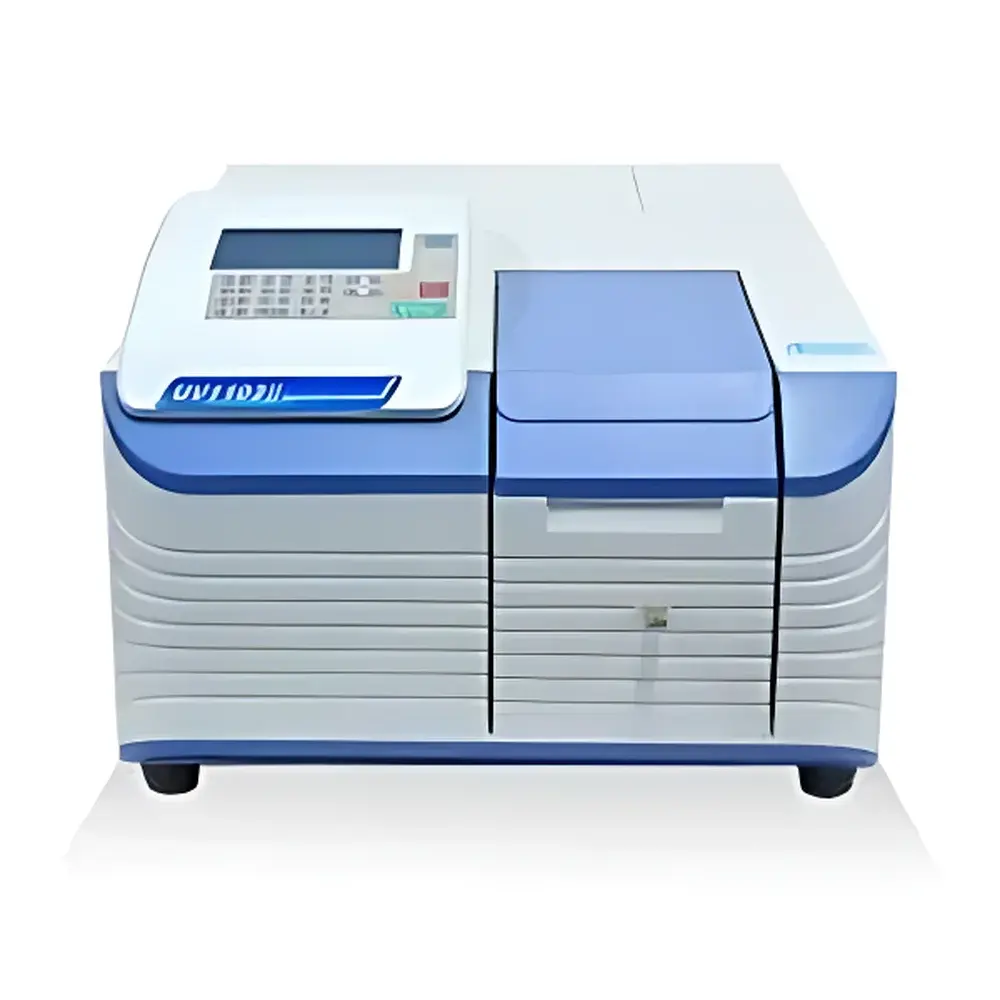
Techcomp UV11II Series Ultraviolet-Visible Spectrophotometer
| Brand | Techcomp |
|---|---|
| Origin | Shanghai, China |
| Instrument Architecture | Pseudo-Double-Beam |
| Detector Type | Photodiode Array (PDA) |
| Wavelength Range | 190–1100 nm |
| Wavelength Accuracy | ±0.5 nm |
| Spectral Bandwidth | UV1101II: 1 nm |
| UV1102II | 2 nm |
| UV1100II | 4 nm |
| Stray Light | ≤0.05% (at 220 nm using NaI |
| Compliance | CE, IEC 61010-1, IEC 61326-1 (EMC), LVD Directive |
Overview
The Techcomp UV11II Series Ultraviolet-Visible Spectrophotometer is a precision optical absorption measurement system engineered for routine and regulatory-compliant quantitative and qualitative analysis across research, quality control, and environmental monitoring laboratories. Based on the fundamental principle of Beer–Lambert law, it measures sample absorbance by comparing light intensity transmitted through a sample cuvette against a reference path—enabled by its pseudo-double-beam optical architecture. This design compensates for source intensity drift and detector sensitivity variation in real time, delivering high reproducibility without requiring manual baseline recalibration between measurements. The instrument integrates a Seya-Namioka monochromator with a high-efficiency concave holographic grating, optimized to maximize photon throughput while minimizing stray radiation. Dual broadband sources—a deuterium lamp (190–400 nm) and a tungsten-halogen lamp (340–1100 nm)—ensure seamless spectral coverage across the full UV-Vis range. All optical components—including quartz-coated mirrors and lenses—are selected for long-term stability under ambient laboratory conditions, supporting uninterrupted operation over extended duty cycles.
Key Features
- Pseudo-double-beam optical path with real-time reference compensation for enhanced photometric stability and reduced baseline drift
- High-resolution photodiode array (PDA) detector enabling rapid full-spectrum acquisition (190–1100 nm) in <1 second
- Selectable spectral bandwidth models: UV1101II (1 nm), UV1102II (2 nm), and UV1100II (4 nm), each optimized for specific resolution–sensitivity trade-offs per application requirements
- Wavelength accuracy certified to ±0.5 nm across the entire range, verified via traceable holmium oxide and didymium filters
- Stray light performance ≤0.05% at critical validation wavelengths (220 nm NaI, 340 nm NaNO₂), meeting ISO 9001 and ASTM E275-22 criteria for spectrophotometric validation
- Long-life dual-lamp system: deuterium lamp (≥2000 h) and tungsten-halogen lamp (≥2000 h), with automatic lamp switching and intensity balancing
- Thermally stabilized optical bench and intelligent fan-controlled thermal management ensure consistent photometric response during prolonged multi-sample runs
Sample Compatibility & Compliance
The UV11II Series accommodates standard 10 mm square quartz or glass cuvettes (including matched pairs for ratio-based quantitation), as well as optional micro-volume adapters (e.g., 50–200 µL pathlength). It supports both transmission and reflectance modes (with optional integrating sphere accessory). The system complies with international safety and electromagnetic compatibility standards: IEC 61010-1 (electrical safety), IEC 61326-1 (EMC), and EU Low Voltage Directive (LVD). Its firmware and embedded diagnostics support GLP/GMP-aligned operational practices—including user-accessible wavelength verification protocols, photometric linearity checks, and lamp energy logging—all documented in audit-ready format. While not natively 21 CFR Part 11 compliant, the UV Analyst PC software (optional) provides electronic signature capability, audit trail generation, and role-based access control when deployed on validated Windows platforms.
Software & Data Management
The instrument ships with embedded firmware featuring intuitive touchscreen navigation and context-sensitive help. Core functions include fixed-wavelength measurement, kinetic scanning, spectrum acquisition, quantitative analysis (single/multi-point calibration), and DNA/protein A280/A260 calculations. Optional UV Analyst PC software extends functionality to method development, spectral library creation (up to 500 spectra), derivative spectroscopy, peak identification, and export to CSV, TXT, or XML formats compatible with LIMS integration. All data files contain embedded metadata: timestamp, operator ID, instrument serial number, lamp usage hours, and calibration history. Software-generated reports adhere to ISO/IEC 17025 documentation guidelines and may be archived in accordance with internal SOPs for regulatory review.
Applications
The UV11II Series is routinely deployed in water quality testing (e.g., nitrate, phosphate, COD determination per EPA Method 353.2 and ISO 7890), pharmaceutical assay validation (USP , ), enzyme kinetics (NADH/NADPH monitoring at 340 nm), nucleic acid and protein quantification (A260/A280 ratios), dye concentration profiling in textile chemistry, and catalyst characterization in fine chemical synthesis. Its robustness and repeatability make it suitable for ISO/IEC 17025-accredited laboratories performing routine QC in food safety (e.g., sulfite detection), environmental compliance (e.g., heavy metal complexation studies), and academic teaching labs requiring pedagogically transparent instrumentation.
FAQ
What is the difference between pseudo-double-beam and true double-beam designs?
Pseudo-double-beam instruments use a single detector with time-shared reference and sample beam paths—achieved via a rotating mirror or chopper—whereas true double-beam systems employ two physically separate detectors. The UV11II’s design balances cost-effectiveness with high stability, eliminating the need for matched detector pairs while maintaining <0.002 Abs/h baseline drift.
Can the UV11II be used for GMP-regulated environments?
Yes—when operated with UV Analyst software and configured with appropriate SOPs, it supports key GMP elements including instrument qualification (IQ/OQ), calibration traceability, and electronic record retention. Full 21 CFR Part 11 compliance requires additional IT infrastructure validation.
Is wavelength calibration traceable to NIST standards?
Yes—the built-in wavelength verification protocol uses certified holmium oxide and didymium reference filters, each accompanied by NIST-traceable calibration certificates supplied with the instrument.
What maintenance is required for long-term reliability?
Annual lamp replacement (recommended at 2000 h), quarterly cleaning of the sample compartment and optical window with lint-free wipes and spectroscopic-grade methanol, and biannual verification of photometric accuracy using neutral density filters are sufficient to maintain specification compliance.
Does the system support custom method programming?
Yes—UV Analyst enables users to define multi-step methods including auto-zero, multi-wavelength reading, timed kinetic loops, and conditional pass/fail logic for release testing workflows.





