
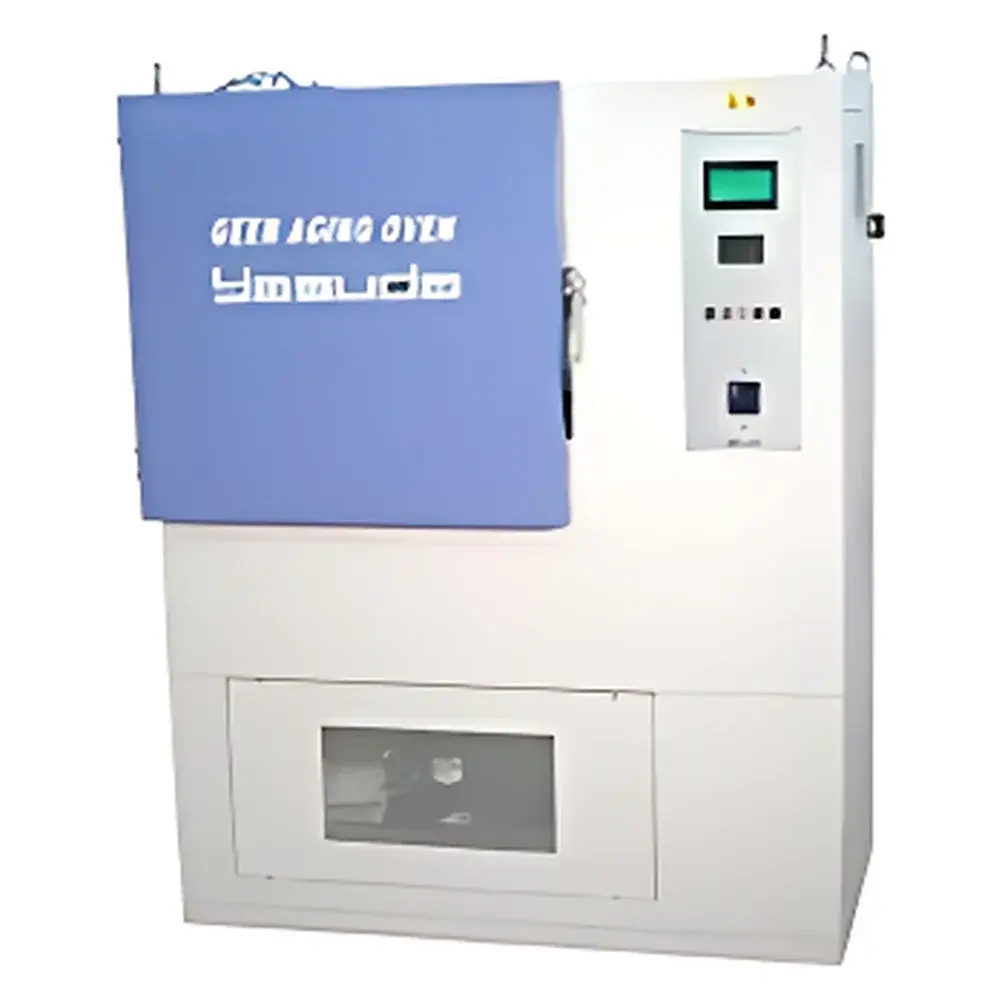
Yasuda No.102 (Gill-Type) Thermal Aging Test Chamber
| Brand | Yasuda |
|---|---|
| Origin | Japan |
| Model | No.102 |
| Temperature Range | Ambient + 20 °C to 300 °C (400 °C optional upon confirmation) |
| Air Exchange Rate | 3–10 h⁻¹ (SHF-S), 5–20 h⁻¹ (SHF-SA), ≥60 h⁻¹ (adjustable) |
| Air Velocity | Low: 0.5 ± 0.1 m/s |
| High | 1.0 ± 0.2 m/s |
| Chamber Internal Dimensions | 450 × 450 × 500 mm (SHF-S standard) |
| Total Heated Volume | 225.2 L (standard) |
| Sample Rotation Speed | 7.5 ± 2.5 rpm |
| Power Supply | AC 200 V, 3-phase, 30 A / 40 A (50/60 Hz) |
| Compliance Standards | JIS A5756, B7757, C3005, K6257, K6723, K7212 |
Overview
The Yasuda No.102 (Gill-Type) Thermal Aging Test Chamber is an engineered environmental test system designed for standardized evaluation of thermal oxidative degradation in polymeric materials—particularly elastomers and thermoplastics—under controlled, accelerated aging conditions. Based on the classical Gill-type circulation principle, the chamber maintains uniform temperature distribution and precisely regulated air exchange kinetics within the test space, enabling reproducible simulation of long-term thermal exposure in industrial service environments. Unlike static oven-based methods, this system incorporates forced-air convection with adjustable velocity profiles and mechanically driven sample rotation, minimizing thermal gradient effects and ensuring consistent surface exposure across all specimens. The design adheres to internationally recognized aging protocols where air exchange rate—not merely temperature—is a critical process parameter governing oxidation kinetics. This makes the No.102 suitable for qualification testing under regulatory frameworks requiring traceable, physics-based aging simulation.
Key Features
- Gill-type airflow architecture with dual-speed fan control (0.5 ± 0.1 m/s low; 1.0 ± 0.2 m/s high) for optimized convective heat transfer and oxygen replenishment
- Real-time air exchange rate calculation via calibrated electrical power consumption method—eliminating reliance on volumetric flow meters subject to drift or calibration drift
- Two operational variants: SHF-S (manual exhaust damper adjustment) and SHF-SA (closed-loop servo-controlled damper actuation for dynamic air exchange rate stabilization)
- Motor-driven rotating specimen rack (7.5 ± 2.5 rpm) ensuring uniform thermal exposure and mitigating directional bias in property degradation
- Dual-chamber configuration options: Standard (450 × 450 × 500 mm; 225.2 L heated volume) and Large (600 × 600 × 600 mm; 417.6 L heated volume), both featuring stainless-steel interior construction and double-wall insulation
- Integrated safety systems including overtemperature cut-off, ground-fault circuit interrupter (GFCI), and thermal fuse redundancy
- Modular accessory support for UL-compliant wiring harness testing, including high-air-exchange modes (up to 200 h⁻¹) compatible with UL 746B Clause 22 requirements
Sample Compatibility & Compliance
The No.102 accommodates standard dumbbell-shaped, circular, or rectangular polymer test specimens per ISO 37, ASTM D412, and JIS K6251. Its rotating fixture holds up to 40 circular samples simultaneously, while two fixed-angle shelves support flat or irregularly shaped components—including insulated wire segments per UL 746B and IEC 60811-1-1. All configurations meet the spatial uniformity requirements of ASTM E145 Class II and ISO 188 Annex A for thermal aging chambers. The system supports full compliance documentation packages, including temperature mapping reports (per IQ/OQ protocols), air exchange validation records, and traceable calibration certificates aligned with ISO/IEC 17025-accredited laboratories. It is routinely deployed in GLP-regulated R&D labs and GMP-aligned QC environments where audit readiness for FDA 21 CFR Part 11–compatible data integrity is required.
Software & Data Management
While the base No.102 operates via analog front-panel controls, optional digital interfaces enable integration into centralized lab data ecosystems. Available modules include analog voltage output (0–10 V DC) for external DAQ systems, CSV data logging via RS-485 Modbus RTU, and optional mini-printer output for hard-copy timestamped chamber logs. For enhanced traceability, the SHF-SA variant supports programmable air exchange setpoints with event-triggered data capture—facilitating alignment with 21 CFR Part 11 electronic record requirements when paired with validated third-party software platforms. All temperature sensors are PT100 Class A certified, and air exchange calculations are derived from NIST-traceable power metering, supporting metrological traceability in quality audits.
Applications
- Accelerated aging of rubber compounds per JIS K6257 and ISO 188 for automotive sealing systems and industrial hoses
- Thermal endurance evaluation of cable insulation materials under UL 746B and IEC 60811-5-1
- Long-term stability screening of engineering thermoplastics (e.g., PBT, PPS, PEEK) used in electronics housings
- Validation of antioxidant package efficacy in compounded polymers prior to outdoor exposure trials
- Supporting ASTM D573 rubber aging studies in tire and conveyor belt manufacturing QA workflows
- Pre-compliance thermal stress testing for medical device polymer components under ISO 10993-12
FAQ
What standards does the No.102 explicitly support?
The chamber is configured and validated for JIS A5756, B7757, C3005, K6257, K6723, K7212; ASTM D573, D2436, E145; UL 746B; IEC 60811; ISO 188; and IEC 4577.
Can the air exchange rate be verified independently?
Yes—air exchange is calculated via the electrical power consumption method per JIS K6257 Annex B and ASTM D573 Annex A, using calibrated wattmeters traceable to national standards; alternative verification via tracer gas (SF₆) is possible with external instrumentation.
Is the 400 °C option available as a factory-modified unit?
The 400 °C configuration requires structural reinforcement of heating elements, insulation, and sensor calibration—available only as a custom order with extended lead time and separate validation protocol.
How is temperature uniformity maintained during high air exchange operation?
Uniformity (±1.5 °C at setpoint) is sustained through balanced inlet/outlet duct geometry, pre-heated air recirculation bypass, and PID-controlled heater banks with zone-specific feedback.
Does the system support automated test sequencing?
Native automation is not included, but the analog outputs and Modbus interface allow integration with PLCs or LabVIEW-based test sequencers for multi-step aging profiles.



