
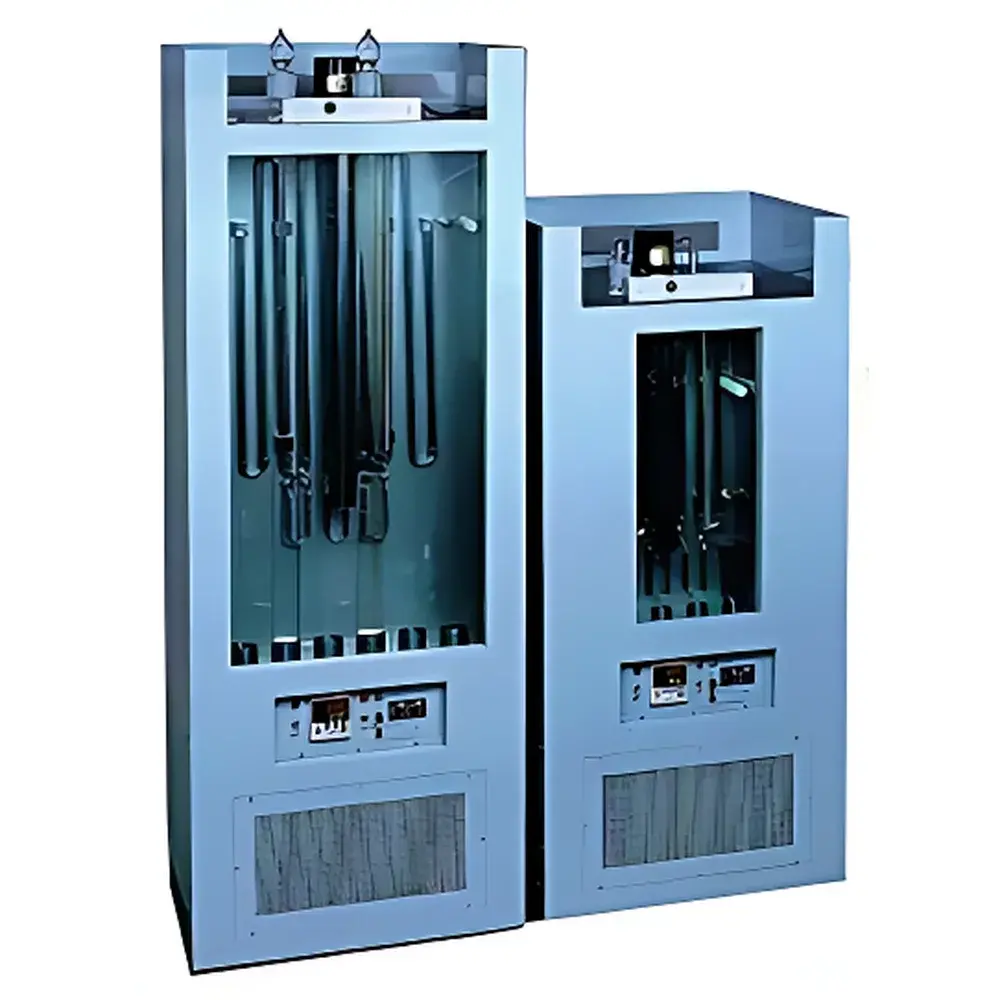
Shibayama Density Gradient Tube System
| Brand | Shibayama |
|---|---|
| Origin | Japan |
| Manufacturer Type | Authorized Distributor |
| Origin Category | Imported |
| Model | Density Gradient Tube System |
| Instrument Type | Density Gradient Column |
| Instrument Class | Benchtop Laboratory |
| Measurement Type | Solid Density Analyzer |
| Density Range | 0.8–2.2 g/cm³ |
| Density Accuracy | ±0.0002 g/cm³ |
| Temperature Control Range | 5–40.0 °C |
| Repeatability | Excellent |
| Resolution | ±0.0002 g/cm³ (Grade A Reference Spheres) |
| Minimum Sample Volume | 1–2 mL |
| Compliance Standards | JIS K-0061:1992, JIS K-7112:1980, ASTM D1505, ISO 1183 |
Overview
The Shibayama Density Gradient Tube System is a precision benchtop instrument engineered for high-accuracy determination of solid material density using the density gradient column method—a hydrostatic equilibrium technique grounded in Archimedes’ principle and calibrated buoyancy displacement. Unlike digital densitometers or pycnometers, this system establishes a stable, linear vertical density gradient within a thermostatically controlled column using immiscible solvent mixtures (e.g., aqueous cesium chloride or organic binary blends). Solid samples—regardless of irregular geometry—are introduced as small fragments, films, granules, or fibers; their equilibrium suspension position is optically observed and correlated to local density via pre-calibrated reference spheres. This method eliminates surface tension, air entrapment, and sample shape bias—critical limitations in gas pycnometry or liquid displacement techniques—making it uniquely suited for heterogeneous, porous, or low-density polymeric solids where volumetric accuracy is non-negotiable.
Key Features
- Thermostatically stabilized column housing with integrated refrigerated recirculation system (5–40.0 °C), ensuring thermal homogeneity and minimizing convection-induced gradient distortion.
- Automated density gradient generator: motor-driven dual-syringe pump and programmable controller produce reproducible, linear gradients—eliminating manual layering variability and reducing operator dependency.
- Motorized constant-speed sample insertion/extraction mechanism mounted atop the temperature chamber, minimizing mechanical disturbance to the gradient column and extending usable gradient lifetime by 2–3× versus manual rod-based methods.
- Grade A certified reference spheres traceable to NMIJ (National Metrology Institute of Japan), calibrated to ±0.0002 g/cm³ with full uncertainty budget documentation per ISO/IEC 17025.
- Benchtop modular architecture: column assembly, gradient generator, temperature cabinet, and optical observation unit are functionally segregated for serviceability and calibration isolation.
Sample Compatibility & Compliance
The system accommodates diverse solid morphologies—including thin films (≥10 µm), extruded pellets, textile fibers (natural and synthetic), microspheres, and ultra-high-molecular-weight polyethylene (UHMWPE) powders—without requiring machining or encapsulation. Its non-destructive, immersion-based protocol complies with international standards governing polymer and fiber characterization: JIS K-0061:1992 (method for density of plastics), JIS K-7112:1980 (density of rubber), ASTM D1505 (standard test method for density of plastics by the density-gradient technique), and ISO 1183-1:2019 (plastics — methods for determining the density of non-cellular plastics — Part 1: Immersion method, liquid pyknometer method and titration method). All calibration services include ISO/IEC 17025-compliant certificates with measurement uncertainty statements, supporting GLP and GMP audit readiness.
Software & Data Management
While the core measurement remains visual and analog (position-to-density interpolation), optional digital imaging module integrates with Shibayama’s GradientView™ software (v3.2+). This Windows-based application captures high-resolution column images, auto-detects sphere and sample positions via edge-enhanced thresholding, and interpolates density values using third-order polynomial calibration curves derived from ≥12 Grade A reference spheres. Audit trails, user access logs, and electronic signatures comply with FDA 21 CFR Part 11 requirements when configured with networked domain authentication and encrypted database storage. Raw image files and calibration reports are exportable in TIFF, CSV, and PDF/A-1a formats for long-term archival.
Applications
- Density profiling of UHMWPE and cross-linked polyethylene (XLPE) for crystallinity estimation and resin batch qualification.
- Fiber density analysis in technical textiles—differentiating cellulose acetate from viscose rayon or quantifying filler loading in glass-reinforced aramid yarns.
- Quality control of injection-molded thermoplastics (PP, HDPE, POM) where density correlates directly with copolymer composition and branching index.
- Characterization of recycled polymer streams: detecting contamination (e.g., PET in PE flake) through discrete density band separation.
- Research-grade density mapping of gradient copolymers and phase-separated polymer blends under controlled thermal history protocols.
FAQ
What is the primary advantage of the density gradient tube method over gas pycnometry for polymer density measurement?
The gradient column method measures bulk density without requiring sample compaction or vacuum degassing—critical for low-density, porous, or friable materials where gas intrusion artifacts compromise pycnometer accuracy.
Can the system be used for liquids or powders?
It is validated exclusively for solid-phase materials. Liquids require separate hydrometer or oscillating U-tube densitometry; powders must be consolidated into coherent fragments or embedded in low-density resins prior to testing.
How often does the density gradient column require recalibration?
Reference spheres are recommended for annual recalibration at an ISO/IEC 17025-accredited lab; gradient stability verification (using control spheres) should be performed before each analytical session.
Is the refrigerated circulation system required for all measurements?
Yes—it maintains thermal equilibrium across the 1.2 m column height; ambient operation induces convective mixing, degrading gradient linearity and measurement repeatability beyond ±0.001 g/cm³.
Does Shibayama provide training and method validation support?
Yes—on-site installation qualification (IQ), operational qualification (OQ), and application-specific protocol development are available under contract, including ASTM D1505-compliant validation reports.



