
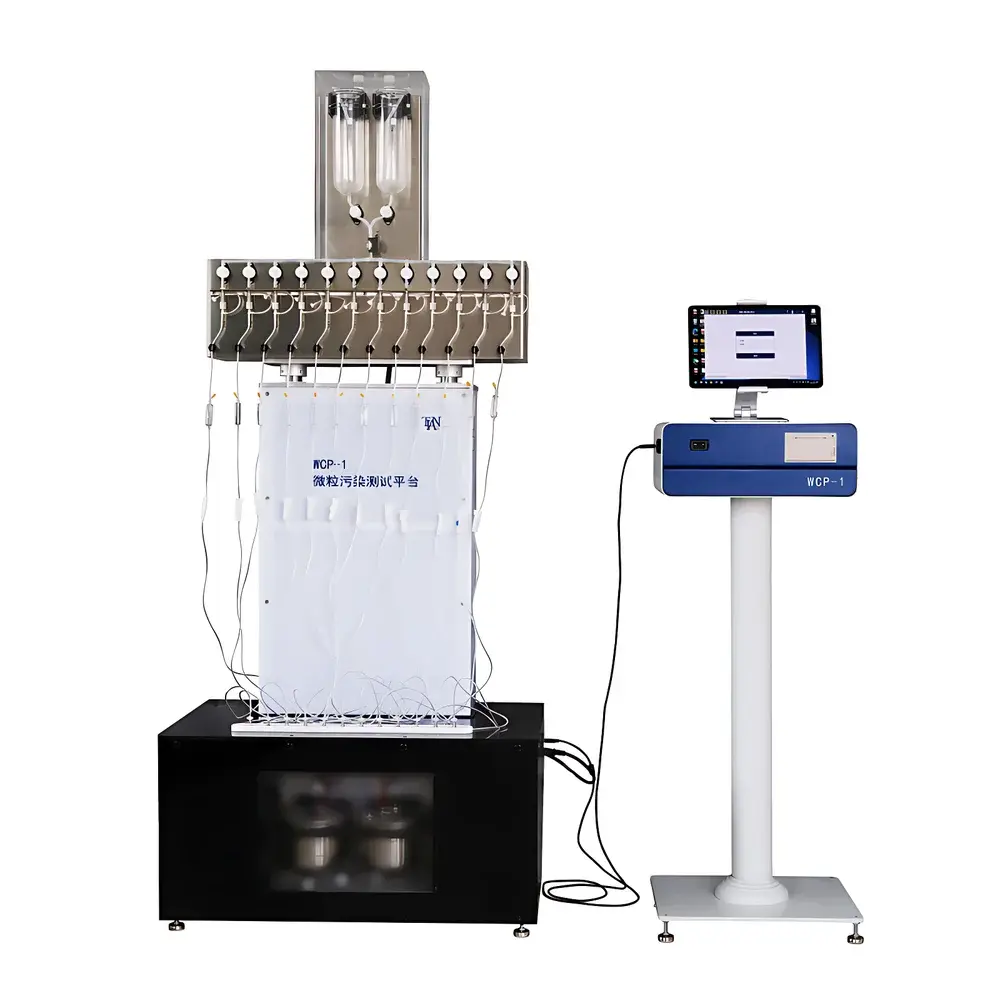
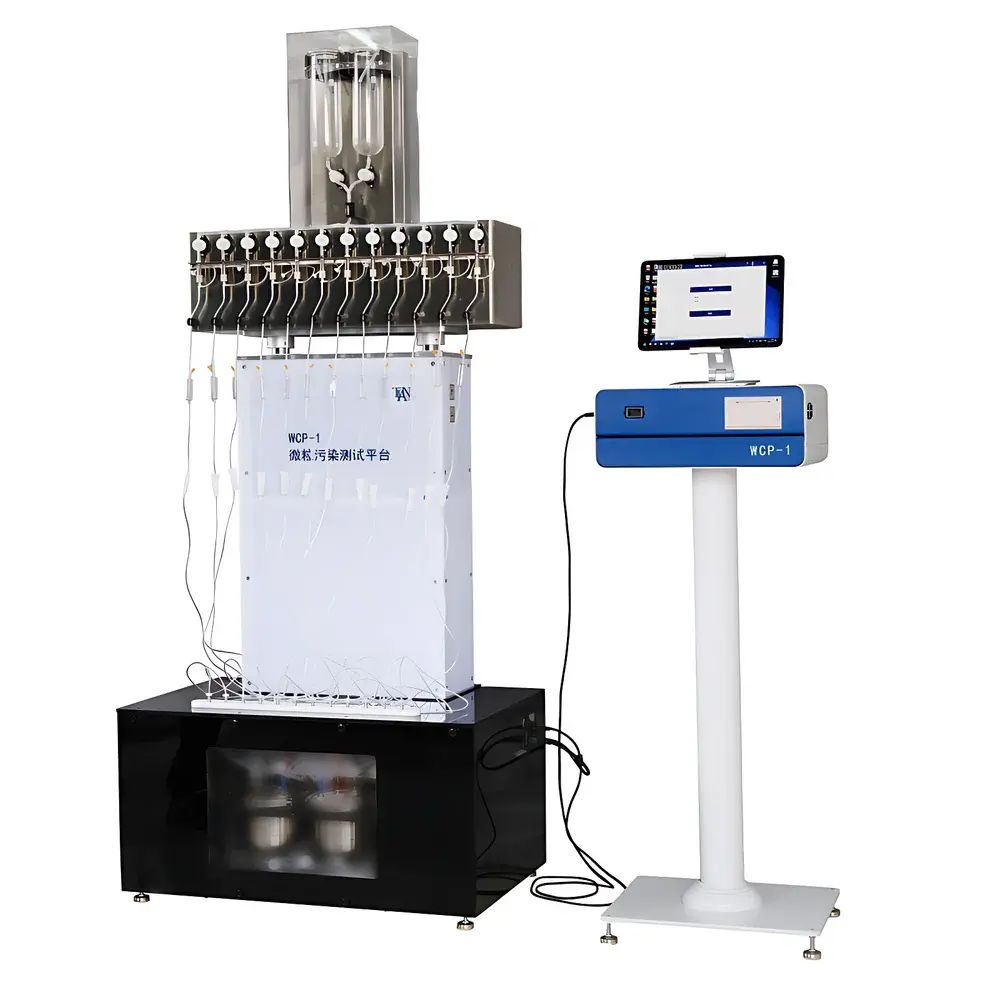

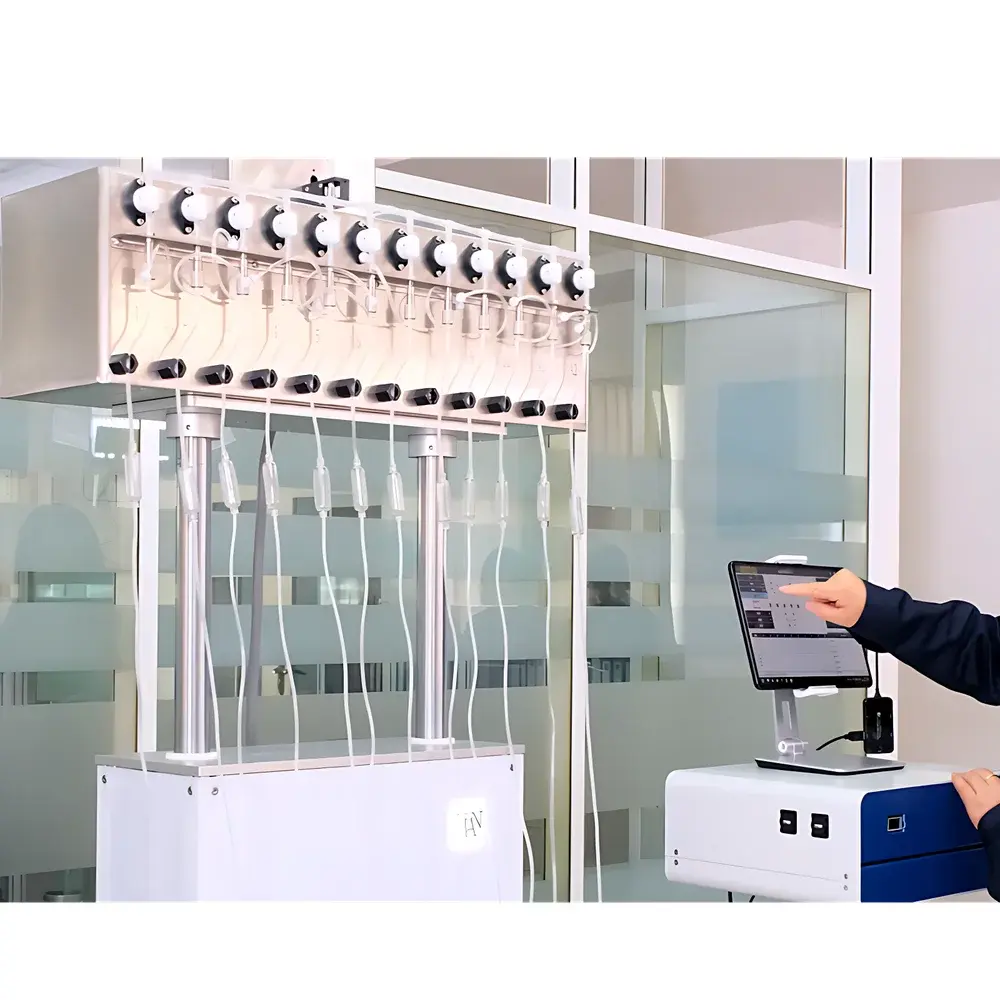
Tianhe WCP-1 Automated Microcontamination Testing Platform for Infusion Devices
| Brand | Tianhe |
|---|---|
| Origin | Tianjin, China |
| Manufacturer Type | Authorized Distributor |
| Region of Manufacture | Domestic (China) |
| Model | WCP-1 |
| Instrument Type | Optical Particle Counter |
| Particle Detection Principle | Light Obscuration (LO) |
| Counting Channels | 64 programmable channels |
| Adjustable Size Range | 10–100 µm (resolution down to 0.1 µm) |
| Sample Volume | 2–500 mL |
| Volume Accuracy | ±0.5% at 500 mL |
| Counting Accuracy | ±10% |
| Relative Standard Deviation (RSD) | ≤2% (for standard particle suspension ≥1000 particles/mL) |
| Maximum Detectable Concentration | 10,000 particles/mL |
| Power Supply | AC 220 V, 50 Hz, 110 W |
Overview
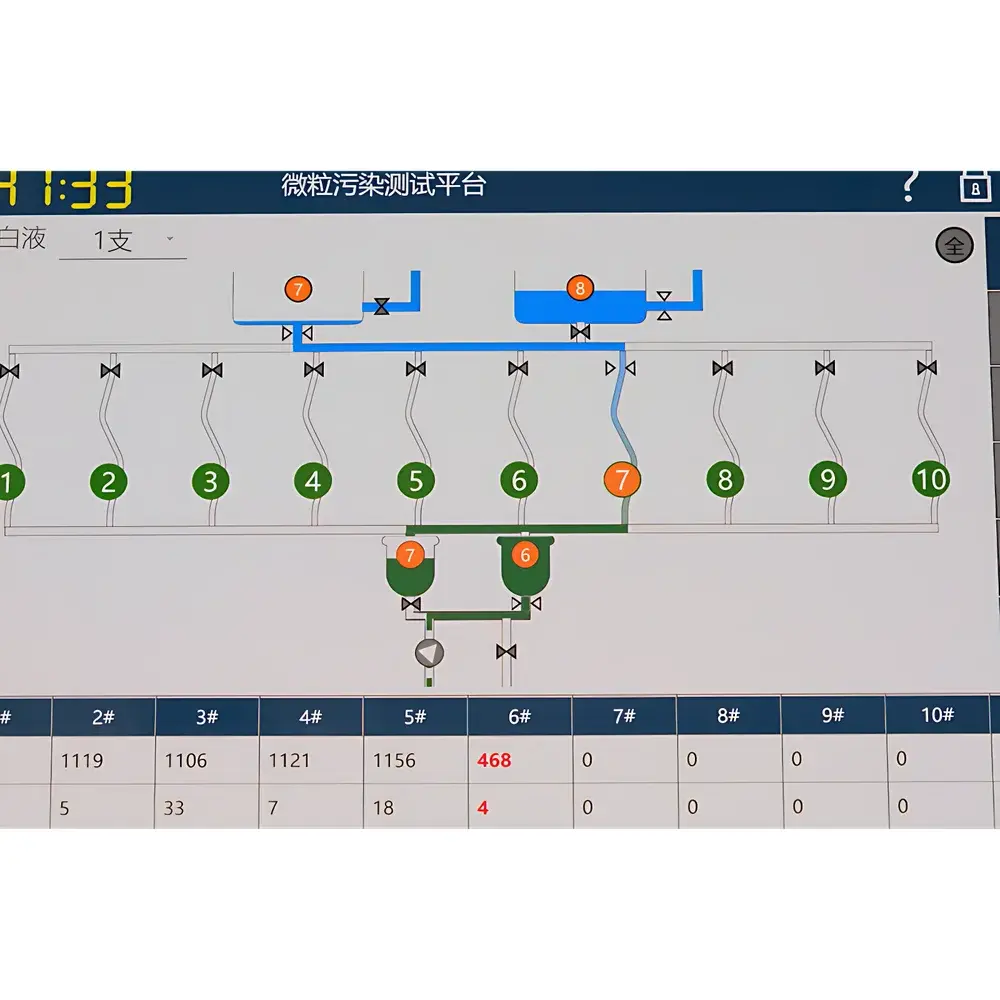
The Tianhe WCP-1 Automated Microcontamination Testing Platform is an integrated, closed-loop optical particle counter engineered specifically for compliance-driven particulate testing of infusion devices per GB 8368–2018 (“Sterile disposable infusion sets — Requirements”). Unlike conventional manual washout-and-analyze workflows—which require separate extraction of particulate-laden rinse fluid followed by off-line analysis—the WCP-1 executes both washout and real-time particle enumeration in a single, unattended sequence. Its core measurement principle is light obscuration (LO), wherein particles suspended in liquid interrupt a collimated light beam; the magnitude of signal attenuation correlates directly with particle cross-sectional area, enabling quantitative sizing and counting across 64 user-configurable thresholds. Designed for ISO 13485-aligned quality control laboratories, the platform eliminates operator-dependent variability in rinse volume, flow rate, dwell time, and handling—key sources of non-reproducibility cited in regulatory audits.
Key Features
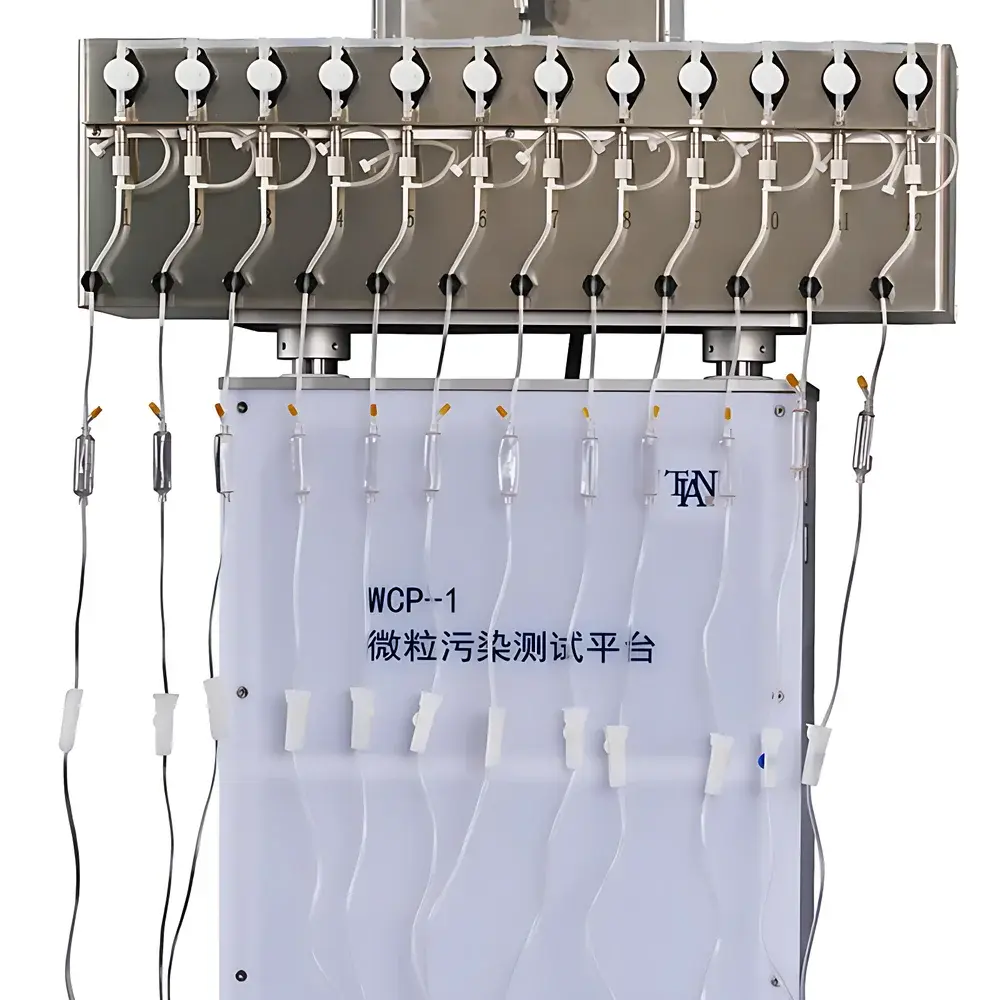
- Fully automated, walk-away operation for up to 10 infusion sets per batch—no manual rinse fluid preparation or transfer required
- Hermetically sealed fluidic path with inert wetted materials (316L stainless steel, pharmaceutical-grade PTFE, and borosilicate glass) to prevent ambient contamination and adsorption artifacts
- 64-channel optical detection with sub-micron resolution (0.1 µm binning granularity), supporting customizable size bins from 10 µm to 100 µm
- Precise volumetric delivery via gravimetrically calibrated peristaltic pump system (±0.5% accuracy at 500 mL)
- Integrated thermal stabilization module maintains rinse fluid temperature within ±1.0 °C during extended runs, minimizing viscosity-induced counting drift
- Compliance-ready firmware with full 21 CFR Part 11 audit trail, electronic signatures, and role-based access control (RBAC)
Sample Compatibility & Compliance
The WCP-1 accommodates diverse infusion device geometries through modular adapter kits—including Luer-lock, spike, and membrane-piercing configurations—ensuring consistent wetting and particle release across brands and generations of IV sets. All test protocols align with the mechanical agitation, rinse volume (≥200 mL), and filtration criteria defined in GB 8368–2018 Annex A. The system further supports method verification per USP and ISO 8536-4 when configured with traceable NIST-traceable calibration standards (e.g., CPS polystyrene latex spheres). Data integrity meets GLP/GMP documentation requirements, including timestamped raw count logs, instrument calibration history, and deviation flagging for out-of-spec rinse volumes or pressure anomalies.
Software & Data Management
Running on embedded Windows IoT Enterprise OS, the WCP-1 software provides FDA 21 CFR Part 11-compliant data governance: all user actions are logged with immutable timestamps, IP addresses, and session IDs. The local database stores >100,000 test records with metadata indexing (batch ID, operator, date/time, device type, pass/fail status). Advanced query filters enable statistical trend analysis (e.g., Cpk, X-bar/R charts) across shifts, operators, or supplier lots. Reports export in PDF/A-1a or CSV formats—with optional digital signature embedding—and support barcode/QR code scanning for sample ID capture. Optional network integration enables HL7/SFTP transmission to LIMS or ERP systems.
Applications
- QC release testing of sterile disposable infusion sets, blood transfusion sets, and epidural catheters
- Process validation of final rinse steps in medical device manufacturing cleanrooms
- Comparative evaluation of filter integrity and leachable particle generation under simulated clinical flow conditions
- Root cause analysis of elevated particulate counts linked to tubing material degradation, lubricant migration, or sterilization residue
- Supporting ISO 14971 risk management files by quantifying worst-case particulate exposure profiles
FAQ
Does the WCP-1 comply with international pharmacopoeial standards beyond GB 8368?
Yes—the optical detection engine and fluidic architecture meet the performance benchmarks of USP , EP 2.9.19, and JP 17 for subvisible particle enumeration in parenteral products.
Can the system be validated for GMP environments?
Absolutely. IQ/OQ/PQ documentation templates, calibration certificates (traceable to NIST SRM 1963), and 21 CFR Part 11 configuration reports are provided as standard deliverables.
What maintenance is required between runs?
No routine disassembly is needed. The closed-loop design includes automatic post-run flush cycles with ultrapure water and ethanol; only annual photodetector alignment verification and pump tube replacement are recommended.
Is remote monitoring supported?
Yes—via secure HTTPS web interface with TLS 1.2 encryption, allowing real-time status checks, queue management, and alarm notifications via email or SNMP traps.
How does the system handle high-concentration samples that exceed 10,000 particles/mL?
It automatically triggers dilution mode using onboard precision syringe pumps, maintaining counting statistics fidelity while preserving sample integrity through laminar-flow mixing chambers.



