
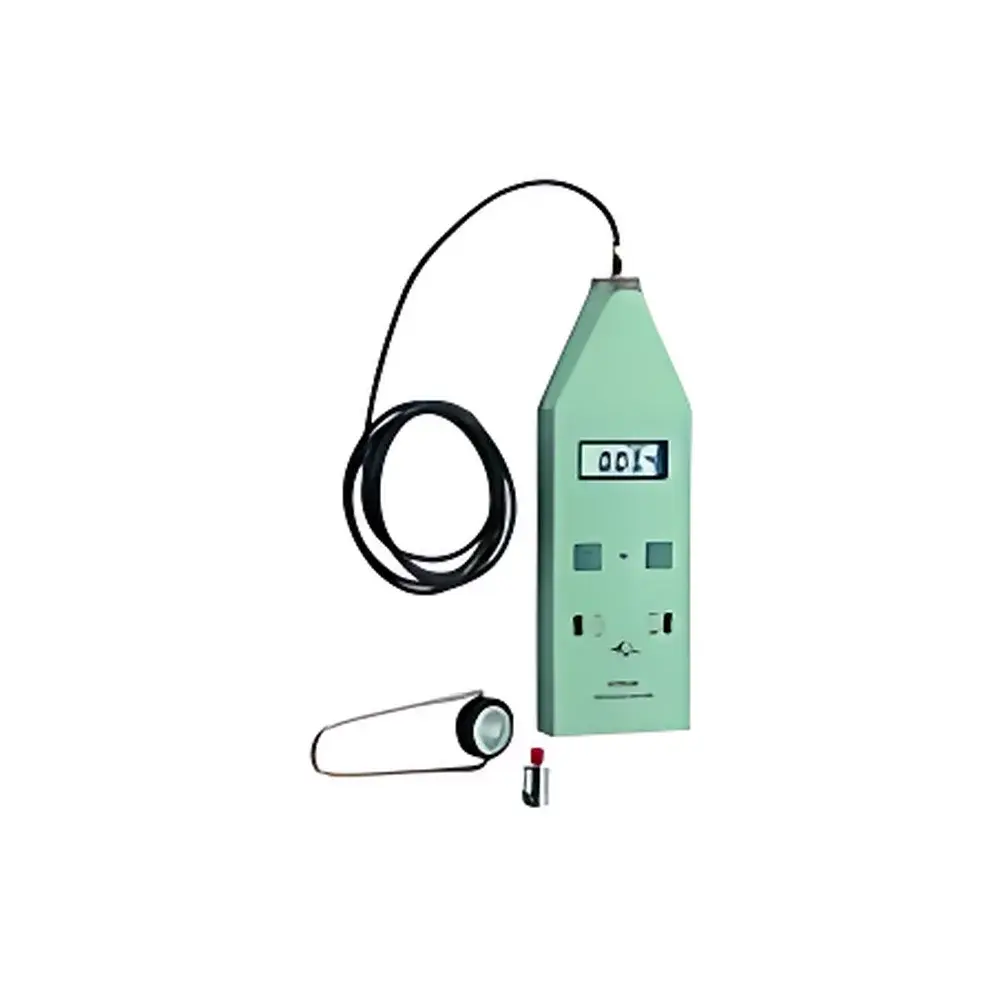
HS5936 Portable Vibration Analyzer
| Origin | Jiangsu, China |
|---|---|
| Manufacturer Type | Authorized Distributor |
| Origin Category | Domestic (PRC) |
| Model | HS5936 |
| Pricing | Upon Request |
| Sensor Type | Piezoelectric Accelerometer |
| Charge Sensitivity | 4 pC/m·s⁻² ±2 pC/m·s⁻² |
| Frequency Range (Acceleration) | 1 Hz–10 kHz |
| Max Measurable Acceleration | 10 km/s² |
| Measurement Modes | Acceleration (m/s²), Velocity (cm/s), Hand-Arm Weighted Acceleration (Ha, m/s²) |
| Dynamic Range | Dual-range (L/H), manually switched |
| Display | 4.5-digit LCD with Max Hold |
| Detection | True RMS, Peak, Peak-to-Peak |
| Accuracy | ±5% ±2 digits (first decimal place) |
| Output | AC/DC, ~2 Vrms full-scale, 2 kΩ output impedance |
| Power | DC 9 V external or internal 7.5 V (5× LR6 alkaline) |
| Dimensions | 237 × 81 × 34 mm |
| Mass | ~400 g (incl. sensor & magnetic mount) |
| Compliance | ISO 2372, ISO 2373, ISO 5349, ISO 5439, GB/T 14790, ISO 8041 |
Overview
The HS5936 Portable Vibration Analyzer is a compact, handheld instrumentation system engineered for field-deployable vibration assessment in industrial maintenance, occupational health monitoring, and product qualification testing. It operates on the principle of piezoelectric transduction, converting mechanical vibration into proportional electrical charge via a calibrated accelerometer sensor. The instrument supports three primary measurement domains: unweighted acceleration (a, in m/s²), velocity (v, in cm/s) as vibration intensity (often referred to as “vibration severity” per ISO 2372), and frequency-weighted hand-arm acceleration (Ha, in m/s²) compliant with ISO 5349-1 and ISO 5439 for human exposure evaluation. Its dual-range analog front-end (Low and High gain) enables high-resolution low-level signal capture (e.g., bearing fault precursors) and robust high-amplitude measurement (e.g., impact events or heavy machinery operation), all while maintaining traceable metrological performance aligned with ISO 8041:2017 — the international standard specifying requirements for vibration meters used in human exposure and machine condition monitoring.
Key Features
- Integrated piezoelectric accelerometer with nominal charge sensitivity of 4 pC/m·s⁻² ±2 pC/m·s⁻² and flat frequency response from 1 Hz to 10 kHz — suitable for both low-frequency structural resonance analysis and high-frequency gearmesh or bearing defect detection.
- Dual manual range selection (L/H) provides optimized dynamic range coverage: acceleration from 0.30 to 1999.9 m/s², velocity from 0.03 to 199.99 cm/s, and hand-arm weighted acceleration from 0.30 to 1999.9 m/s² across defined bandwidths (5–10 kHz for general acceleration; 1–2.5 kHz for Ha; 10 Hz–1 kHz for velocity).
- True RMS, peak, and peak-to-peak detection modes support multiple diagnostic conventions — RMS for energy-based severity classification (ISO 2372), peak for transient shock identification, and peak-to-peak for displacement estimation in low-frequency regimes.
- 4.5-digit LCD display with real-time Max Hold function captures and retains extremal values over user-defined observation periods — essential for intermittent fault detection during walk-around surveys.
- Simultaneous AC and DC analog outputs (~2 Vrms full scale, 2 kΩ impedance) allow seamless integration with oscilloscopes, data loggers, FFT analyzers, or SCADA systems for extended spectral analysis or long-term trending.
- Portable architecture: total mass of ~400 g including sensor and magnetic mounting fixture; dimensions of 237 × 81 × 34 mm ensure one-handed operation in confined or elevated workspaces.
Sample Compatibility & Compliance
The HS5936 is validated for direct contact measurement on rotating equipment (pumps, motors, gearboxes), reciprocating machinery (compressors, engines), and hand-held power tools (pneumatic drills, grinders, chainsaws). Its sensor interface complies with IEC 60747-14 for piezoelectric transducers and meets environmental class IP54 when used with supplied protective housing. Regulatory conformance includes ISO 2372:1974 (mechanical vibration evaluation of machines), ISO 2373:1974 (vibration of rotating machines), ISO 5349-1:2001 and ISO 5439:2011 (hand-transmitted vibration assessment), and GB/T 14790.1–2014 (Chinese national standard equivalent to ISO 5349). Instrument-level metrological validation satisfies ISO 8041:2017 Class 2 requirements for vibration meters used in occupational health and predictive maintenance applications.
Software & Data Management
While the HS5936 operates as a standalone analog meter without embedded firmware or USB connectivity, its analog outputs are fully compatible with industry-standard data acquisition platforms such as National Instruments DAQmx, Dewesoft X, or MATLAB Data Acquisition Toolbox. Users may configure time-synchronized multi-channel acquisition (e.g., acceleration + temperature + acoustic emission) and apply post-processing filters (band-pass, weighting curves per ISO 5349, octave band analysis) to generate compliance reports aligned with OSHA 54A, EU Directive 2002/44/EC, or internal corporate vibration health & safety protocols. Audit trails, calibration certificate logging, and GLP/GMP-compliant report templates can be implemented externally via validated third-party software environments.
Applications
- Predictive maintenance programs: periodic screening of motor bearings, couplings, and fan assemblies per ISO 10816 thresholds.
- Occupational hygiene assessments: quantification of hand-arm vibration exposure (HAVS) for workers operating powered hand tools — supporting risk assessment under EU Physical Agents (Vibration) Directive.
- Product development labs: verification of vibration isolation efficacy in tool housings or ergonomic redesigns.
- Transportation infrastructure monitoring: evaluation of rail vehicle suspension components or bridge deck vibration signatures.
- Quality assurance in manufacturing: final-test verification of assembled rotating equipment prior to shipment.
FAQ
Does the HS5936 support real-time FFT spectral analysis?
No — it is a time-domain vibration meter providing amplitude-domain metrics only. Spectral decomposition requires connection to an external FFT analyzer or PC-based DAQ system.
Is calibration traceable to NIST or other national metrology institutes?
Calibration certificates issued by authorized service centers include traceability to CNAS-accredited standards (equivalent to ILAC MRA signatories); NIST-traceable calibration is available upon request with additional lead time.
Can the instrument measure vibration according to ISO 10816-3 for small industrial machines?
Yes — its acceleration and velocity measurement ranges and accuracy meet the Class 2 performance criteria specified in ISO 8041 for instruments used in accordance with ISO 10816 series standards.
What is the recommended recalibration interval?
Annual recalibration is advised under normal use conditions; biannual calibration is recommended in high-humidity, high-dust, or high-impact operational environments.
Is the magnetic sensor mount suitable for curved or painted surfaces?
The included rare-earth magnet mount achieves reliable coupling on ferromagnetic surfaces with surface roughness < Ra 6.3 µm; non-magnetic or coated surfaces require adhesive or stud-mounted alternatives.



