
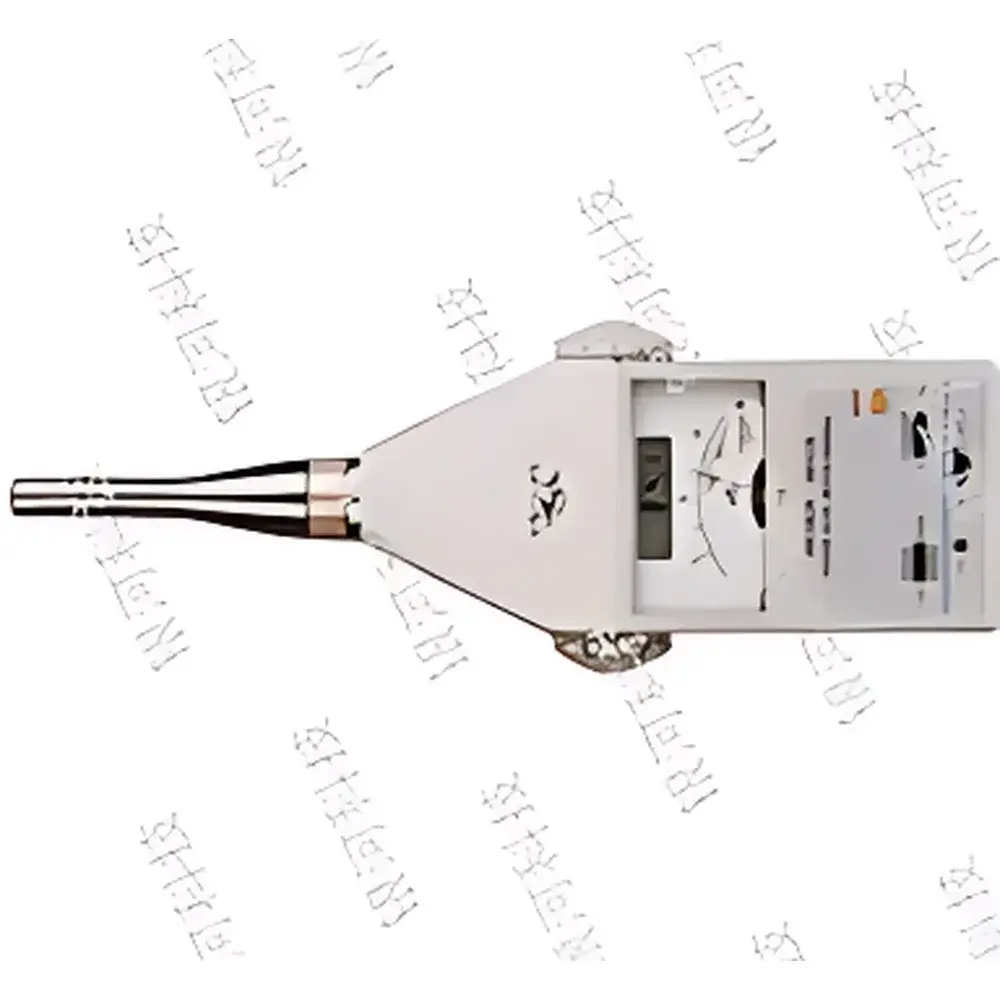
HS5660A Precision Pulse Sound Level Meter
| Origin | Jiangsu, China |
|---|---|
| Manufacturer Type | Distributor |
| Origin Category | Domestic (China) |
| Model | HS5660A |
| Pricing | Upon Request |
| Measurement Range | 30–138 dB(A), 40–138 dB(C), 45–138 dB(Linear) |
| Frequency Range | 10 Hz – 20 kHz |
| Frequency Weighting | A, C, Linear |
| Detector | True RMS & Peak |
| Time Weighting | Fast (F), Slow (S), Impulse (I) |
| Overload Indicator | +10 ±0.5 dB Full Scale |
| Power Supply | 4 × 1.5 V LR20 batteries or AC adapter (220 V) |
| Built-in Calibration Tone | 1000 Hz sine wave |
| Output | AC/DC analog outputs |
| Dimensions | 290 × 106 × 65 mm |
| Compliance | JJG 188–2002 (China National Verification Regulation), IEC 61672-1:2013 Class 1 |
Overview
The HS5660A Precision Pulse Sound Level Meter is a portable, dual-display (digital + analog needle) acoustic measurement instrument engineered for high-fidelity characterization of transient and impulsive noise events. It operates on the principle of condenser microphone transduction coupled with true RMS and peak detection circuitry, enabling accurate quantification of short-duration sound pressure events—including gunfire, stamping press impacts, explosions, typewriter strikes, and industrial shock emissions—where conventional integrating meters fail to capture peak amplitude and temporal structure. Designed to meet Class 1 performance requirements per IEC 61672-1:2013 and JJG 188–2002, the HS5660A delivers metrologically traceable measurements across a wide dynamic range (30–138 dB in A-weighting) and full audio bandwidth (10 Hz–20 kHz). Its modular architecture supports seamless integration with external frequency-selective components—specifically the HS5721 1/1-octave and HS5731 1/3-octave filter sets—enabling field-deployable spectral analysis without reliance on PC-based post-processing.
Key Features
- Class 1-compliant acoustical performance per IEC 61672-1:2013 and JJG 188–2002, validated for legal metrology and regulatory reporting
- Dual-mode display: simultaneous digital numeric readout and analog needle indicator for real-time trend visualization and impulse response confirmation
- Three time-weighting modes: Fast (125 ms), Slow (1 s), and Impulse (I)—optimized for capturing rise times < 35 ms and peak hold retention
- Multi-weighting capability: A-weighting (for human hearing relevance), C-weighting (broadband low-frequency assessment), and Linear (unweighted, full-band SPL)
- True RMS and peak detection circuits ensure fidelity in measuring both steady-state and non-repetitive transient signals
- Integrated 1000 Hz calibration tone generator (±0.2 dB stability) for on-site self-check and system-level sensitivity verification with connected recorders or analyzers
- Dual analog output interfaces: AC-coupled (for spectrum analyzers, tape recorders) and DC-coupled (for data loggers, chart recorders, and external integrators)
- Robust mechanical design: compact housing (290 × 106 × 65 mm), windscreen included, optimized for handheld and tripod-mounted operation in field environments
Sample Compatibility & Compliance
The HS5660A is compatible with standard 1/2-inch electret condenser microphones (IEC 61094-4 compliant) and accepts optional extension cables (10 m / 15 m / 30 m) for remote or hazardous-area deployment. When paired with HS6020 acoustic calibrators (94 dB / 114 dB @ 1 kHz), it satisfies periodic verification requirements under ISO/IEC 17025-accredited laboratory practices. Its electrical and acoustic specifications align with regulatory frameworks governing occupational noise exposure (e.g., OSHA 1910.95, EU Directive 2003/10/EC), environmental noise monitoring (EU Environmental Noise Directive 2002/49/EC), and building acoustics testing (ISO 140 series). The device supports audit-ready documentation when used in GLP-compliant workflows, though native electronic signature or 21 CFR Part 11 compliance requires external software-controlled data acquisition systems.
Software & Data Management
The HS5660A operates as a standalone analog front-end; it does not include embedded memory or USB/WiFi connectivity. Data acquisition relies on external recording devices—such as strip-chart recorders, analog-to-digital converters, or oscilloscopes—connected via its AC/DC outputs. For digital archiving and analysis, users typically interface the meter with third-party DAQ hardware (e.g., National Instruments USB-4431, Dewesoft SIRIUS) and configure signal conditioning in LabVIEW, MATLAB, or dedicated acoustic software (e.g., Brüel & Kjær PULSE, HEAD Acoustics ArtemiS). All analog outputs are galvanically isolated to minimize ground-loop interference in multi-instrument setups. Firmware updates are not applicable; calibration traceability is maintained through annual third-party verification against national standards.
Applications
- Impulse noise assessment in manufacturing: stamping, forging, riveting, and pneumatic tool operations
- Military and law enforcement: firearms discharge characterization, blast overpressure mapping, and small-arms range compliance monitoring
- Building acoustics: impact sound insulation testing (ISO 140-7), floor impact noise evaluation (e.g., bang machine simulations)
- Electroacoustic validation: loudspeaker transient response, amplifier clipping detection, and transducer diaphragm integrity screening
- Environmental noise surveys: railway horn events, construction pile driving, and demolition-related impulsive emissions
- Research & development: psychoacoustic studies of startle thresholds, material impact response modeling, and vibro-acoustic coupling analysis
FAQ
Does the HS5660A support data logging internally?
No—the instrument provides only analog outputs (AC and DC) and lacks onboard memory or digital communication ports. Continuous waveform capture requires external recording equipment.
Is the HS5660A suitable for occupational noise exposure assessments per OSHA or EU directives?
Yes, when operated in A-weighted mode with Fast or Impulse time weighting and calibrated per IEC 61672-1 Class 1, it meets technical requirements for workplace noise surveys under OSHA 1910.95 and EU 2003/10/EC.
Can the built-in 1000 Hz calibration tone be used to verify external microphones?
No—the internal calibrator is designed exclusively for verifying the complete electroacoustic chain (microphone + preamplifier + meter). To calibrate an external microphone independently, a traceable pistonphone or sound calibrator (e.g., HS6020) must be used at the microphone capsule.
What is the maximum measurable peak sound pressure level?
The peak detection circuit supports up to 138 dB re 20 µPa, with overload indication triggered at +10 ±0.5 dB above full scale (i.e., 148 dB peak SPL threshold).
Is the HS5660A intrinsically safe for use in explosive atmospheres?
No—it is not certified for hazardous locations (ATEX, IECEx, or UL Class I Div 1). For such applications, purpose-built explosion-proof sound level meters with appropriate certifications are required.
Related Products







