
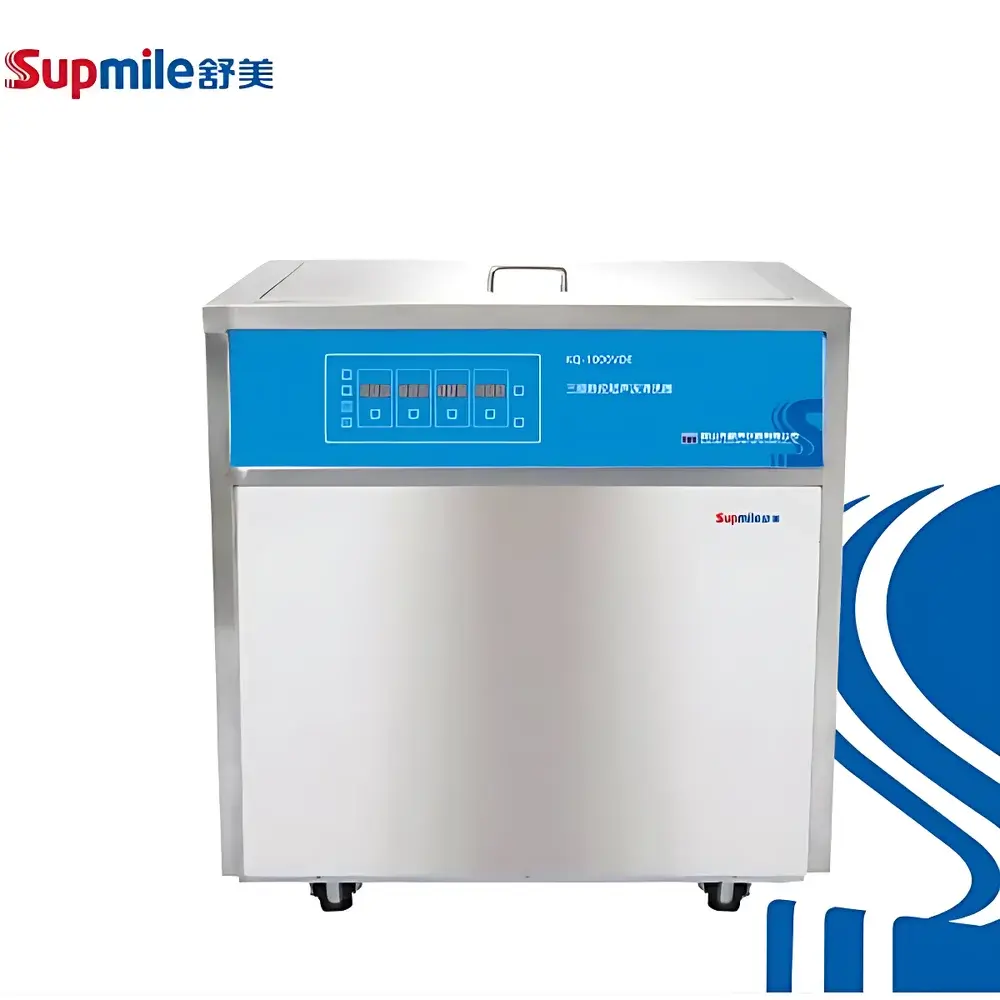
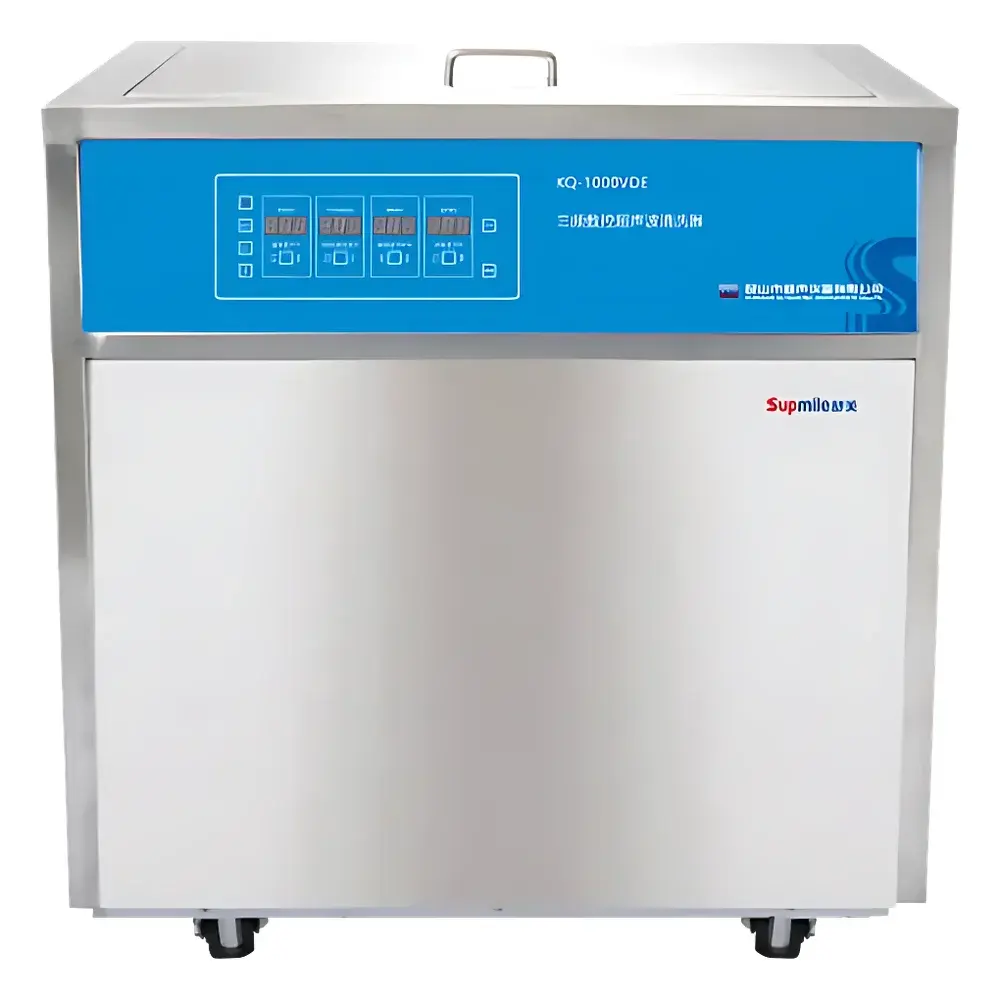
Shumei KQ-1000VDE Triple-Frequency Digital Ultrasonic Cleaner
| Brand | Shumei |
|---|---|
| Origin | Jiangsu, China |
| Manufacturer Type | Direct Manufacturer |
| Product Category | Domestic |
| Model | KQ-1000VDE |
| Instrument Type | General-Purpose |
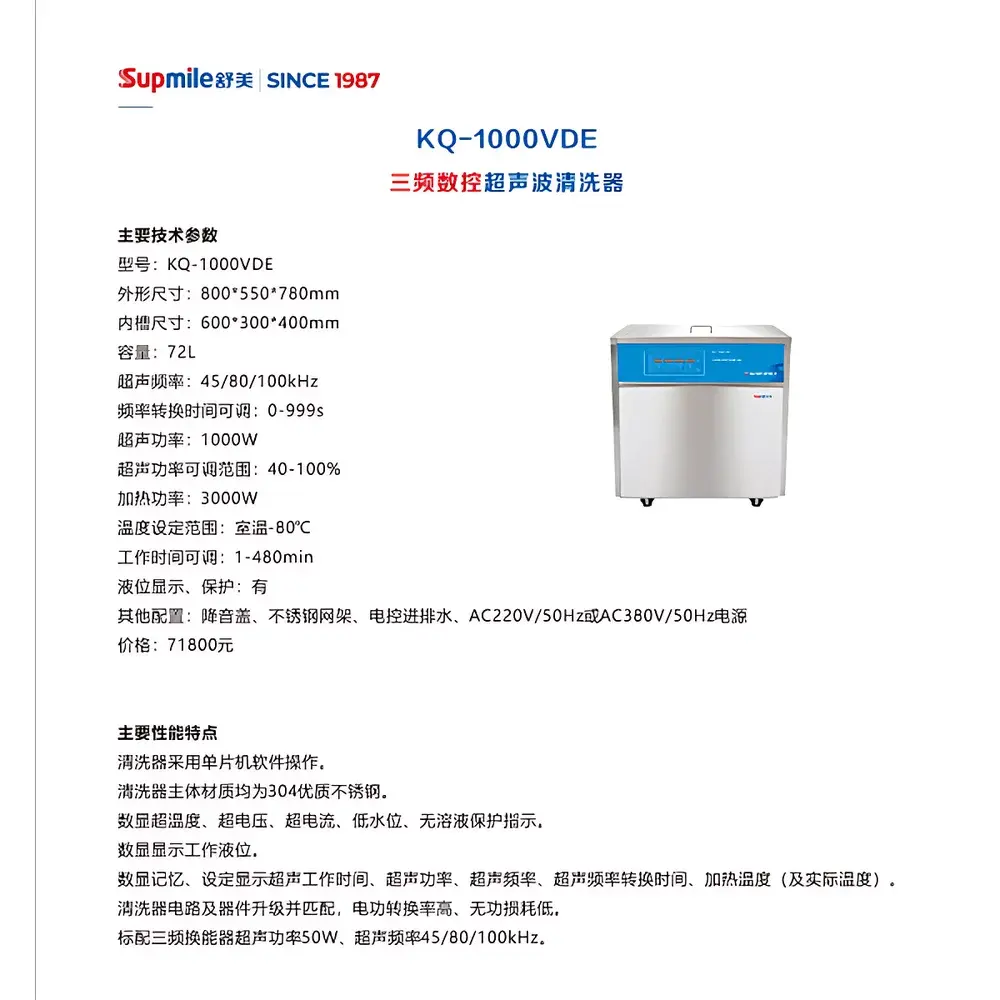
| Tank Capacity | 72 L |
| Ultrasonic Frequencies | 45 / 80 / 100 kHz |
| Ultrasonic Power Output | 1000 W |
| Power Adjustment Range | 40–100% |
| Heating Temperature Range | Ambient to 80 °C |
| Timer Range | 1–480 min |
| Sound-Dampening Lid | Yes |
| Drain/Inlet Control | Manual |
| Tank Dimensions (L×W×H) | 600 × 300 × 400 mm |
| Overall Dimensions (L×W×H) | 800 × 550 × 780 mm |
| Heating Power | 3000 W |
| Power Supply | AC 220 V / 50 Hz or AC 380 V / 50 Hz |
| Safety Protections | Low-level liquid detection, over-temperature, over-voltage, over-current, and dry-run prevention |
| Display | Digital LCD showing real-time temperature, power level, frequency mode, timer, and liquid level |
Overview
The Shumei KQ-1000VDE Triple-Frequency Digital Ultrasonic Cleaner is an industrial-grade laboratory cleaning system engineered for precision, repeatability, and operational flexibility in demanding analytical, quality control, and research environments. It operates on the principle of cavitation-induced acoustic energy transfer—where high-frequency sound waves generate microbubbles in a liquid medium that collapse violently upon implosion, producing localized shockwaves and microstreaming capable of dislodging particulate, organic, and inorganic contaminants from complex surface geometries. Unlike single-frequency cleaners, the KQ-1000VDE integrates three discrete ultrasonic frequencies—45 kHz, 80 kHz, and 100 kHz—each optimized for distinct cleaning mechanisms: lower frequencies deliver higher cavitation intensity suitable for robust macro-contaminants (e.g., machining oils, metal particles), while higher frequencies provide finer, more uniform energy distribution ideal for delicate substrates such as optical lenses, semiconductor wafers, and microfluidic components. The unit features a 72-liter stainless-steel tank constructed entirely from AISI 304 grade material, ensuring corrosion resistance, structural integrity, and compatibility with aqueous and mild solvent-based cleaning media.
Key Features
- Triple-frequency operation (45 / 80 / 100 kHz) with programmable frequency switching intervals (0–999 s), enabling sequential or alternating mode execution for multi-stage cleaning protocols.
- Digital microprocessor control with full LCD interface displaying real-time parameters: ultrasonic power (%), selected frequency, elapsed/remaining time, set and actual bath temperature, and liquid level status.
- Adjustable ultrasonic power output (40–100% of 1000 W nominal), allowing fine-tuned energy delivery to prevent sample damage while maintaining cleaning efficacy.
- Integrated heating system (3000 W) with precise digital temperature regulation from ambient to 80 °C—critical for enhancing detergent activity and reducing surface tension during aqueous cleaning cycles.
- Comprehensive safety architecture including automatic shutdown on low liquid level detection, over-temperature, over-voltage, over-current, and dry-run conditions.
- Sound-dampening lid reduces ambient noise to ≤65 dB(A) at 1 m distance, supporting compliance with occupational health standards in shared lab spaces.
- Manual inlet and drain valves facilitate controlled fluid exchange; stainless-steel mesh basket included for secure part placement and optimal acoustic coupling.
Sample Compatibility & Compliance
The KQ-1000VDE accommodates a broad range of sample types—including glassware (volumetric flasks, cuvettes), metallic components (surgical instruments, calibration standards), ceramic substrates, and polymer-based devices—without risk of erosion or pitting when operated within recommended parameters. Its 304 stainless-steel construction meets ASTM A240 and ISO 8502-3 specifications for passive layer stability in mildly aggressive chemical environments. While not certified for medical device reprocessing under ISO 15883 or EN 285, the unit supports GLP-compliant documentation workflows when integrated with external audit-trail-capable lab information management systems (LIMS). All electrical design conforms to IEC 61010-1:2010 for laboratory equipment safety, and thermal controls comply with IEC 60519-12 for heating apparatus in wet locations.
Software & Data Management
The KQ-1000VDE operates via embedded firmware without proprietary PC software; however, its digital interface supports manual protocol logging and repeatable parameter recall. Each cleaning cycle stores user-defined settings—including frequency sequence, power ramp profile, temperature ramp rate, and dwell times—for rapid re-execution. Optional RS-232 or USB-to-serial adapters enable integration with third-party automation platforms for centralized scheduling and electronic record retention. When used in regulated environments (e.g., pharmaceutical QC labs), operators may implement supplementary procedural controls—such as pre-cycle verification checklists and post-cycle visual inspection logs—to satisfy FDA 21 CFR Part 11 requirements for electronic records and signatures.
Applications
- Pre-analytical sample preparation: removal of residual solvents, salts, or biological residues from HPLC vials, GC liners, and autosampler needles.
- Calibration standard maintenance: cleaning of reference weights, pipette tips, and volumetric glassware to eliminate adsorbed films affecting metrological accuracy.
- Electronics manufacturing: deburring and flux residue removal from PCB assemblies and SMT stencils prior to AOI inspection.
- Materials science: surface decontamination of catalyst supports, powder metallurgy compacts, and thin-film deposition substrates prior to SEM/EDS analysis.
- Academic research: reproducible cleaning of custom microfabricated devices where particle-free surfaces are essential for functional testing.
FAQ
What is the purpose of triple-frequency capability?
It enables selective optimization of cleaning efficiency across diverse contaminant types and substrate sensitivities—low frequency for heavy soils, high frequency for fine particulates and fragile surfaces.
Can this unit be used with organic solvents?
Only with compatible, non-flammable, low-volatility solvents (e.g., isopropanol/water mixtures); flammable solvents require explosion-proof variants not offered in the KQ-1000VDE configuration.
Is the heater PID-controlled?
Yes—the temperature control system employs proportional-integral-derivative (PID) algorithm with ±1 °C stability over the full 20–80 °C operating range.
Does it support continuous operation?
Yes, with active cooling and duty-cycle monitoring; maximum recommended continuous run time per cycle is 480 minutes, followed by ≥15-minute cooldown before restart.
How is liquid level monitored?
Via conductive probe sensing at multiple thresholds—providing both visual indication and automatic cutoff if level falls below minimum operational height.



